
[Paper Review] Context-based Ontology Modelling for Database: Enabling ChatGPT for Semantic Database Management
The paper proposes COM-DB, a context-based ontology method that converts database schemas into natural language to enable ChatGPT to perform semantic integration and table joins without accessing actual data. Case studies show improved precision and privacy benefits compared to non-semantic representations.
This research paper explores the use of ChatGPT in database management. ChatGPT, an AI-powered chatbot, has limitations in performing tasks related to database management due to the lack of standardized vocabulary and grammar for representing database semantics. To address this limitation, the paper proposes a solution that involves developing a set of syntaxes that can represent database semantics in natural language. The syntax is used to convert database schemas into natural language formats, providing a new application of ChatGPT in database management. The proposed solution is demonstrated through a case study where ChatGPT is used to perform two tasks, semantic integration, and tables joining. Results demonstrate that the use of semantic database representations produces more precise outcomes and avoids common mistakes compared to cases with no semantic representation. The proposed method has the potential to speed up the database management process, reduce the level of understanding required for database domain knowledge, and enable automatic database operations without accessing the actual data, thus illuminating privacy protection concerns when using AI. This paper provides a promising new direction for research in the field of AI-based database management.
Motivation & Objective
- Motivate the use of ChatGPT for database management and identify limitations due to lack of standardized database semantics.
- Propose a syntax system to represent database semantics in natural language (COM-DB).
- Demonstrate COM-DB with case studies on semantic integration and table joining.
- Show that semantic representations yield more precise results and reduce common mistakes.
Proposed method
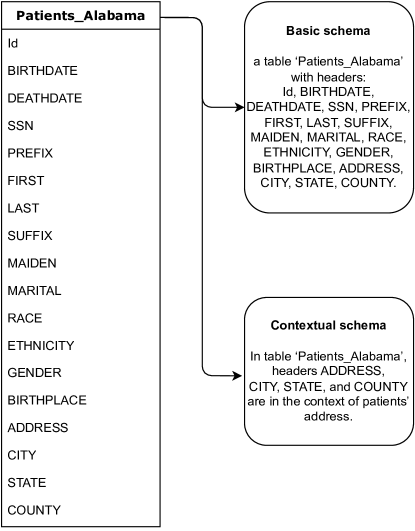
- Introduce COM-DB built on ontology modelling with context-of constructs to describe database schemas.
- Convert base schemas (table headers) and contextual schemas (relations) into natural language descriptions.
- Use COM-DB to generate natural language representations that ChatGPT can interpret for tasks.
- Apply COM-DB in semantic integration and table joining case studies using two real databases (Synthea_Alabama and BDA_EHR).
- Compare ChatGPT performance with and without COM-DB to demonstrate improvements in accuracy and task success.
Experimental results
Research questions
- RQ1Can COM-DB representations improve semantic integration between differently structured tables?
- RQ2Do COM-DB based descriptions enable correct generation of SQL queries involving joins across multiple tables?
- RQ3Does using context-of semantics reduce ambiguities that hinder ChatGPT in database tasks?
- RQ4What privacy advantages arise from generating schemas without exposing actual data?
Key findings
- ChatGPT achieves higher accuracy in semantic integration when using COM-DB representations.
- ChatGPT generates correct SQL views for multi-table joins with COM-DB, avoiding errors caused by missing contextual relations.
- COM-DB’s context-of construct reduces ambiguity and improves task success in both semantic integration and joining experiments.
- Using schema-only representations preserves privacy since no actual data is shared with AI systems.
- Experiments repeated ten times show reliable improvements with COM-DB over non-semantic baselines.
- COM-DB enables automatic database operations without accessing data, addressing privacy concerns in AI-enabled DB management.

Better researchstarts right now
From reading papers to final review, dramatically reduce your research time.
No credit card · Free plan available
This review was created by AI and reviewed by human editors.