
[Paper Review] Context, Composition, Automation, and Communication -- The C2AC Roadmap for Modeling and Simulation
This paper proposes the C2AC roadmap—Context, Composition, Automation, and Communication—to advance modeling and simulation by enhancing context capture, model composition and reuse, automation of simulation workflows, and effective communication of results. The framework emphasizes unambiguous, machine-processable representations of all simulation artifacts to improve reproducibility, trust, and usability across research and decision-making contexts.
Simulation has become, in many application areas, a sine-qua-non. Most recently, COVID-19 has underlined the importance of simulation studies and limitations in current practices and methods. We identify four goals of methodological work for addressing these limitations. The first is to provide better support for capturing, representing, and evaluating the context of simulation studies, including research questions, assumptions, requirements, and activities contributing to a simulation study. In addition, the composition of simulation models and other simulation studies' products must be supported beyond syntactical coherence, including aspects of semantics and purpose, enabling their effective reuse. A higher degree of automating simulation studies will contribute to more systematic, standardized simulation studies and their efficiency. Finally, it is essential to invest increased effort into effectively communicating results and the processes involved in simulation studies to enable their use in research and decision-making. These goals are not pursued independently of each other, but they will benefit from and sometimes even rely on advances in other subfields. In the present paper, we explore the basis and interdependencies evident in current research and practice and delineate future research directions based on these considerations.
Motivation & Objective
- Address limitations in current simulation practices revealed during the COVID-19 pandemic, particularly in model development speed, result interpretation, and communication with non-experts.
- Improve the methodological foundation of simulation studies by treating research questions, assumptions, requirements, and simulation experiments as first-class, formally represented artifacts.
- Enable higher reuse and composability of simulation models beyond syntactic compatibility by incorporating semantic and purpose-driven integration.
- Increase automation of simulation workflows to reduce human error, improve consistency, and allow broader application of advanced analysis techniques.
- Enhance communication between modelers, domain experts, and decision-makers through structured, accessible, and interactive representations of simulation results and processes.
Proposed method
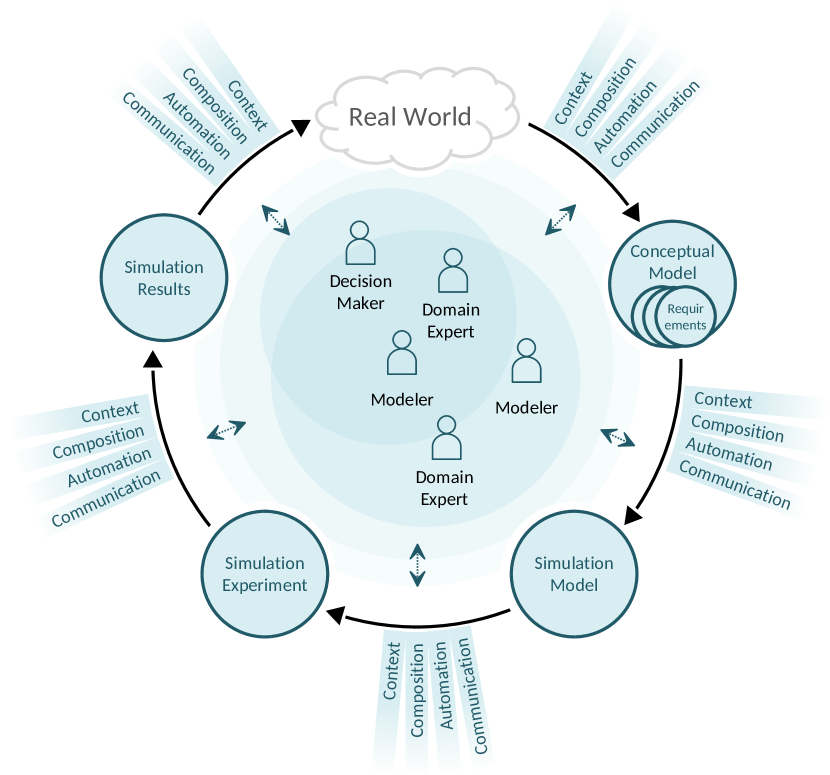
- Propose a unified modeling and simulation life cycle that explicitly models context, composition, automation, and communication as interdependent dimensions.
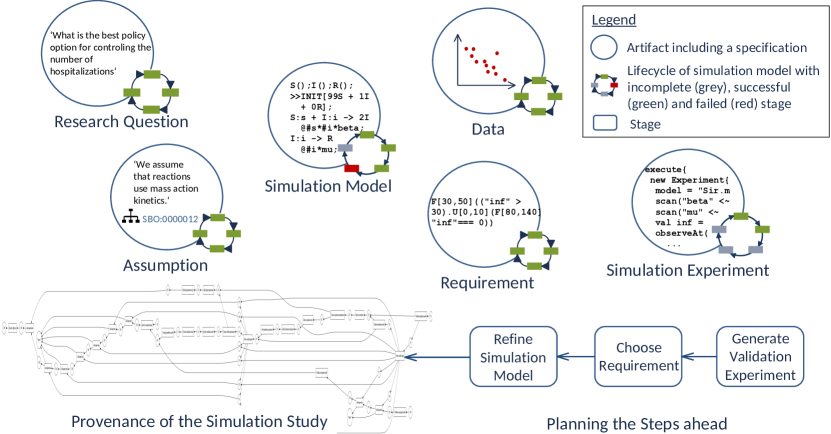
- Introduce the need for unambiguous, machine-processable representations of simulation artifacts—including research questions, assumptions, requirements, simulation experiments, and results.
- Leverage domain-specific languages (DSLs), ontologies, and annotations to support semantic-level composition and reuse of models and components.
- Integrate knowledge-based systems and AI techniques, including deductive reasoning and machine learning, to automate model generation, experiment configuration, and result explanation.
- Apply principles from software engineering and human-computer interaction to design tools that maintain modeler and user engagement throughout the simulation lifecycle.
- Develop evaluation frameworks for assessing simulation studies based on efficiency, effectiveness, and accuracy, with a focus on trust and understanding metrics.
Experimental results
Research questions
- RQ1How can simulation studies be systematically documented with rich context, including research questions, assumptions, and decision-making processes, to ensure reproducibility and trust?
- RQ2What formal mechanisms enable semantic-level composition and reuse of simulation models beyond syntactic compatibility?
- RQ3In what ways can automation be systematically applied across the simulation lifecycle to improve consistency, reduce errors, and scale analysis capabilities?
- RQ4How can simulation results and processes be effectively communicated to non-expert stakeholders, including domain experts and decision-makers?
- RQ5What evaluation metrics and methods can reliably assess improvements in understanding, trust, and usability of simulation studies?
Key findings
- The C2AC roadmap identifies four interdependent pillars—context, composition, automation, and communication—as essential for advancing simulation research and practice.
- Formal, machine-processable representations of all simulation artifacts, including assumptions and research questions, are foundational for achieving reproducibility and interoperability.
- Semantic-level model composition and reuse are enabled by domain-specific languages, ontologies, and structured annotations that go beyond syntactic compatibility.
- Automation in simulation workflows reduces human error, increases efficiency, and allows broader application of advanced analytical methods.
- Effective communication of simulation results requires interactive, visual, and abstractive techniques tailored to different user types, such as decision-makers and domain experts.
- Evaluation of simulation studies must extend beyond technical correctness to include metrics on trust, understanding, and usability, which require new research in human-computer interaction and metrics design.
Read this paper
Open the full text in the Nubint reader and ask about any passage as you read.
Read this paper on NubintThis review was generated by AI from the original paper. Please check the paper before citing it.