
[Paper Review] Context Matters: A Strategy to Pre-train Language Model for Science Education
The paper shows that continual pre-training of BERT-based models on in-domain science education data improves automatic scoring of student scientific writing, with SR2-BERT and SR2-SciBERT achieving the best results on downstream tasks.
This study aims at improving the performance of scoring student responses in science education automatically. BERT-based language models have shown significant superiority over traditional NLP models in various language-related tasks. However, science writing of students, including argumentation and explanation, is domain-specific. In addition, the language used by students is different from the language in journals and Wikipedia, which are training sources of BERT and its existing variants. All these suggest that a domain-specific model pre-trained using science education data may improve model performance. However, the ideal type of data to contextualize pre-trained language model and improve the performance in automatically scoring student written responses remains unclear. Therefore, we employ different data in this study to contextualize both BERT and SciBERT models and compare their performance on automatic scoring of assessment tasks for scientific argumentation. We use three datasets to pre-train the model: 1) journal articles in science education, 2) a large dataset of students' written responses (sample size over 50,000), and 3) a small dataset of students' written responses of scientific argumentation tasks. Our experimental results show that in-domain training corpora constructed from science questions and responses improve language model performance on a wide variety of downstream tasks. Our study confirms the effectiveness of continual pre-training on domain-specific data in the education domain and demonstrates a generalizable strategy for automating science education tasks with high accuracy. We plan to release our data and SciEdBERT models for public use and community engagement.
Motivation & Objective
- Motivate automatic scoring of student scientific writings and reduce teacher annotation workload.
- Investigate whether domain-specific pre-training data improves BERT-based model performance in science education tasks.
- Compare in-domain contextualization strategies across BERT and SciBERT variants.
- Demonstrate the effectiveness of continual pre-training on student responses for downstream scoring tasks.
- Provide a scalable approach and release SciEdBERT models for community use.
Proposed method
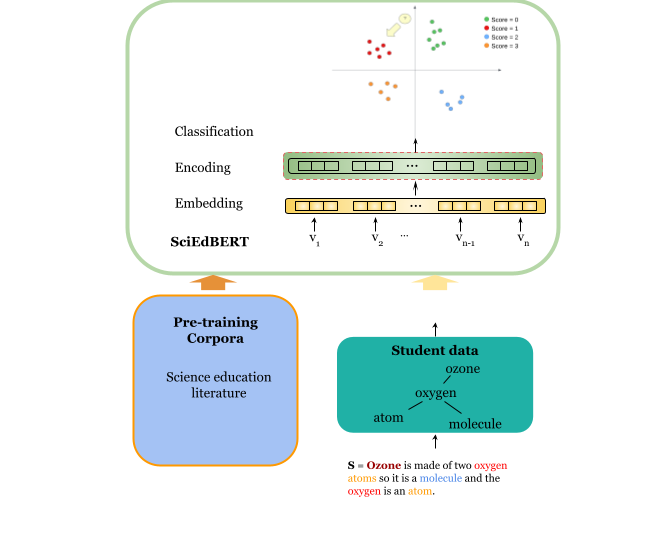
- Employ a pyramid training scheme to contextualize pre-trained models with in-domain data before fine-tuning.
- Pre-train models on three data sources: SciEdJ (science education journals), SR1 (50k+ student responses), SR2 (scientific argumentation responses).
- Fine-tune on downstream tasks using 7T (seven tasks from SR1) and 4T (SR2 tasks).
- Compare baseline BERT with SR1-BERT and additional variants including SciBERT, SciEdJ-BERT, SciEdJ-SciBERT, SR2-BERT, and SR2-SciBERT to assess contextualization effects.
- Evaluate performance using task-level accuracy across multiple constructed-response tasks.
- Adopt a continual pre-training regime to maximize alignment between pre-training data and downstream tasks.
Experimental results
Research questions
- RQ1Does in-domain continual pre-training improve automatic scoring accuracy relative to generic BERT baselines?
- RQ2How does contextualization (with SciEdJ, SR1, SR2) affect model performance on science education scoring tasks?
- RQ3Which model variants (BERT vs SciBERT, with different domain data) yield the best downstream accuracy for constructed responses?
- RQ4Is there a benefit to training on task-relevant contexts before fine-tuning on the specific scoring tasks?
Key findings
- SR1-BERT slightly outperforms the baseline BERT on average (0.912 vs 0.904).
- SR2-SciBERT achieves the highest average accuracy on the 4T tasks (0.866).
- SR2-BERT also shows strong performance (0.852 average) and often matches or exceeds SciEdJ variants across individual tasks.
- Contextualizing models with downstream-task language (SR2) yields better per-task performance than broader domain language alone.
- SciEdJ-SciBERT and SciEdJ-BERT perform worst on average among evaluated models, suggesting science-ed publications alone may confuse student-writing language.
- Overall, continual pre-training on domain-specific data, especially aligned with downstream tasks, improves automatic scoring of student scientific writing.
Read this paper
Open the full text in the Nubint reader and ask about any passage as you read.
Read this paper on NubintThis review was generated by AI from the original paper. Please check the paper before citing it.