
[Paper Review] Contextualization Distillation from Large Language Model for Knowledge Graph Completion
The paper introduces Contextualization Distillation, a plug-in approach that uses LLM-generated contextual descriptions to train smaller KGC models, improving both discriminative and generative KGC across datasets WN18RR and FB15k-237N.
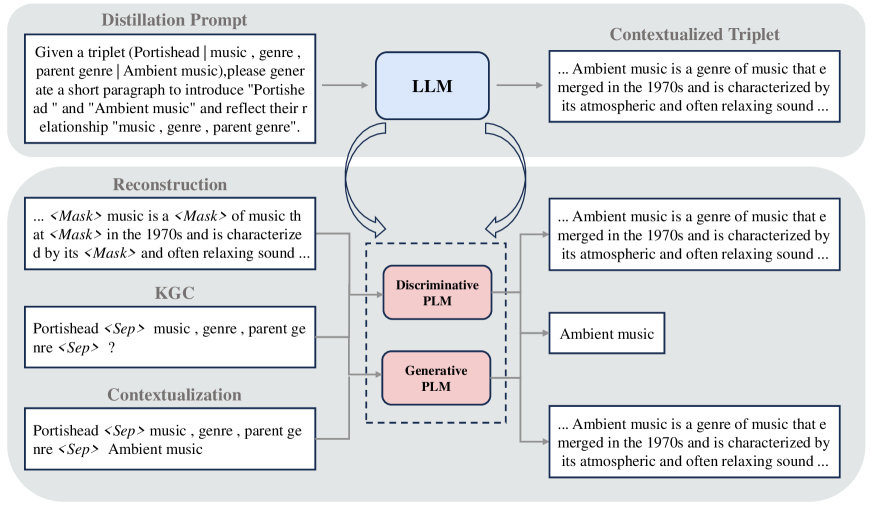
While textual information significantly enhances the performance of pre-trained language models (PLMs) in knowledge graph completion (KGC), the static and noisy nature of existing corpora collected from Wikipedia articles or synsets definitions often limits the potential of PLM-based KGC models. To surmount these challenges, we introduce the Contextualization Distillation strategy, a versatile plug-in-and-play approach compatible with both discriminative and generative KGC frameworks. Our method begins by instructing large language models (LLMs) to transform compact, structural triplets into context-rich segments. Subsequently, we introduce two tailored auxiliary tasks, reconstruction and contextualization, allowing smaller KGC models to assimilate insights from these enriched triplets. Comprehensive evaluations across diverse datasets and KGC techniques highlight the efficacy and adaptability of our approach, revealing consistent performance enhancements irrespective of underlying pipelines or architectures. Moreover, our analysis makes our method more explainable and provides insight into generating path selection, as well as the choosing of suitable distillation tasks. All the code and data in this work will be released at https://github.com/David-Li0406/Contextulization-Distillation
Motivation & Objective
- Motivate addressing noisy and static textual corpora in KGC that limit PLM performance.
- Leverage LLMs to convert triplets into descriptive contexts (entity descriptions and triplet descriptions).
- Propose a multi-task learning framework with auxiliary tasks to train smaller KGC models on contextualized data.
- Show that Contextualization Distillation improves performance across diverse KGC pipelines and architectures.
Proposed method
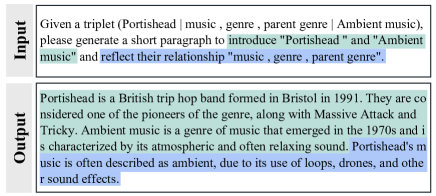
- Curate prompts to extract descriptive context from LLMs for each triplet, producing entity and triplet descriptions.
- Explore multiple generation paths (e.g., T -> ED, TD, RA, ED->TD, ED+TD) and select a robust single-step path (T -> (ED, TD)).
- Introduce two auxiliary tasks: reconstruction (MLM-based) for discriminative models and contextualization (generation task) for generative models.
- Train smaller KGC models with a combined loss (kgc loss + alpha * auxiliary loss) to transfer contextual knowledge.
- Evaluate across multiple PLM-based KGC baselines (discriminative and generative) on standard benchmarks.
Experimental results
Research questions
- RQ1Can LLM-generated descriptive contexts consistently improve KGC performance across different model types?
- RQ2Which generating paths and auxiliary tasks contribute most to performance gains?
- RQ3How does contextualization influenceability, explainability, and convergence in KGC training?
Key findings
- Contextualization Distillation consistently improves baseline KGC models on WN18RR and FB15k-237N, regardless of architecture (discriminative or generative).
- Using both entity descriptions and triplet descriptions (T -> (ED, TD)) yields stronger gains than using either alone.
- Contextualization often outperforms reconstruction alone in generative KGC models, underscoring the value of coherent descriptive context.
- Ablation shows comprehensive, coherent descriptive context enables smaller models to learn more effectively from LLMs.
- The method accelerates convergence in some models (e.g., CSProm-KG-CD) and yields competitive training efficiency.
Read this paper
Open the full text in the Nubint reader and ask about any passage as you read.
Read this paper on NubintThis review was generated by AI from the original paper. Please check the paper before citing it.