
[Paper Review] Continual Learning of Hand Gestures for Human-Robot Interaction
This paper proposes HAGIL, a continual learning framework for incremental recognition of static hand gestures using a single RGB camera and hand landmarks from MediaPipe. It achieves over 90% average accuracy after learning 38 gestures with only 5 exemplars per class, reducing incremental training time to under 10% of full retraining, while mitigating catastrophic forgetting through effective rehearsal strategies like iCaRL.
In this paper, we present an efficient method to incrementally learn to classify static hand gestures. This method allows users to teach a robot to recognize new symbols in an incremental manner. Contrary to other works which use special sensors or external devices such as color or data gloves, our proposed approach makes use of a single RGB camera to perform static hand gesture recognition from 2D images. Furthermore, our system is able to incrementally learn up to 38 new symbols using only 5 samples for each old class, achieving a final average accuracy of over 90\%. In addition to that, the incremental training time can be reduced to a 10\% of the time required when using all data available.
Motivation & Objective
- To enable robots to learn new static hand gestures incrementally without forgetting previously learned ones.
- To develop a low-cost, sensor-free solution using only a single RGB camera for real-time gesture recognition in human-robot interaction.
- To evaluate the effectiveness of continual learning strategies in a practical robotics context with limited data per class.
- To introduce a new benchmark dataset of 21 hand gestures performed by 4 subjects for continual gesture learning.
- To minimize computational cost and memory usage while maintaining high accuracy in incremental learning scenarios.
Proposed method
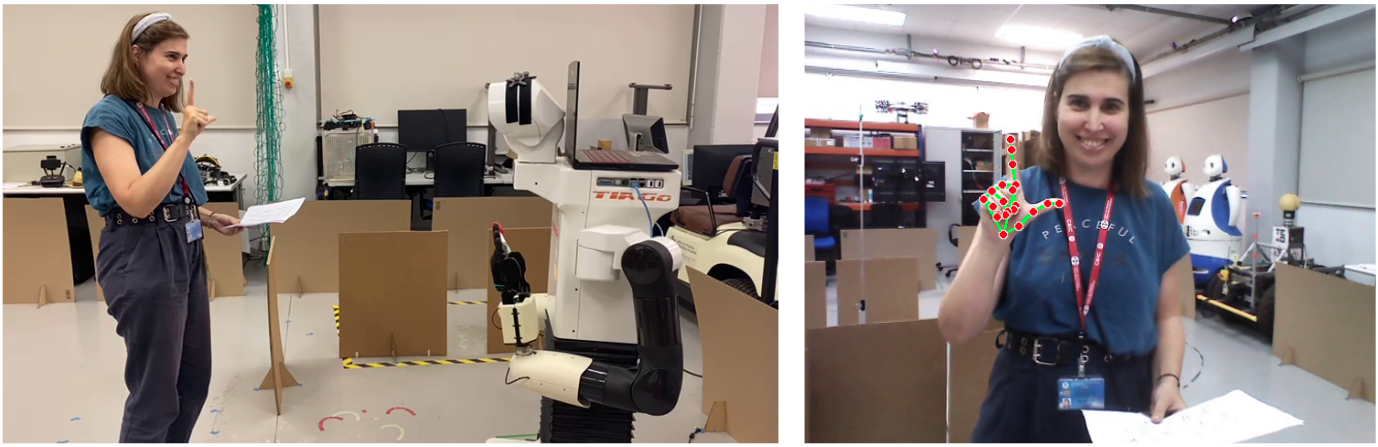
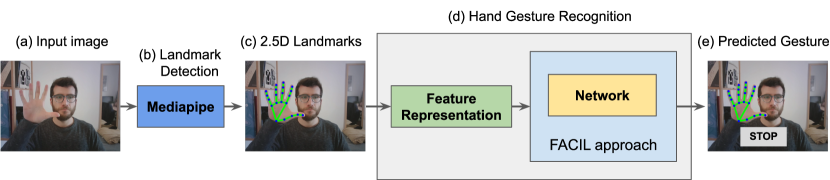
- The system uses MediaPipe's lightweight hand landmark detector to extract 21 keypoint coordinates from RGB images.
- Hand landmarks are encoded into a fixed-length feature vector for input to a neural network classifier.
- A modified FACIL framework integrates incremental learning strategies, including iCaRL and IL2M, to support continual learning.
- The iCaRL method uses a nearest exemplar mean classifier and a feature replay mechanism with a small memory of 5 exemplars per class.
- The model is trained incrementally using a rehearsal memory of past class exemplars, minimizing catastrophic forgetting.
- Training is optimized by fine-tuning on only the new class and a small subset of old class exemplars, reducing training time significantly.
Experimental results
Research questions
- RQ1Can a robot learn new static hand gestures incrementally from RGB images without forgetting previously learned gestures?
- RQ2How effective is a small rehearsal memory (5 exemplars per class) in maintaining high accuracy during continual learning of hand gestures?
- RQ3Which incremental learning strategy—iCaRL or IL2M—performs better under low-data and low-computation constraints?
- RQ4To what extent does the use of hand landmarks from a single RGB camera compare to other sensor-based methods in terms of accuracy and efficiency?
- RQ5Can the proposed system achieve real-time performance suitable for deployment in real-world human-robot interaction scenarios?
Key findings
- HAGIL achieved an average accuracy of over 90% after learning 38 distinct hand gestures using only 5 exemplars per class.
- The incremental training time was reduced to less than 10% of the time required for full retraining, with HAGIL training in 7.76 seconds compared to 79.73 seconds for the Joint baseline.
- On the Kaggle ASL Alphabet dataset, HAGIL stabilized at high accuracy after learning the first 7 classes, while the Joint baseline's performance degraded over time.
- The iCaRL strategy outperformed IL2M in low-exemplar regimes, particularly due to its efficient nearest exemplar mean classifier.
- The system achieved a total latency of 37.5ms per inference, enabling real-time operation at approximately 26 FPS, suitable for real-world deployment.
- The introduced dataset of 21 gestures from 4 subjects provides a new benchmark for continual learning in hand gesture recognition.
Read this paper
Open the full text in the Nubint reader and ask about any passage as you read.
Read this paper on NubintThis review was generated by AI from the original paper. Please check the paper before citing it.