
[Paper Review] Continuous-time Trajectory Estimation: A Comparative Study Between Gaussian Process and Spline-based Approaches
The paper directly compares Gaussian process (GP) and spline-based continuous-time trajectory estimation, showing similar accuracy and comparable solve times when models and spline orders are aligned, across linear and SE(3) scenarios.
Continuous-time trajectory estimation is an attractive alternative to discrete-time batch estimation due to the ability to incorporate high-frequency measurements from asynchronous sensors while keeping the number of optimization parameters bounded. Two types of continuous-time estimation have become prevalent in the literature: Gaussian process regression and spline-based estimation. In this paper, we present a direct comparison between these two methods. We first compare them using a simple linear system, and then compare them in a camera and IMU sensor fusion scenario on SE(3) in both simulation and hardware. Our results show that if the same measurements and motion model are used, the two methods achieve similar trajectory accuracy. In addition, if the spline order is chosen so that the degree-of-differentiability of the two trajectory representations match, then they achieve similar solve times as well.
Motivation & Objective
- Motivate and formalize continuous-time trajectory estimation as an alternative to discrete-time batch estimation.
- Develop generalized motion priors that work for both GP-based and spline-based representations.
- Provide a fair comparison between GP and spline approaches using linear and SE(3) scenarios with both simulated and hardware data.
- Extend GP motion priors to be applicable in spline-based estimation to enable apples-to-apples evaluation.
Proposed method
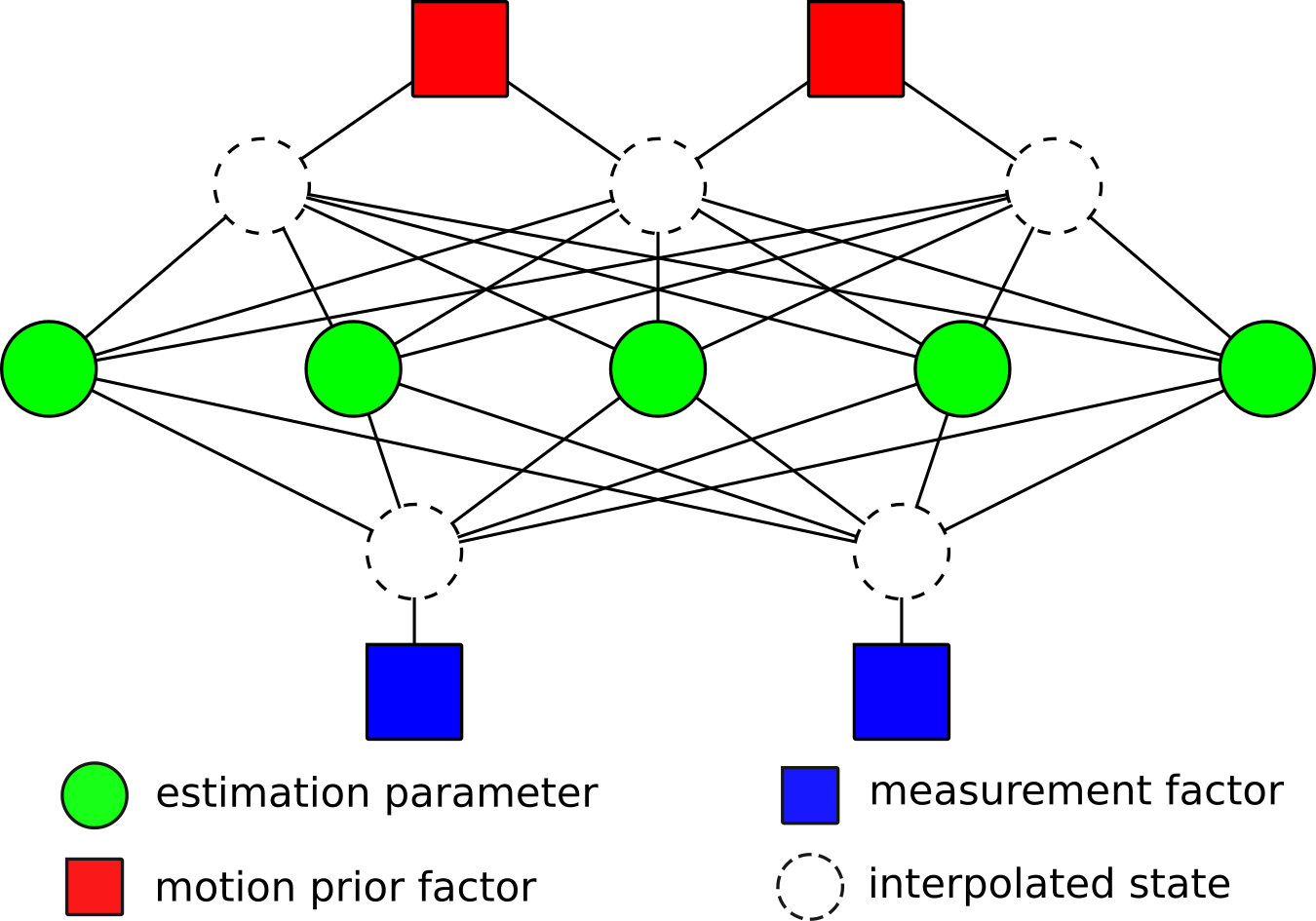
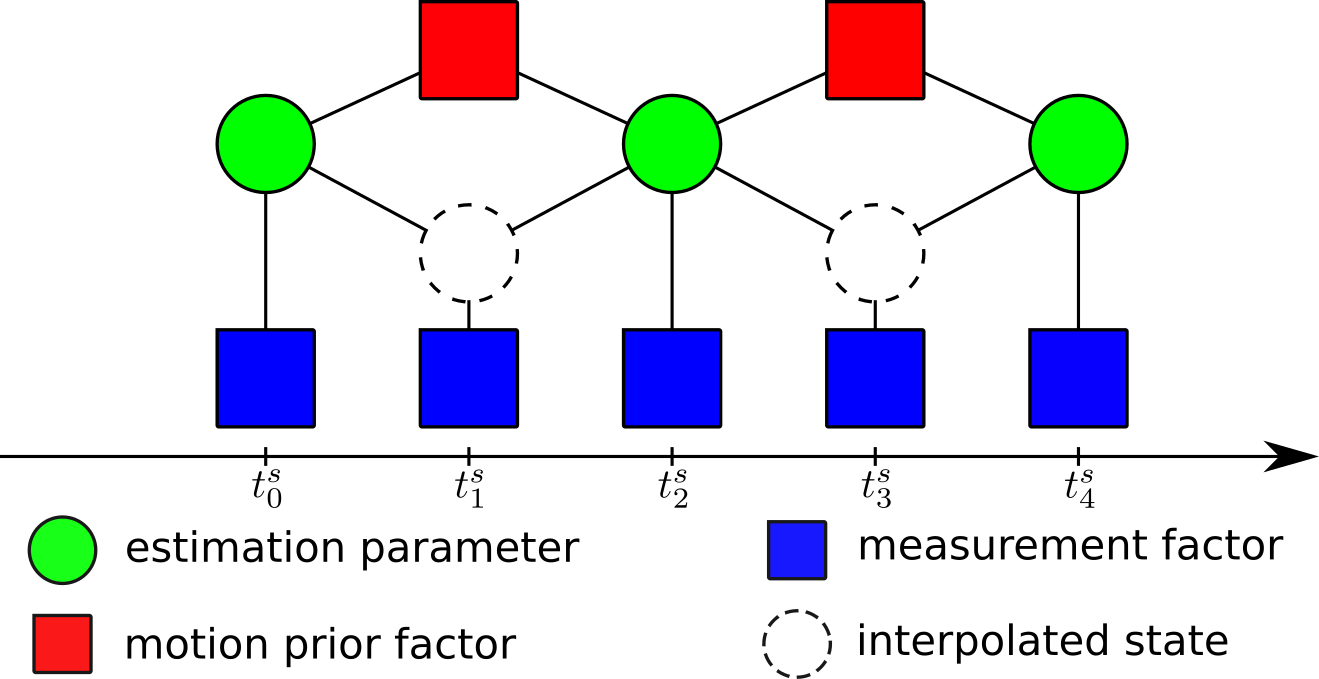
- Represent trajectories with estimation parameters and a state interpolation function to map parameters to states over time.
- Generalize motion priors for linear systems and Lie group (SE(3)) settings, including WNOJ/WNOA models and their Lie algebra formulations.
- Derive GP interpolation formulas for linear systems and Lie groups (including equations (19)-(21) and (22)-(24)).
- Derive spline representations on vector spaces and Lie groups, including cumulative form and group-product formulation for SE(3) (equations (27)-(32)).
- Formulate estimation as a nonlinear least-squares problem with measurement residuals and motion-prior terms (equation (5)).
- Compare GP-based and spline-based estimations through two scenarios: a linear WNOJ system and camera-IMU fusion on SE(3), using simulated and hardware data.
Experimental results
Research questions
- RQ1Do GP-based and spline-based continuous-time trajectory estimations yield similar trajectory accuracy when the same measurements and motion models are used?
- RQ2Do matching spline orders (to align degree-of-differentiability) lead to similar solve times between GP and spline representations in SE(3) scenarios?
- RQ3How do GP and spline estimators compare in linear and SE(3) sensor fusion problems with asynchronous/high-frequency measurements?
Key findings
- When the same measurements and motion model are used, GP and spline methods achieve similar trajectory accuracy.
- If the spline order is chosen so that the degree of differentiability matches the GP representation, the two methods have similar solve times.
- The study covers both linear and SE(3) cases, with simulated and hardware data to validate findings.
- The motion priors can be generalized to be used simultaneously with GP and spline representations, enabling fair comparisons.
Read this paper
Open the full text in the Nubint reader and ask about any passage as you read.
Read this paper on NubintThis review was generated by AI from the original paper. Please check the paper before citing it.