
[Paper Review] Continuously Learning, Adapting, and Improving: A Dual-Process Approach to Autonomous Driving
LeapAD proposes a dual-process, closed-loop autonomous driving system inspired by human cognition, using a fast Heuristic Process (System-I) and a slow Analytic Process (System-II) for reasoning and decision-making. By leveraging self-reflection and a growing memory bank of high-quality driving experiences, LeapAD enables continuous improvement with 1–2 orders of magnitude less labeled data than prior methods, achieving strong generalization across environments in CARLA simulations.
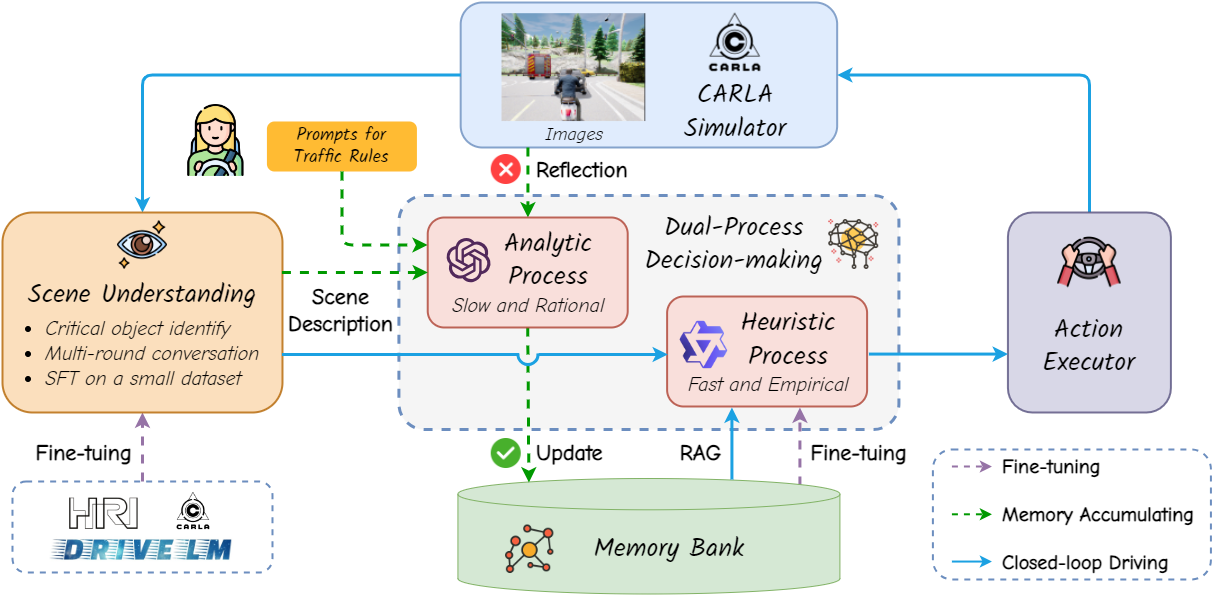
Autonomous driving has advanced significantly due to sensors, machine learning, and artificial intelligence improvements. However, prevailing methods struggle with intricate scenarios and causal relationships, hindering adaptability and interpretability in varied environments. To address the above problems, we introduce LeapAD, a novel paradigm for autonomous driving inspired by the human cognitive process. Specifically, LeapAD emulates human attention by selecting critical objects relevant to driving decisions, simplifying environmental interpretation, and mitigating decision-making complexities. Additionally, LeapAD incorporates an innovative dual-process decision-making module, which consists of an Analytic Process (System-II) for thorough analysis and reasoning, along with a Heuristic Process (System-I) for swift and empirical processing. The Analytic Process leverages its logical reasoning to accumulate linguistic driving experience, which is then transferred to the Heuristic Process by supervised fine-tuning. Through reflection mechanisms and a growing memory bank, LeapAD continuously improves itself from past mistakes in a closed-loop environment. Closed-loop testing in CARLA shows that LeapAD outperforms all methods relying solely on camera input, requiring 1-2 orders of magnitude less labeled data. Experiments also demonstrate that as the memory bank expands, the Heuristic Process with only 1.8B parameters can inherit the knowledge from a GPT-4 powered Analytic Process and achieve continuous performance improvement. Project page: https://pjlab-adg.github.io/LeapAD.
Motivation & Objective
- To address the limitations of current data-driven autonomous driving systems in handling unseen scenarios, causal reasoning, and interpretability.
- To enable continuous learning and adaptation in autonomous vehicles through a closed-loop, human-inspired cognitive framework.
- To bridge the gap between high-capacity reasoning models and lightweight, real-time inference by transferring knowledge from a large Analytic Process to a compact Heuristic Process.
- To improve generalization and robustness in diverse driving environments using a transferable memory bank and reflection mechanisms.
- To develop a system compatible with cloud-edge architectures for real-world deployment.
Proposed method
- LeapAD employs a scene understanding module that applies human-like attention to focus on critical objects, simplifying environmental input for decision-making.
- It implements a dual-process decision-making architecture: a slow, rational Analytic Process (System-II) for logical reasoning and a fast, empirical Heuristic Process (System-I) for real-time inference.
- The Analytic Process accumulates linguistic driving experience and generates high-quality decision trajectories, which are distilled into a transferable memory bank via supervised fine-tuning (SFT).
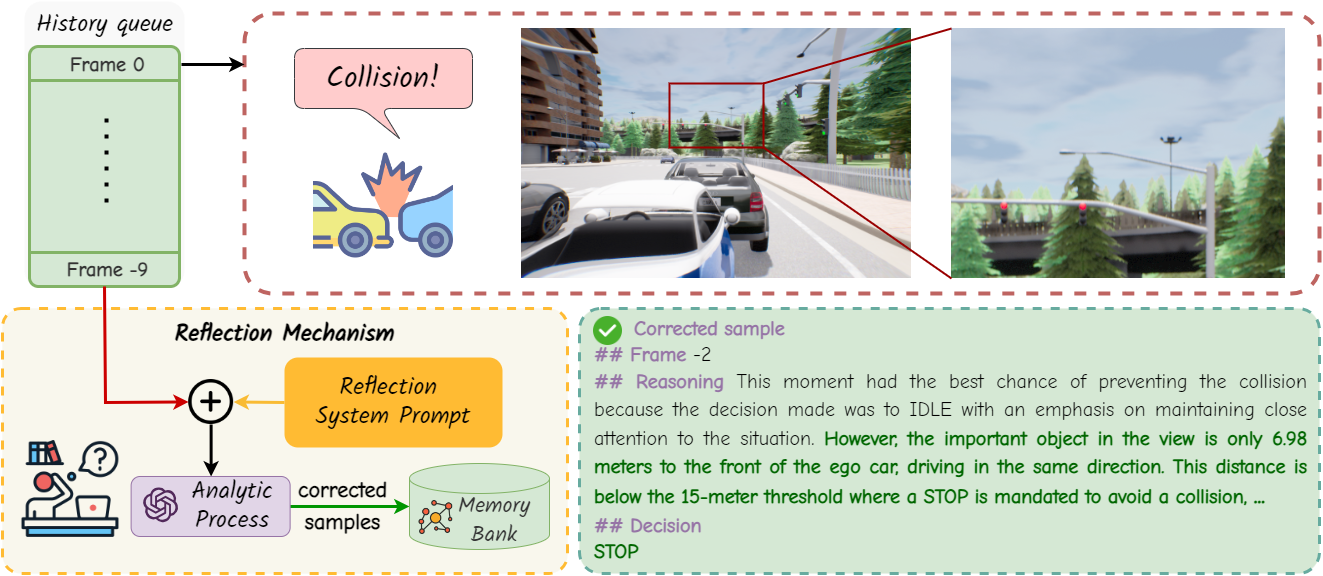
- A reflection mechanism identifies and analyzes traffic accidents, extracting lessons and updating the memory bank to enable self-improvement in a closed-loop setup.
- The Heuristic Process uses few-shot prompting with the memory bank to adapt quickly to new scenarios, enabling real-time decision-making at the edge.
- The system is trained and evaluated in a closed-loop CARLA simulation, ensuring dynamic interaction and feedback, unlike open-loop evaluation.
Experimental results
Research questions
- RQ1Can a dual-process cognitive architecture improve continuous learning and adaptability in autonomous driving systems?
- RQ2How effectively can a lightweight Heuristic Process inherit complex reasoning capabilities from a large Analytic Process through knowledge distillation?
- RQ3To what extent does a reflection-based memory bank enhance performance and generalization across diverse driving environments?
- RQ4Can LeapAD achieve strong performance with significantly less labeled data compared to existing camera-only methods?
- RQ5How does the system generalize when tested on towns not seen during memory bank collection?
Key findings
- LeapAD outperforms all camera-only methods in CARLA, achieving state-of-the-art performance in closed-loop evaluation.
- The system requires 1–2 orders of magnitude less labeled data than prior methods due to efficient knowledge transfer and continuous learning.
- As the memory bank grows, the 1.8B-parameter Heuristic Process achieves performance comparable to a GPT-4-powered Analytic Process through supervised fine-tuning.
- Reflection mechanisms significantly improve driving scores, with average performance increasing across multiple rounds of self-improvement in challenging routes.
- The memory bank demonstrates strong generalization: LeapAD achieves high performance on Town05 using memory collected from other towns, and vice versa, indicating robust cross-environment transfer.
- The system maintains strong performance even when low-quality samples are included in the memory bank, suggesting resilience to noisy data.
Read this paper
Open the full text in the Nubint reader and ask about any passage as you read.
Read this paper on NubintThis review was generated by AI from the original paper. Please check the paper before citing it.