
[Paper Review] Continuum Attention for Neural Operators
The paper formulates attention as a mapping between infinite-dimensional function spaces, proves it can be approximated by finite-dimensional implementations, and develops universal-approximation transformer neural operators with a patch-based, discretization-invariant architecture.
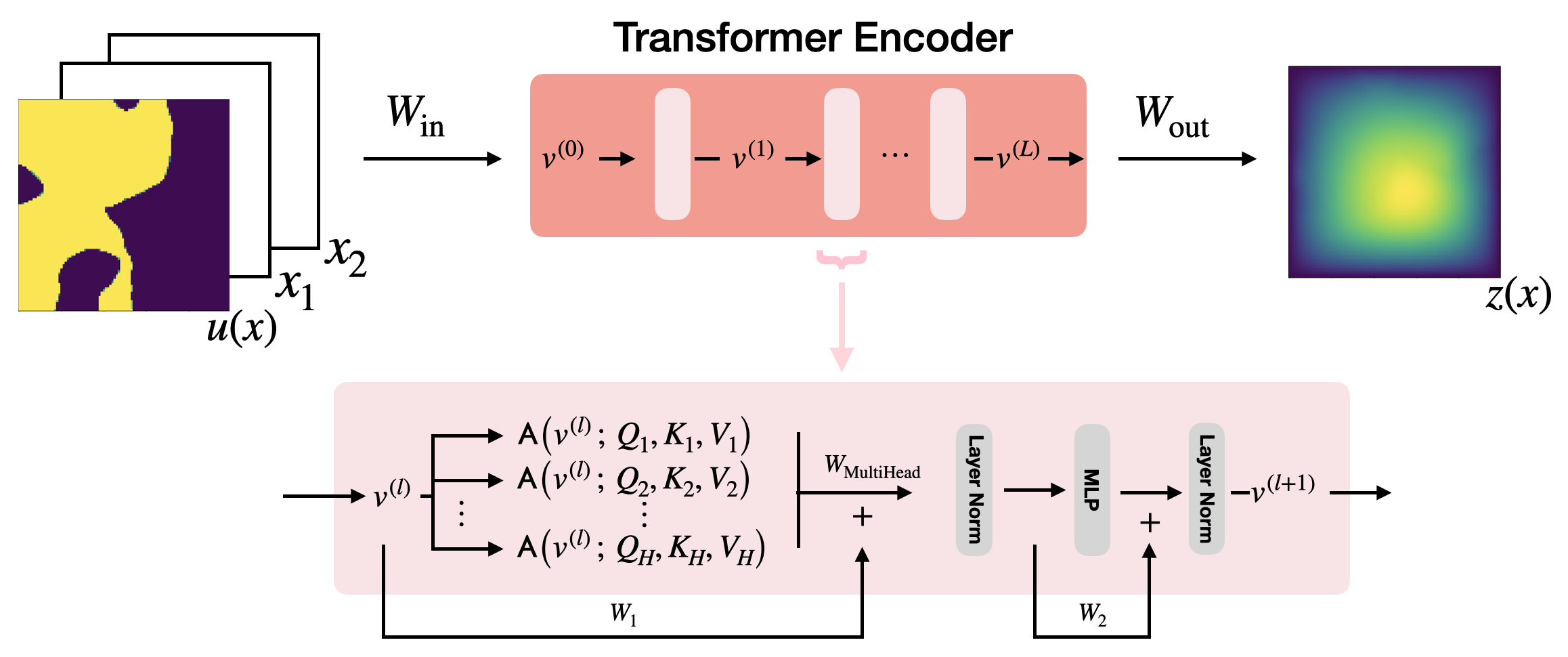
Transformers, and the attention mechanism in particular, have become ubiquitous in machine learning. Their success in modeling nonlocal, long-range correlations has led to their widespread adoption in natural language processing, computer vision, and time series problems. Neural operators, which map spaces of functions into spaces of functions, are necessarily both nonlinear and nonlocal if they are universal; it is thus natural to ask whether the attention mechanism can be used in the design of neural operators. Motivated by this, we study transformers in the function space setting. We formulate attention as a map between infinite dimensional function spaces and prove that the attention mechanism as implemented in practice is a Monte Carlo or finite difference approximation of this operator. The function space formulation allows for the design of transformer neural operators, a class of architectures designed to learn mappings between function spaces. In this paper, we state and prove the first universal approximation result for transformer neural operators, using only a slight modification of the architecture implemented in practice. The prohibitive cost of applying the attention operator to functions defined on multi-dimensional domains leads to the need for more efficient attention-based architectures. For this reason we also introduce a function space generalization of the patching strategy from computer vision, and introduce a class of associated neural operators. Numerical results, on an array of operator learning problems, demonstrate the promise of our approaches to function space formulations of attention and their use in neural operators.
Motivation & Objective
- Motivate and formalize attention in the function space setting for neural operators.
- Show that practical attention is a Monte Carlo/finite-difference approximation of a continuous operator.
- Define transformer neural operators that are discretization-invariant and can learn mappings between function spaces.
- Establish a first universal approximation result for transformer-based neural operators.
- Introduce patch-based attention to enable efficient, scalable operator learning on multi-dimensional domains.
Proposed method
- Formulate self-attention and cross-attention as operators acting on Banach spaces of functions over a domain D.
- Prove that practical attention. is a Monte Carlo approximation of the continuum attention operator (Theorems 6 and 12).
- Define continuum attention mappings and their patched variants to enable discretization-invariant learning.
- Construct transformer-based neural operators that map between function spaces and prove a universal approximation theorem.
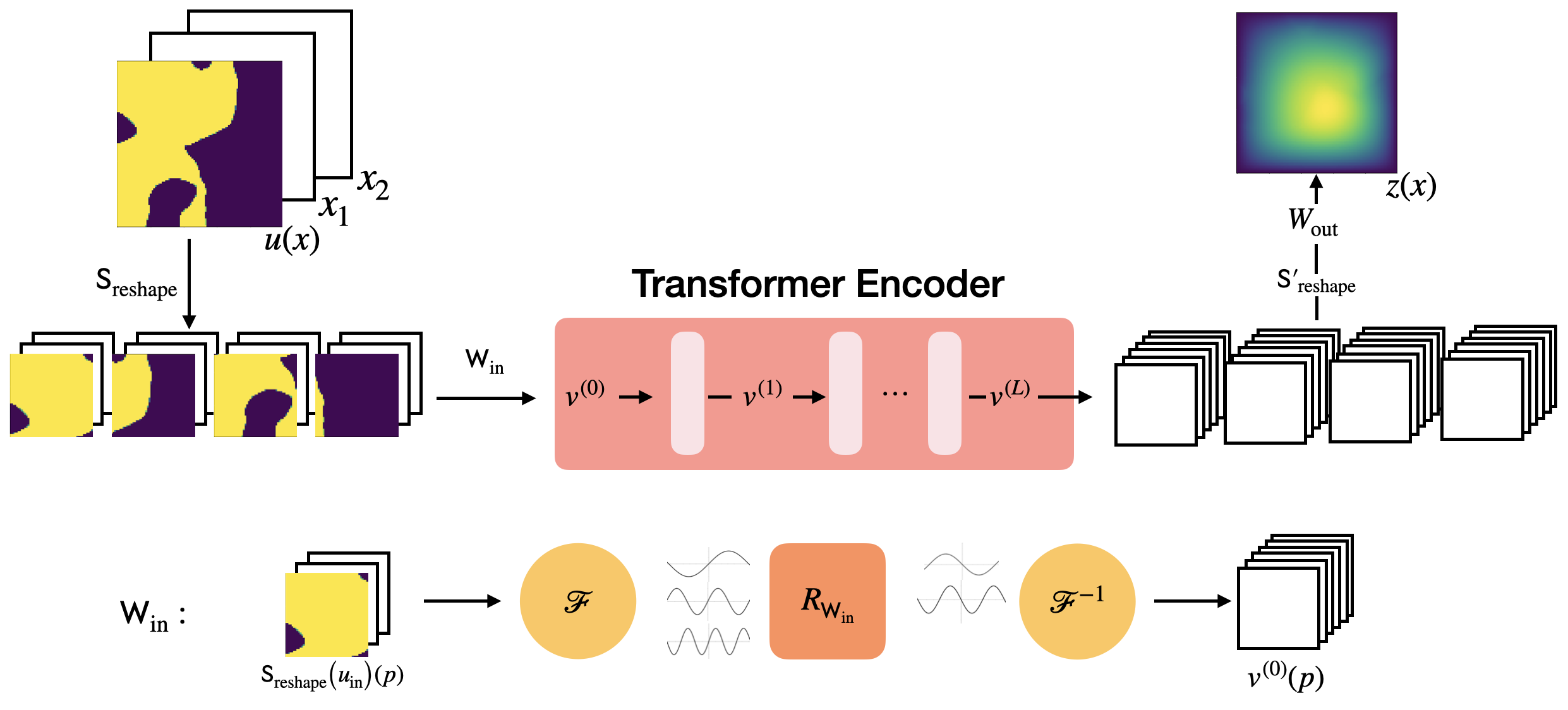
- Introduce patch-attention by partitioning the domain into patches and applying attention across patches (patching framework).
- Provide numerical experiments on operator learning problems to demonstrate effectiveness.
Experimental results
Research questions
- RQ1How can attention mechanisms be rigorously defined on infinite-dimensional function spaces?
- RQ2Can discretized attention mechanisms approximate their continuum counterparts with provable error control?
- RQ3Do transformer-based neural operators possess universal approximation capabilities for mappings between function spaces?
- RQ4Does a patch-based attention strategy yield discretization-invariant, scalable neural operators applicable to PDEs and related problems?
Key findings
- Attention is formulated as a mapping between function spaces and shown to be approximable by finite-dimensional implementations used in practice.
- An approximation theorem quantifies the error between continuous self-attention and its finite discretization; a similar result holds for cross-attention.
- A transformer-based neural operator framework is established that is discretization/invariance and supports zero-shot generalization to irregular meshes.
- A first universal approximation theorem for transformer neural operators is presented.
- Patch-attention is developed to enable efficient computation and mesh-invariant operator learning via function patches.
Read this paper
Open the full text in the Nubint reader and ask about any passage as you read.
Read this paper on NubintThis review was generated by AI from the original paper. Please check the paper before citing it.