
[Paper Review] CONTRACTFIX: A Framework for Automatically Fixing Vulnerabilities in Smart Contracts
ContractFix is an end-to-end framework that automatically detects, patches, and verifies security vulnerabilities in smart contracts using ensemble static analysis, template-based fix patterns, and program analysis. It successfully fixes 94% of 601 detected vulnerabilities across 144 real-world contracts with minimal performance overhead, achieving an average patching time of 3.75 seconds.
The increased adoption of smart contracts in many industries has made them an attractive target for cybercriminals, leading to millions of dollars in losses. Thus, deploying smart contracts with detected vulnerabilities (known to developers) are not acceptable, and fixing all the detected vulnerabilities is needed, which incurs high manual labor cost without effective tool support. To fill this need, in this paper, we propose ContractFix, a novel framework that automatically generates security patches for vulnerable smart contracts. ContractFix is a general framework that can incorporate different fix patterns for different types of vulnerabilities. Users can use it as a security fix-it tool that automatically applies patches and verifies the patched contracts before deploying the contracts. To address the unique challenges in fixing smart contract vulnerabilities, given an input smart contract, ool conducts our proposed ensemble identification based on multiple static verification tools to identify vulnerabilities that are amenable for automatic fix. Then, ContractFix generates patches using template-based fix patterns and conducts program analysis (program dependency computation and pointer analysis) for smart contracts to accurately infer and populate the parameter values for the fix patterns. Finally, ContractFix performs static verification that guarantees the patched contract is free of vulnerabilities. Our evaluations on $144$ real vulnerable contracts demonstrate that ool can successfully fix $94\%$ of the detected vulnerabilities ($565$ out of $601$) and preserve the expected behaviors of the smart contracts.
Motivation & Objective
- To address the critical gap in automated tool support for fixing smart contract vulnerabilities, which are immutable after deployment and require manual patching at high cost.
- To enable automatic generation of secure, behavior-preserving patches for multiple vulnerability types without relying on test suites.
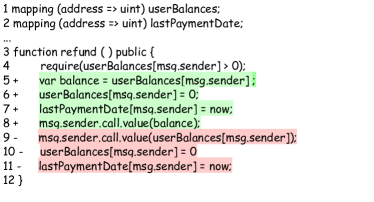
- To support complex fix patterns—such as temporary variable creation and statement reordering—commonly required for critical vulnerabilities like reentrancy.
- To ensure correctness of patched contracts through static verification, guaranteeing vulnerability removal.
- To provide a generalizable, efficient, and scalable framework for integrating detection, patching, and verification in a single pipeline.
Proposed method
- ContractFix uses an ensemble of three static verification tools to detect vulnerabilities, reducing false positives via majority voting and post-processing to filter non-amenable cases.
- It applies template-based fix patterns tailored to specific vulnerability types, such as reentrancy, missing input validation, and locked Ether.
- Custom program analysis (including program dependency and pointer analysis) is used to infer and populate parameters for fix patterns accurately.
- The framework performs static verification on the patched contract to formally prove the absence of the original vulnerabilities.
- Patch generation is decoupled from detection, enabling integration with various vulnerability detectors and supporting extensibility to other smart contract languages.
- Runtime efficiency is achieved through lightweight analysis and optimized template application, with an average patching time of 3.75 seconds per contract.
Experimental results
Research questions
- RQ1Can an automated framework effectively detect and fix multiple vulnerabilities in smart contracts without requiring test suites?
- RQ2Can complex fix patterns—such as temporary variable creation and statement reordering—be reliably generated and applied using static analysis and templates?
- RQ3Can the framework ensure that generated patches preserve the original contract behavior while eliminating vulnerabilities?
- RQ4How effective is the ensemble of static verification tools in reducing false positives compared to individual tools?
- RQ5What is the performance overhead of the full pipeline, and can it scale to real-world contracts?
Key findings
- ContractFix successfully fixed 565 out of 601 detected vulnerabilities (94%) across 144 real-world smart contracts.
- The framework achieved an average patching time of 3.75 seconds per contract, demonstrating high efficiency.
- The ensemble static verification approach reduced false positives by combining results from three tools and applying post-processing.
- The use of program analysis enabled accurate inference of values for fix patterns, supporting complex repairs like reordering and temporary variable introduction.
- The framework preserved the expected behavior of the original contracts, as verified through static analysis post-patching.
- ContractFix is generalizable and can be extended to other smart contract languages such as Move, given similar language-level constraints.
Read this paper
Open the full text in the Nubint reader and ask about any passage as you read.
Read this paper on NubintThis review was generated by AI from the original paper. Please check the paper before citing it.