
[Paper Review] Contrasting Linguistic Patterns in Human and LLM-Generated News Text
This study contrasts human-written and LLM-generated English news text using the LLaMA family of models, analyzing linguistic patterns across morphosyntactic, psychometric, and sociolinguistic dimensions. Despite high fluency, LLMs produce texts with more objective language, shorter constituents, reduced aggressive emotions (fear, disgust), and higher pronoun use—while also reflecting and amplifying human-like gender biases, especially in larger models.
We conduct a quantitative analysis contrasting human-written English news text with comparable large language model (LLM) output from six different LLMs that cover three different families and four sizes in total. Our analysis spans several measurable linguistic dimensions, including morphological, syntactic, psychometric, and sociolinguistic aspects. The results reveal various measurable differences between human and AI-generated texts. Human texts exhibit more scattered sentence length distributions, more variety of vocabulary, a distinct use of dependency and constituent types, shorter constituents, and more optimized dependency distances. Humans tend to exhibit stronger negative emotions (such as fear and disgust) and less joy compared to text generated by LLMs, with the toxicity of these models increasing as their size grows. LLM outputs use more numbers, symbols and auxiliaries (suggesting objective language) than human texts, as well as more pronouns. The sexist bias prevalent in human text is also expressed by LLMs, and even magnified in all of them but one. Differences between LLMs and humans are larger than between LLMs.
Motivation & Objective
- To investigate whether large language models (LLMs) like LLaMA replicate the linguistic patterns of human-written news text.
- To identify measurable differences in morphosyntactic, psychometric, and sociolinguistic features between human and AI-generated news.
- To evaluate whether model size influences the degree of divergence from human linguistic norms.
- To assess the persistence of human biases—such as gender bias—in LLM-generated content.
- To establish a controlled, novel benchmark for detecting synthetic text using linguistic profiling.
Proposed method
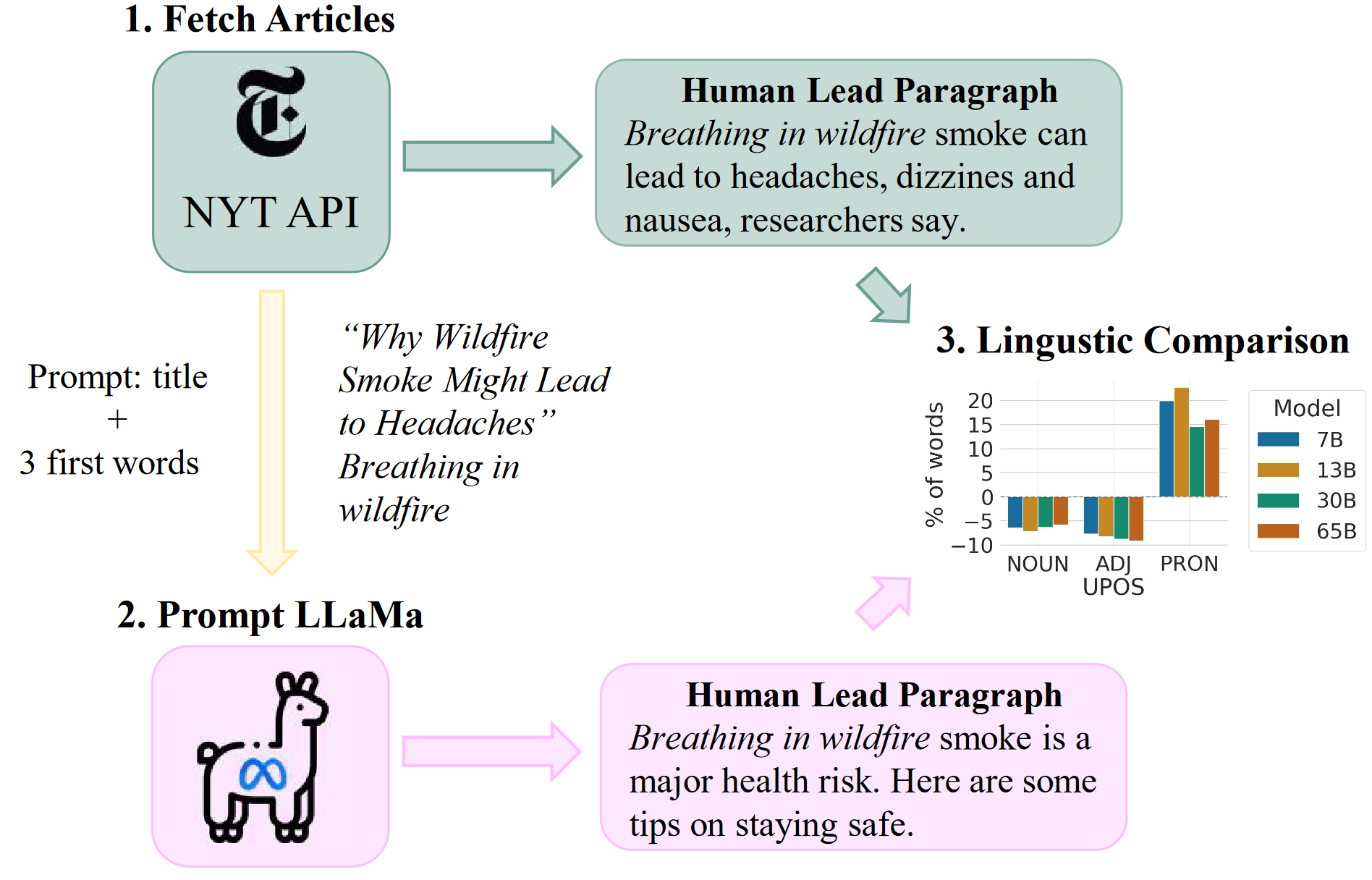
- Collected 11,133 human news articles from the New York Times API, focusing on headlines and lead paragraphs published after LLaMA model release dates to prevent data leakage.
- Used LLaMA models to generate news content based on human headlines and opening sentences, ensuring generation was not memorized from training data.
- Performed quantitative analysis across multiple linguistic dimensions: vocabulary use, sentence length, part-of-speech (PoS) distribution, dependency and constituent structures, emotion tone, and sociolinguistic features like pronoun use and gender bias.
- Employed standardized NLP tools for syntactic parsing (dependency and constituent trees), emotion detection (e.g., fear, disgust), and bias measurement (e.g., pronoun frequency, gendered language).
- Compared results across different LLaMA model sizes to assess scaling effects on linguistic divergence.
- Used controlled, real-time data from a reputable news source to ensure freshness and minimize memorization risks.
Experimental results
Research questions
- RQ1Do LLM-generated news texts exhibit statistically significant differences in syntactic structure compared to human-written news?
- RQ2How do LLMs differ from humans in the use of emotional tone, particularly in negative emotions like fear and disgust?
- RQ3To what extent do LLMs replicate or amplify sociolinguistic biases such as gendered pronoun usage found in human texts?
- RQ4How does model size influence the linguistic divergence between human and LLM-generated news?
- RQ5Are there measurable differences in lexical diversity, use of symbols/numbers, and auxiliary verbs between human and AI-generated news?
Key findings
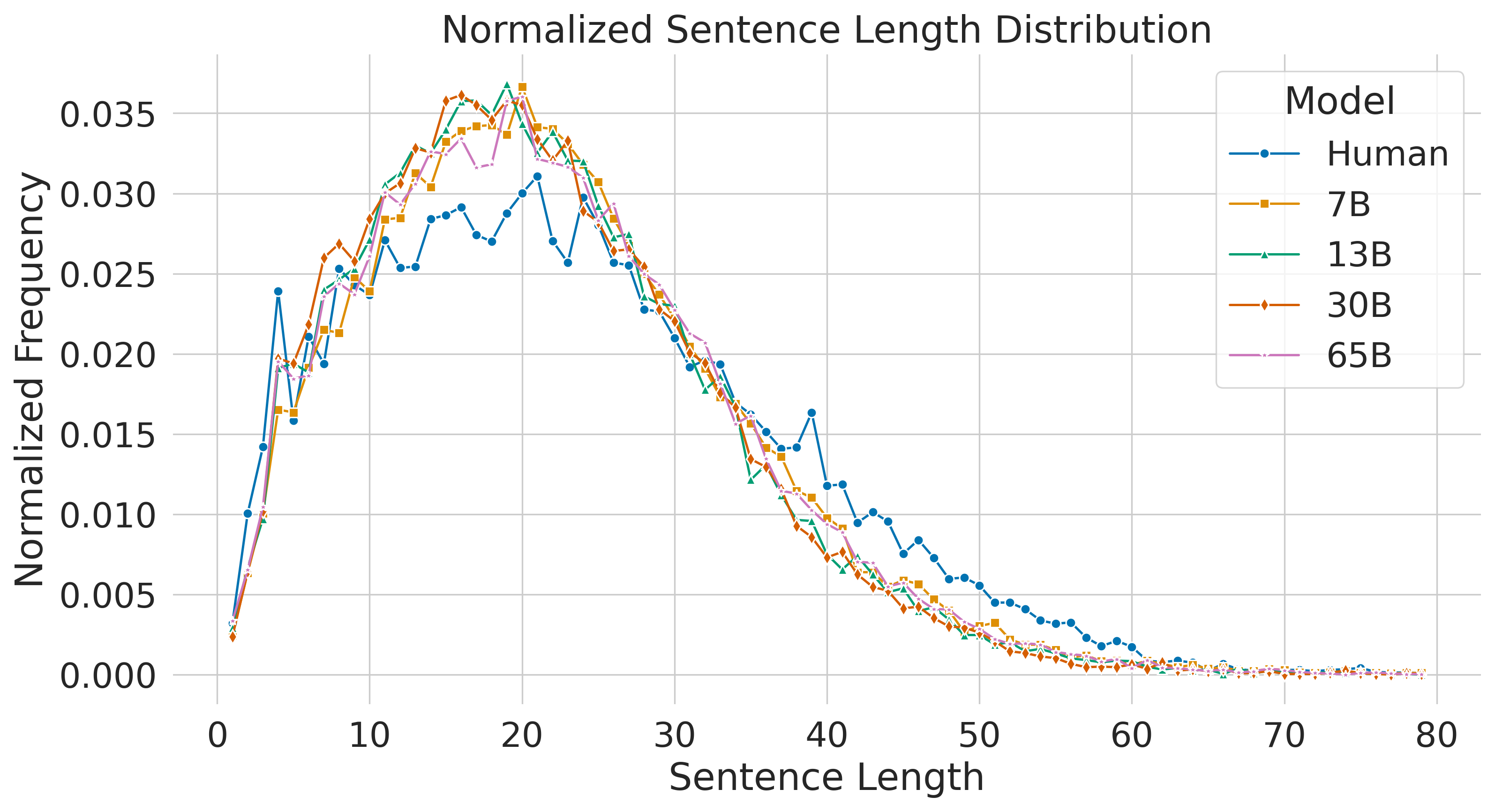
- Human news texts exhibit more scattered sentence length distributions compared to the more uniform distribution in LLM-generated texts.
- LLaMA models use significantly more numbers, symbols, and auxiliary verbs—indicating a preference for objective, formal language—compared to human texts.
- LLM-generated texts show shorter constituent spans and a distinct distribution of dependency and constituent types compared to human-written news.
- Despite high fluency, LLMs express less aggressive negative emotion (e.g., fear, disgust) than human texts, though this tendency increases with model size.
- LLaMA models display a higher frequency of male pronouns than human texts, reflecting and amplifying existing gender biases in training data.
- The study confirms that even highly fluent LLMs produce linguistically distinct outputs, enabling potential detection through linguistic profiling.
Read this paper
Open the full text in the Nubint reader and ask about any passage as you read.
Read this paper on NubintThis review was generated by AI from the original paper. Please check the paper before citing it.