
[Paper Review] Contrastive Learning based Semantic Communication for Wireless Image Transmission
This paper proposes a contrastive learning (CL)-based semantic communication framework for wireless image transmission that treats channel-induced image corruption as data augmentation to enhance semantic similarity between original and reconstructed images. By jointly optimizing a two-stage training procedure with CL loss, the method achieves up to 56% higher accuracy on CIFAR-10 at a 1/48 bandwidth compression ratio while maintaining competitive image reconstruction quality.
Recently, semantic communication has been widely applied in wireless image transmission systems as it can prioritize the preservation of meaningful semantic information in images over the accuracy of transmitted symbols, leading to improved communication efficiency. However, existing semantic communication approaches still face limitations in achieving considerable inference performance in downstream AI tasks like image recognition, or balancing the inference performance with the quality of the reconstructed image at the receiver. Therefore, this paper proposes a contrastive learning (CL)-based semantic communication approach to overcome these limitations. Specifically, we regard the image corruption during transmission as a form of data augmentation in CL and leverage CL to reduce the semantic distance between the original and the corrupted reconstruction while maintaining the semantic distance among irrelevant images for better discrimination in downstream tasks. Moreover, we design a two-stage training procedure and the corresponding loss functions for jointly optimizing the semantic encoder and decoder to achieve a good trade-off between the performance of image recognition in the downstream task and reconstructed quality. Simulations are finally conducted to demonstrate the superiority of the proposed method over the competitive approaches. In particular, the proposed method can achieve up to 56\% accuracy gain on the CIFAR10 dataset when the bandwidth compression ratio is 1/48.
Motivation & Objective
- To address the limitation of existing semantic communication systems in balancing image reconstruction quality and downstream inference performance under bandwidth constraints.
- To improve semantic representation learning in wireless image transmission by leveraging image corruption during transmission as a form of data augmentation.
- To design a two-stage training procedure that jointly optimizes the semantic encoder and decoder for better trade-off between semantic fidelity and reconstruction quality.
- To achieve robust performance in low-SNR and low-bandwidth scenarios, particularly for downstream AI tasks like image classification.
Proposed method
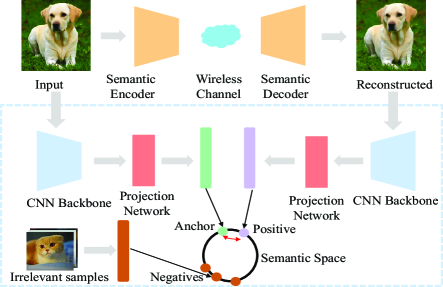
- Treats image corruption during wireless transmission as a form of data augmentation in contrastive learning (CL), enhancing semantic similarity between original and reconstructed images.
- Introduces a semantic contrastive coding mechanism that minimizes the semantic distance between original and corrupted-reconstructed images while maximizing it between semantically unrelated images.
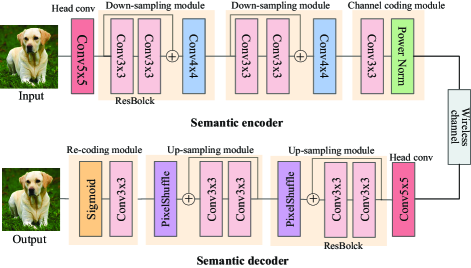
- Employs a two-stage training procedure: first pre-training the semantic encoder and decoder using contrastive loss, then fine-tuning with joint source-channel coding objectives.
- Uses a contrastive loss function that encourages positive pairs (original and reconstructed images) to have small semantic distance and negative pairs (dissimilar images) to have large semantic distance.
- Applies power normalization to the encoded signal to satisfy the average power constraint at the transmitter.
- Models the wireless channel as an additive white Gaussian noise (AWGN) channel, with the received signal corrupted by noise, and reconstructs the image at the receiver using the decoder.
Experimental results
Research questions
- RQ1Can treating channel-induced image corruption as data augmentation in contrastive learning improve semantic representation in wireless image transmission?
- RQ2How does the proposed two-stage training procedure balance semantic fidelity and image reconstruction quality under limited bandwidth?
- RQ3What is the performance gain of the CL-based framework over existing DeepJSCC and DeepSC methods in terms of downstream image classification accuracy at low compression ratios?
- RQ4How robust is the proposed method in low-SNR environments, particularly when bandwidth is severely constrained?
Key findings
- The proposed method achieves up to 56% higher accuracy on the CIFAR-10 dataset at a 1/48 bandwidth compression ratio compared to DeepJSCC, demonstrating significant gains in downstream image classification performance.
- At a bandwidth compression ratio of 1/48, the proposed method attains 87.65% test accuracy, outperforming DeepSC by 1% and DeepJSCC by 56%.
- The method maintains a PSNR of 38.75 dB at a 1/2.5 compression ratio, closely approaching DeepJSCC’s 39.27 dB, indicating strong reconstruction quality when bandwidth is sufficient.
- Even at low SNR (5 dB), the proposed method maintains superior accuracy compared to DeepJSCC, DeepJSCC-ft, and DeepSC, showing robustness in poor channel conditions.
- Visualizations on the Kodak dataset confirm that the method effectively suppresses redundant background information while preserving key semantic content, reducing corruption in salient image regions.
- The method achieves comparable PSNR and MS-SSIM to DeepJSCC and DeepJSCC-ft, confirming its effectiveness in preserving perceptual image quality despite prioritizing semantic information.
Read this paper
Open the full text in the Nubint reader and ask about any passage as you read.
Read this paper on NubintThis review was generated by AI from the original paper. Please check the paper before citing it.