
[Paper Review] Contrastive Learning for Compact Single Image Dehazing
This paper proposes AECR-Net, a compact single image dehazing framework that leverages contrastive regularization (CR) to improve dehazing performance by pulling restored images closer to clear images (positive samples) and pushing them away from hazy images (negative samples) in representation space. The method achieves state-of-the-art performance with significantly fewer parameters by combining an autoencoder-like architecture with adaptive mixup and dynamic feature enhancement, outperforming existing models on both synthetic and real-world benchmarks.
Single image dehazing is a challenging ill-posed problem due to the severe information degeneration. However, existing deep learning based dehazing methods only adopt clear images as positive samples to guide the training of dehazing network while negative information is unexploited. Moreover, most of them focus on strengthening the dehazing network with an increase of depth and width, leading to a significant requirement of computation and memory. In this paper, we propose a novel contrastive regularization (CR) built upon contrastive learning to exploit both the information of hazy images and clear images as negative and positive samples, respectively. CR ensures that the restored image is pulled to closer to the clear image and pushed to far away from the hazy image in the representation space. Furthermore, considering trade-off between performance and memory storage, we develop a compact dehazing network based on autoencoder-like (AE) framework. It involves an adaptive mixup operation and a dynamic feature enhancement module, which can benefit from preserving information flow adaptively and expanding the receptive field to improve the network's transformation capability, respectively. We term our dehazing network with autoencoder and contrastive regularization as AECR-Net. The extensive experiments on synthetic and real-world datasets demonstrate that our AECR-Net surpass the state-of-the-art approaches. The code is released in https://github.com/GlassyWu/AECR-Net.
Motivation & Objective
- To address the ill-posed nature of single image dehazing by exploiting both positive (clear) and negative (hazy) samples in representation space.
- To reduce computational and memory overhead in deep dehazing networks without sacrificing performance.
- To develop a compact, efficient dehazing network that maintains strong feature representation and transformation capability.
- To introduce a model-agnostic contrastive regularization module that enhances performance across various architectures.
Proposed method
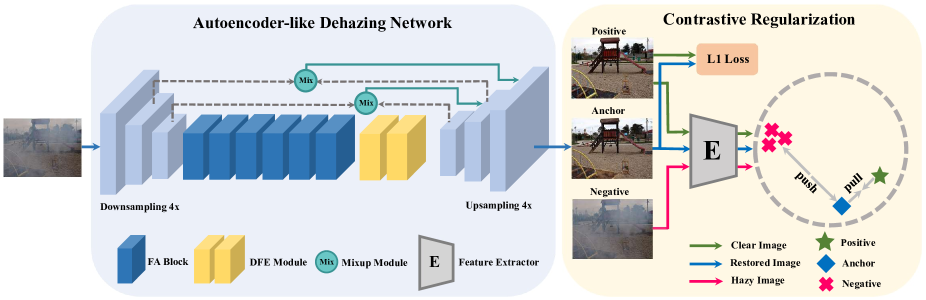
- Proposes contrastive regularization (CR) that treats clear images as positive samples and hazy images as negative samples, constraining the network to pull predictions toward the positive and push them from the negative in representation space.
- Designs an autoencoder-like (AE) dehazing network with reduced depth and parameter count to minimize memory and computation costs.
- Introduces an adaptive mixup operation that enables adaptive flow of shallow features to deeper layers, preserving feature information across the network.
- Employs a dynamic feature enhancement (DFE) module inspired by deformable convolutions to expand the receptive field and improve spatial feature fusion.
- Trains the network using a contrastive loss that compares the representation of the restored image (anchor) with those of the corresponding clear (positive) and hazy (negative) images.
- Enables CR to be removed during inference, ensuring no additional computation or parameters are introduced at test time.
Experimental results
Research questions
- RQ1Can contrastive learning effectively improve dehazing performance by leveraging both positive and negative samples in representation space?
- RQ2How can a compact dehazing network maintain high performance while reducing model parameters and computation cost?
- RQ3What is the optimal configuration of positive and negative sample rates in contrastive regularization for dehazing?
- RQ4Can the proposed contrastive regularization be universally applied to enhance existing state-of-the-art dehazing models?
Key findings
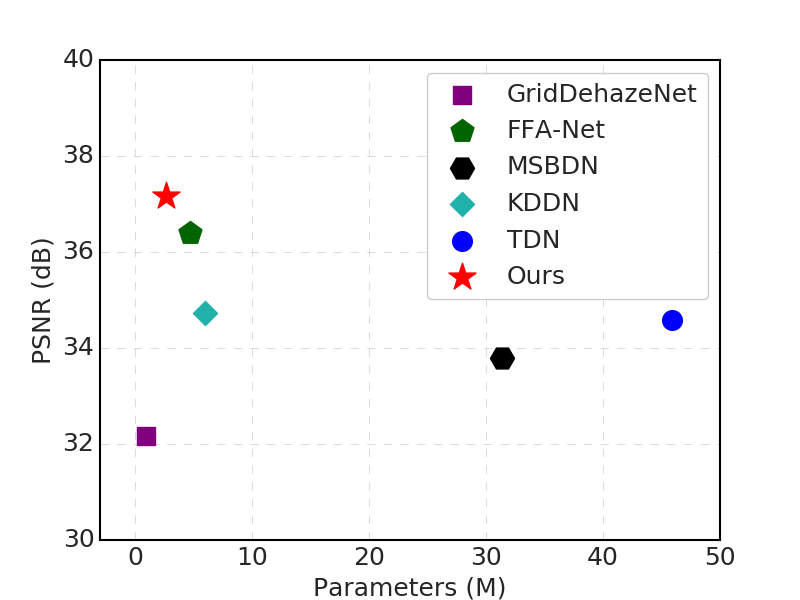
- AECR-Net achieves a PSNR of 37.17 dB on the RESIDE dataset, outperforming the base model with DFE and mixup by 0.71 dB.
- Using a 1:10 ratio of positive to negative samples in CR yields the best performance (37.41 dB PSNR), though it increases training time to ~200 hours.
- Adding CR to existing SOTA models like FFA-Net and KDDN improves PSNR by up to 0.35 dB and 0.46 dB, respectively, demonstrating its model-agnostic effectiveness.
- The dynamic feature enhancement (DFE) module performs best when placed after deeper layers, improving feature representation and overall restoration quality.
- The adaptive mixup operation enhances feature preservation by enabling better information flow from shallow to deep layers.
- The contrastive regularization module can be removed at inference time, adding no computational or parameter overhead.
Read this paper
Open the full text in the Nubint reader and ask about any passage as you read.
Read this paper on NubintThis review was generated by AI from the original paper. Please check the paper before citing it.