
[Paper Review] Contrastive Video-Language Learning with Fine-grained Frame Sampling
FineCo proposes a fine-grained contrastive learning approach that improves video-language representation by sampling semantically relevant video frames using a frame selector, then applying contrastive loss on frame-text pairs. It achieves state-of-the-art performance on YouCookII and competitive results on MSR-VTT benchmarks, especially for long videos with weak video-text correspondence.
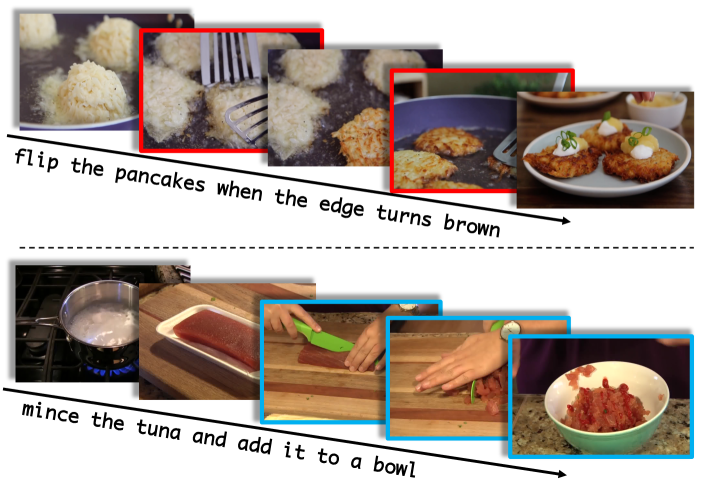
Despite recent progress in video and language representation learning, the weak or sparse correspondence between the two modalities remains a bottleneck in the area. Most video-language models are trained via pair-level loss to predict whether a pair of video and text is aligned. However, even in paired video-text segments, only a subset of the frames are semantically relevant to the corresponding text, with the remainder representing noise; where the ratio of noisy frames is higher for longer videos. We propose FineCo (Fine-grained Contrastive Loss for Frame Sampling), an approach to better learn video and language representations with a fine-grained contrastive objective operating on video frames. It helps distil a video by selecting the frames that are semantically equivalent to the text, improving cross-modal correspondence. Building on the well established VideoCLIP model as a starting point, FineCo achieves state-of-the-art performance on YouCookII, a text-video retrieval benchmark with long videos. FineCo also achieves competitive results on text-video retrieval (MSR-VTT), and video question answering datasets (MSR-VTT QA and MSR-VTT MC) with shorter videos.
Motivation & Objective
- To address the weak or sparse correspondence between video and text in video-language representation learning.
- To improve cross-modal alignment by focusing on semantically relevant frames rather than treating entire video clips as uniform units.
- To mitigate the negative impact of irrelevant frames in long videos, which dilute the learning signal in standard pair-level contrastive learning.
- To develop a frame-level contrastive objective that enhances video representation without requiring frame-level annotations.
- To demonstrate that fine-grained frame sampling improves performance, especially on long video datasets like YouCookII.
Proposed method
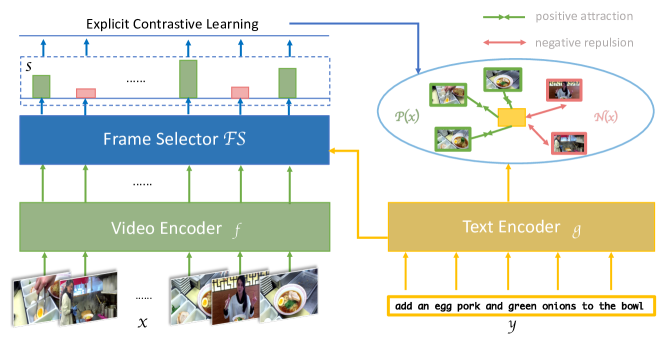
- A frame selector is trained to identify and sample frames with high semantic similarity to the text, based on frame-text similarity scores.
- Fine-grained contrastive loss is applied between selected positive frames and non-selected negative frames, encouraging alignment of relevant visual content with the text.
- The method is integrated into the VideoCLIP framework, using its video and text encoders, and trained end-to-end with both pair-level and frame-level contrastive objectives.
- The number of positive frames (k) is treated as a hyperparameter tuned on a development set, with fixed-k strategy used to select k frames with highest similarity to the text.
- The approach does not require temporal annotations, making it applicable to datasets with loosely aligned video-text pairs.
- Frame sampling is performed before the contrastive loss, enabling distillation of the most informative frames for improved video representation.
Experimental results
Research questions
- RQ1Can frame-level contrastive learning improve video-language representation when only video-text pair-level annotations are available?
- RQ2Does sampling only the most semantically relevant frames from a video lead to better cross-modal alignment than using all frames?
- RQ3How does the performance of frame-level contrastive learning vary across datasets with different video lengths, especially long videos with sparse alignment?
- RQ4Is fine-grained frame sampling more effective than word-level sampling for improving video-language retrieval?
- RQ5Can the proposed method generalize across different video-language frameworks based on contrastive learning?
Key findings
- FineCo achieves state-of-the-art performance on the YouCookII text-video retrieval benchmark, outperforming prior methods on long videos.
- On YouCookII, FineCo achieves R@1 of 32.1, R@5 of 62.6, and R@10 of 75.5, significantly improving over the base VideoCLIP model.
- For MSR-VTT MC (multiple choice), FineCo achieves the best performance with k=25, demonstrating effectiveness on shorter videos too.
- The ablation study shows that fixed-k sampling with k=20 on MSR-VTT QA and k=25 on MSR-VTT MC yields optimal results, confirming the importance of selecting an appropriate number of positive frames.
- Frame-level sampling outperforms word-level sampling, as removing words compromises sentence meaning, while frames are more redundant and suitable for filtering.
- Qualitative examples show that FineCo correctly retrieves videos by focusing on key frames, though it fails on short or less dynamic videos where frame selection is less effective.
Read this paper
Open the full text in the Nubint reader and ask about any passage as you read.
Read this paper on NubintThis review was generated by AI from the original paper. Please check the paper before citing it.