
[Paper Review] Control centrality and hierarchical structure in complex networks
This paper introduces control centrality to quantify a node's ability to control a complex network, proving it is determined by a node's hierarchical position in a directed acyclic network. The key finding is that random upstream attacks—targeting nodes based on their topological position rather than centrality—can be more effective than random or targeted attacks at disrupting controllability, especially in sparse networks.
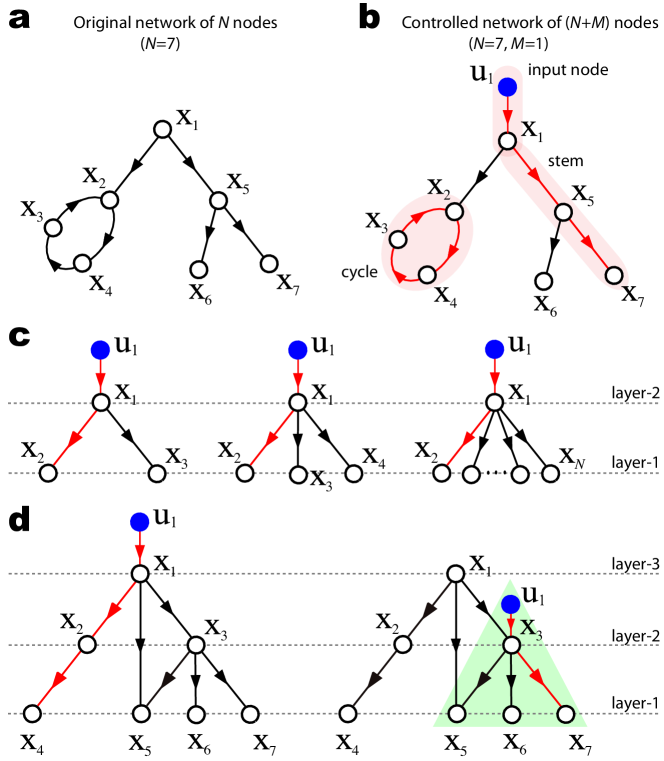
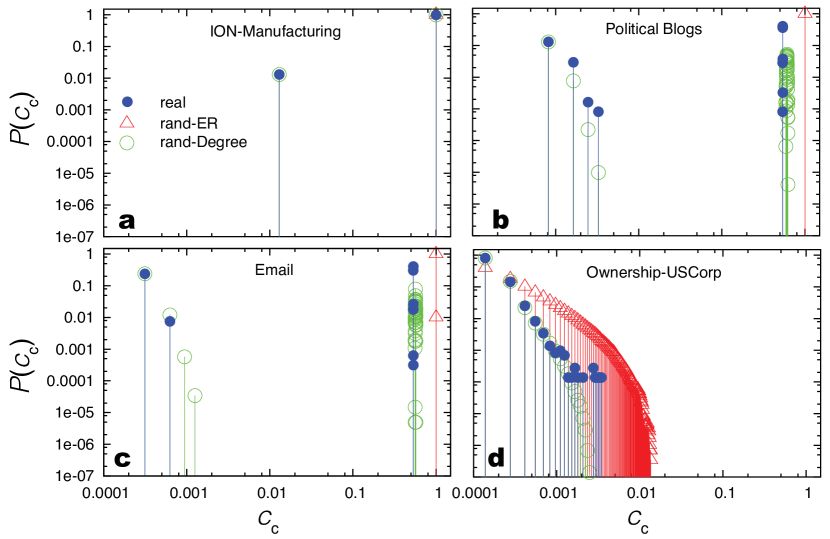
We introduce the concept of control centrality to quantify the ability of a single node to control a directed weighted network. We calculate the distribution of control centrality for several real networks and find that it is mainly determined by the network's degree distribution. We rigorously prove that in a directed network without loops the control centrality of a node is uniquely determined by its layer index or topological position in the underlying hierarchical structure of the network. Inspired by the deep relation between control centrality and hierarchical structure in a general directed network, we design an efficient attack strategy against the controllability of malicious networks.
Motivation & Objective
- To quantify the influence of individual nodes in controlling complex networks, addressing the lack of a metric for node-level controllability.
- To investigate how the hierarchical structure of directed networks determines control centrality and controllability.
- To develop and evaluate efficient attack strategies that disrupt network controllability with minimal structural knowledge.
- To compare the effectiveness of random upstream, downstream, and targeted attacks on network controllability across real and model networks.
Proposed method
- Control centrality is defined as the generic rank of the controllability matrix when only a single node is controlled, representing the dimension of the controllable subspace.
- Theoretical analysis proves that in loop-free directed networks, control centrality strictly decreases along directed edges, meaning upstream nodes have higher or equal control centrality than downstream nodes.
- An attack strategy is designed based on topological position: random upstream attacks select nodes with high in-degree in the hierarchical layer structure.
- The impact of attack strategies is measured by comparing the drop in generic rank of the controllability matrix relative to random node removal.
- The method uses structural controllability theory, assuming matrices A and B are structured (with fixed zeros and free parameters), and focuses on generic rank to ensure robustness to parameter variations.
- The approach is validated on real-world networks (e.g., protein interaction, social, and infrastructure networks) and model networks, using the difference in rank reduction (δ) as a performance metric.
Experimental results
Research questions
- RQ1How does the hierarchical structure of a directed network influence the control centrality of individual nodes?
- RQ2Can control centrality be uniquely determined by a node’s topological position in a network’s underlying hierarchy?
- RQ3How does the effectiveness of random upstream attacks compare to random and targeted attacks in degrading network controllability?
- RQ4Why do targeted attacks sometimes perform worse than random attacks in disrupting controllability?
- RQ5How does network density affect the robustness of controllability to different attack strategies?
Key findings
- Control centrality is strictly decreasing along directed edges in loop-free networks, meaning upstream nodes have higher or equal control centrality than downstream nodes.
- Random upstream attacks consistently reduce the controllable subspace more than random attacks across most real networks, with δ < 0 for 0 < P < 1, indicating higher efficiency.
- The random upstream attack strategy outperforms random downstream and targeted attacks in most networks, despite requiring only local topological knowledge.
- In very dense networks like the intra-organization network (⟨k⟩ ≈ 58), all attack strategies perform similarly because most nodes have maximal control centrality (C_c(i) = N), making the network highly robust.
- Targeted attacks do not always outperform random attacks due to overlap in controllable subspaces of high-centrality nodes, reducing their marginal impact.
- The hierarchical structure of networks is a fundamental determinant of control centrality, and this structural property enables effective, knowledge-light attack strategies.
Read this paper
Open the full text in the Nubint reader and ask about any passage as you read.
Read this paper on NubintThis review was generated by AI from the original paper. Please check the paper before citing it.