
[Paper Review] Controlling Personality Style in Dialogue with Zero-Shot Prompt-Based Learning
This paper proposes a zero-shot prompt-based method for controlling both personality style and semantic accuracy in task-oriented dialogue generation using large language models. By employing textual style transfer (TST) prompts with over-generation and metric-based ranking, it achieves 100% personality accuracy and 87.6% semantic accuracy on video game dialogue, outperforming data-to-text prompts and demonstrating strong cross-domain transferability.
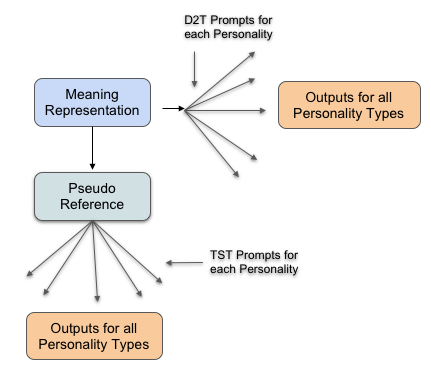
Prompt-based or in-context learning has achieved high zero-shot performance on many natural language generation (NLG) tasks. Here we explore the performance of prompt-based learning for simultaneously controlling the personality and the semantic accuracy of an NLG for task-oriented dialogue. We experiment with prompt-based learning on the PERSONAGE restaurant recommendation corpus to generate semantically and stylistically-controlled text for 5 different Big-5 personality types: agreeable, disagreeable, conscientious, unconscientious, and extravert. We test two different classes of discrete prompts to generate utterances for a particular personality style: (1) prompts that demonstrate generating directly from a meaning representation that includes a personality specification; and (2) prompts that rely on first converting the meaning representation to a textual pseudo-reference, and then using the pseudo-reference in a textual style transfer (TST) prompt. In each case, we show that we can vastly improve performance by over-generating outputs and ranking them, testing several ranking functions based on automatic metrics for semantic accuracy, personality-match, and fluency. We also test whether NLG personality demonstrations from the restaurant domain can be used with meaning representations for the video game domain to generate personality stylized utterances about video games. Our findings show that the TST prompts produces the highest semantic accuracy (78.46% for restaurants and 87.6% for video games) and personality accuracy (100% for restaurants and 97% for video games). Our results on transferring personality style to video game utterances are surprisingly good. To our knowledge, there is no previous work testing the application of prompt-based learning to simultaneously controlling both style and semantic accuracy in NLG.
Motivation & Objective
- To explore prompt-based learning for simultaneously controlling personality style and semantic accuracy in natural language generation for task-oriented dialogue.
- To compare two prompt types: direct data-to-text (D2T) prompts and textual style transfer (TST) prompts for personality stylization.
- To evaluate the impact of few-shot demonstrations, including single vs. multiple personality examples and diverse sampling strategies.
- To test zero-shot transfer of personality style from the restaurant domain to the video game domain using meaning representations.
- To assess performance using automatic metrics for fluency, semantic accuracy, and personality match, and to identify optimal ranking functions.
Proposed method
- The method uses two discrete prompt types: (1) D2T prompts that directly generate from meaning representations with embedded personality specifications, and (2) TST prompts that first convert meaning representations into pseudo-references before applying style transfer.
- For each input, the model generates multiple candidate utterances (over-generation) to increase the likelihood of high-quality outputs.
- Outputs are ranked using a weighted combination of automatic metrics: BLEURT for fluency, a personage-specific slot error rate for semantic accuracy, and a trained personality classifier for personality match.
- The best-performing setting uses TST prompts with a single personality example and diversity-aware sampling, which improves both semantic and stylistic accuracy.
- The approach is evaluated on the Personage corpus (restaurant domain) and transferred to the ViGGO corpus (video game domain) using meaning representations from the latter.
- A ranking function combining personality accuracy, semantic accuracy, and fluency is used to select the final output, with RF3 (incorporating BLEURT and slot error rate) showing significant improvement.
Experimental results
Research questions
- RQ1Can prompt-based learning simultaneously control personality style and semantic accuracy in task-oriented dialogue generation without fine-tuning?
- RQ2Which prompt type—D2T or TST—yields better performance in terms of semantic accuracy and personality match?
- RQ3How does the number and diversity of few-shot demonstrations affect the model’s ability to generalize to unseen personality styles?
- RQ4To what extent can personality stylization learned in the restaurant domain be transferred to the video game domain using meaning representations from the target domain?
- RQ5Which combination of automatic metrics produces the most effective output ranking for balancing fluency, semantic faithfulness, and personality accuracy?
Key findings
- The TST prompt approach achieved 100% personality accuracy and 87.6% semantic accuracy on the ViGGO video game dataset, significantly outperforming D2T prompts.
- On the Personage restaurant dataset, TST prompts achieved 78.46% semantic accuracy and 100% personality accuracy, demonstrating strong performance in the source domain.
- Over-generating multiple outputs and ranking them using a composite metric (RF3) led to a statistically significant improvement in semantic accuracy (p = 0) over simpler ranking functions.
- Using multiple personality examples in a single prompt degraded performance, suggesting that single-style demonstrations are more effective for zero-shot style control.
- The model successfully transferred personality styles from the restaurant domain to the video game domain, generating linguistically consistent markers of personality such as 'Hey' for agreeableness and 'Mmhm...' for extraversion, even in unseen domains.
- The performance gap between restaurant and video game domains was attributed to delexicalized names in the Personage corpus, with real-world knowledge in ViGGO likely improving semantic faithfulness.
Read this paper
Open the full text in the Nubint reader and ask about any passage as you read.
Read this paper on NubintThis review was generated by AI from the original paper. Please check the paper before citing it.