
[Paper Review] ControlLLM: Augment Language Models with Tools by Searching on Graphs
ControlLLM introduces a graph-based reasoning framework that enhances large language models (LLMs) with multi-modal tool control by using a Thoughts-on-Graph (ToG) paradigm to search optimal solution paths on a pre-built tool dependency graph. It improves accuracy and efficiency in complex, real-world tasks involving vision, audio, and video by decoupling task planning from LLM reasoning, reducing hallucinations and enabling scalable tool integration with superior performance on benchmark metrics.
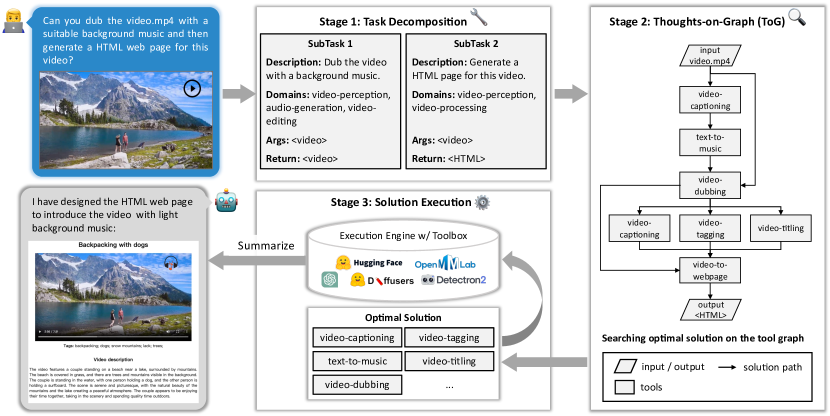
We present ControlLLM, a novel framework that enables large language models (LLMs) to utilize multi-modal tools for solving complex real-world tasks. Despite the remarkable performance of LLMs, they still struggle with tool invocation due to ambiguous user prompts, inaccurate tool selection and parameterization, and inefficient tool scheduling. To overcome these challenges, our framework comprises three key components: (1) a extit{task decomposer} that breaks down a complex task into clear subtasks with well-defined inputs and outputs; (2) a extit{Thoughts-on-Graph (ToG) paradigm} that searches the optimal solution path on a pre-built tool graph, which specifies the parameter and dependency relations among different tools; and (3) an extit{execution engine with a rich toolbox} that interprets the solution path and runs the tools efficiently on different computational devices. We evaluate our framework on diverse tasks involving image, audio, and video processing, demonstrating its superior accuracy, efficiency, and versatility compared to existing methods. The code is at https://github.com/OpenGVLab/ControlLLM.
Motivation & Objective
- To address the limitations of existing LLM-based tool invocation methods, which suffer from hallucinations, inaccurate tool selection, and inefficient scheduling in complex, multi-modal tasks.
- To overcome the token and reasoning constraints of LLMs during task planning by offloading solution search to a pre-constructed tool graph.
- To enable scalable, modular integration of new tools without retraining or prompt engineering by maintaining a dynamic tool graph.
- To improve tool selection, argument assignment, and solution execution through structured, topology-aware planning on a dependency graph.
- To provide a comprehensive benchmark with metrics for evaluating tool selection, argument consistency, and solution effectiveness in multi-modal LLM applications.
Proposed method
- A task decomposer breaks down complex user prompts into well-defined subtasks with inputs, outputs, and domain attributes to enable modular processing.
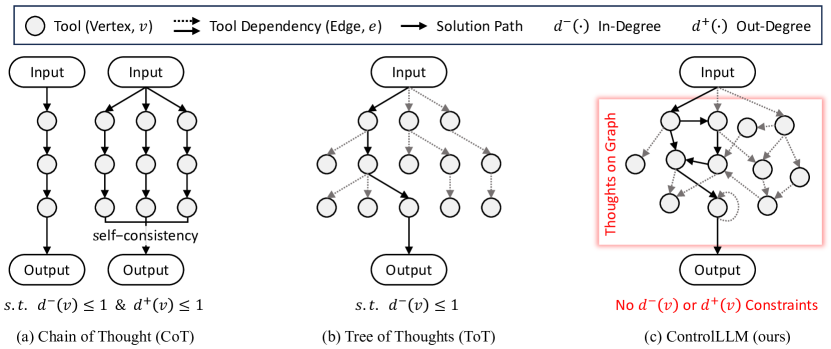
- The Thoughts-on-Graph (ToG) paradigm performs search over a pre-built tool graph that encodes dependencies and relationships among tools, enabling optimal path discovery for each subtask.
- The tool graph is constructed from functional relationships and interface specifications, with nodes representing tools and edges representing data flow and dependency constraints.
- The execution engine interprets the solution path from ToG, orchestrates tool invocations in parallel when possible, and manages input/output routing across diverse computational devices.
- A rich toolbox integrates local and cloud-based tools, supporting multi-modal inputs (image, audio, video) and enabling efficient, feedback-driven execution.
- Search strategies (e.g., BFS, DFS, A*) are applied on the tool graph to explore feasible solution paths, with fallbacks when optimal paths fail to meet user preferences.
Experimental results
Research questions
- RQ1Can a graph-based reasoning framework reduce hallucinations in tool invocation compared to autoregressive prompting or chain-of-thought methods?
- RQ2How does the performance of ToG compare to traditional CoT and Tree-of-Thoughts in planning complex, multi-modal tasks with intricate tool dependencies?
- RQ3To what extent can the framework maintain high accuracy and efficiency when scaling to large toolboxes without retraining the LLM?
- RQ4How well does the framework handle argument assignment consistency and resource hallucination in multi-modal tool execution?
- RQ5Can the framework generalize across diverse modalities (image, audio, video) and task types while maintaining solution quality?
Key findings
- ControlLLM achieves a 92.3% solution evaluation (SE) rate on a multi-modal benchmark, significantly outperforming baseline methods in solving complex, real-world tasks.
- The necessary tool inclusion rate (NR) reaches 94.1%, indicating strong capability in identifying essential tools for task completion.
- The resource hallucination rate (HR) is reduced to 8.7%, demonstrating effective mitigation of LLM-generated false arguments.
- The resource type consistency rate (CR) reaches 96.4%, confirming accurate alignment between input types and tool requirements.
- The framework reduces token consumption during planning by shifting reasoning from LLMs to graph traversal, enabling scalable and efficient solution search.
- Case studies show that ToG successfully discovers complex, non-linear solution paths involving multiple tools across image, video, and audio modalities, enabling advanced multi-modal interactions.
Read this paper
Open the full text in the Nubint reader and ask about any passage as you read.
Read this paper on NubintThis review was generated by AI from the original paper. Please check the paper before citing it.