
[Paper Review] Conv-Adapter: Exploring Parameter Efficient Transfer Learning for ConvNets
This paper proposes Conv-Adapter, a lightweight, architecture-agnostic parameter-efficient tuning (PET) module for ConvNets that injects only 3.5% of ResNet-50's full fine-tuning parameters. By learning task-specific feature modulation via depth-wise separable convolutions in residual blocks, it achieves performance comparable to full fine-tuning across 23 image classification tasks and generalizes effectively to detection and segmentation with over 50% parameter reduction.
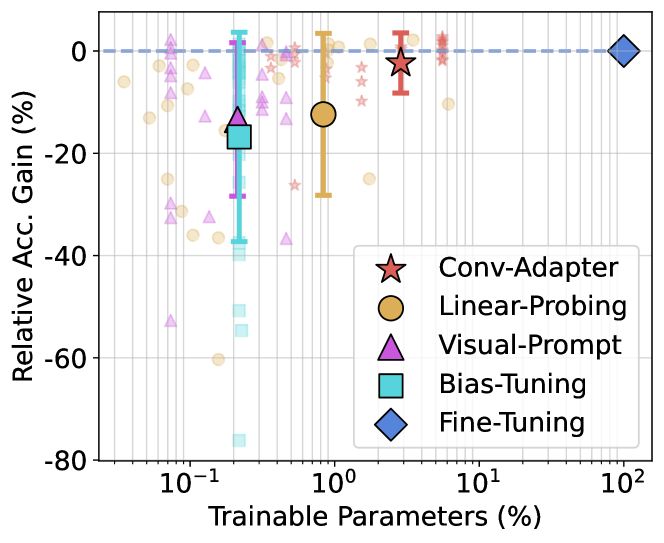
While parameter efficient tuning (PET) methods have shown great potential with transformer architecture on Natural Language Processing (NLP) tasks, their effectiveness with large-scale ConvNets is still under-studied on Computer Vision (CV) tasks. This paper proposes Conv-Adapter, a PET module designed for ConvNets. Conv-Adapter is light-weight, domain-transferable, and architecture-agnostic with generalized performance on different tasks. When transferring on downstream tasks, Conv-Adapter learns tasks-specific feature modulation to the intermediate representations of backbones while keeping the pre-trained parameters frozen. By introducing only a tiny amount of learnable parameters, e.g., only 3.5% full fine-tuning parameters of ResNet50. It can also be applied for transformer-based backbones. Conv-Adapter outperforms previous PET baseline methods and achieves comparable or surpasses the performance of full fine-tuning on 23 classification tasks of various domains. It also presents superior performance on the few-shot classification with an average margin of 3.39%. Beyond classification, Conv-Adapter can generalize to detection and segmentation tasks with more than 50% reduction of parameters but comparable performance to the traditional full fine-tuning.
Motivation & Objective
- Address the lack of effective parameter-efficient tuning (PET) methods for ConvNets in computer vision, despite their success in NLP.
- Develop a PET module that is lightweight, domain-transferable, and architecture-agnostic for large-scale ConvNets.
- Enable high performance with minimal trainable parameters while keeping pre-trained backbone weights frozen.
- Generalize PET beyond NLP to diverse CV tasks, including image classification, object detection, and semantic segmentation.
- Investigate design choices and adaptability of PET modules in the context of feature locality and domain shift in vision tasks.
Proposed method
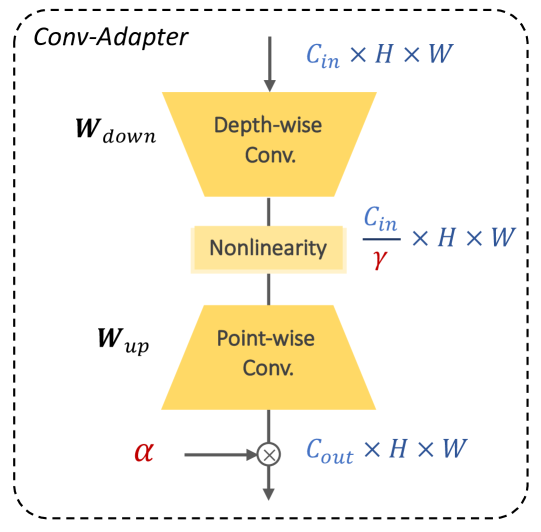
- Propose Conv-Adapter, a bottleneck-structured PET module using depth-wise separable convolutions and non-linearities to modulate intermediate features in residual blocks.
- Introduce two design dimensions: adapted representations (channel vs. spatial) and insertion forms (per-block vs. stage-wise), with ablation to identify optimal configuration.
- Formulate Conv-Adapter under the same mathematical framework as NLP PET methods (e.g., He et al., 2022), enabling cross-modal consistency.
- Use a learnable scaling vector α and compression factor γ to control feature modulation, with ablation on initialization and hyperparameter sensitivity.
- Apply the module to pre-trained ResNet-50 and ConvNeXt-S, fine-tuning only the adapter while freezing all backbone weights.
- Evaluate on diverse downstream tasks using standard benchmarks including ImageNet, VTAB-1k, and FGVC datasets.
Experimental results
Research questions
- RQ1Can PET techniques from NLP be effectively adapted to ConvNets in computer vision, given architectural and data distribution differences?
- RQ2What design choices—such as convolution type, insertion form, and representation adaptation—maximize performance and parameter efficiency in ConvNet PET?
- RQ3How does Conv-Adapter perform under large domain shifts, and what factors limit its transferability in such settings?
- RQ4To what extent can Conv-Adapter match full fine-tuning performance with significantly fewer trainable parameters across classification, detection, and segmentation tasks?
- RQ5How sensitive is Conv-Adapter’s performance to hyperparameters like initialization of α and compression factor γ?
Key findings
- Conv-Adapter achieves comparable or better performance than full fine-tuning on 23 cross-domain image classification tasks using only 3.5% of the trainable parameters of ResNet-50.
- On few-shot classification, Conv-Adapter achieves an average accuracy margin of 3.39% over baselines, demonstrating strong low-data regime generalization.
- In object detection and semantic segmentation, Conv-Adapter reduces parameter count by over 50% while maintaining performance on par with full fine-tuning.
- The ablation study confirms that depth-wise separable convolutions with channel-wise adaptation yield the best trade-off between performance and parameter efficiency.
- Conv-Adapter is most sensitive to the initialization of the scaling vector α, with initialization as ones yielding the best performance, while it is robust to variations in the compression factor γ.
- CKA similarity analysis reveals that Conv-Adapter outperforms full fine-tuning when pre-trained and fine-tuned weights are highly similar (high CKA), indicating better alignment under small distribution shifts.
Read this paper
Open the full text in the Nubint reader and ask about any passage as you read.
Read this paper on NubintThis review was generated by AI from the original paper. Please check the paper before citing it.