
[Paper Review] Convex Clustering: Model, Theoretical Guarantee and Efficient Algorithm
This paper proposes a semismooth Newton-based augmented Lagrangian method (Ssnal) for large-scale convex clustering with theoretical recovery guarantees. It establishes sufficient conditions for perfect recovery in the general weighted convex clustering model and demonstrates superior efficiency and scalability, solving a 200,000-point problem in ℝ³ in ~6 minutes—significantly outperforming first-order methods like AMA and ADMM.
Clustering is a fundamental problem in unsupervised learning. Popular methods like K-means, may suffer from poor performance as they are prone to get stuck in its local minima. Recently, the sum-of-norms (SON) model (also known as the clustering path) has been proposed in Pelckmans et al. (2005), Lindsten et al. (2011) and Hocking et al. (2011). The perfect recovery properties of the convex clustering model with uniformly weighted all pairwise-differences regularization have been proved by Zhu et al. (2014) and Panahi et al. (2017). However, no theoretical guarantee has been established for the general weighted convex clustering model, where better empirical results have been observed. In the numerical optimization aspect, although algorithms like the alternating direction method of multipliers (ADMM) and the alternating minimization algorithm (AMA) have been proposed to solve the convex clustering model (Chi and Lange, 2015), it still remains very challenging to solve large-scale problems. In this paper, we establish sufficient conditions for the perfect recovery guarantee of the general weighted convex clustering model, which include and improve existing theoretical results as special cases. In addition, we develop a semismooth Newton based augmented Lagrangian method for solving large-scale convex clustering problems. Extensive numerical experiments on both simulated and real data demonstrate that our algorithm is highly efficient and robust for solving large-scale problems. Moreover, the numerical results also show the superior performance and scalability of our algorithm comparing to the existing first-order methods. In particular, our algorithm is able to solve a convex clustering problem with 200,000 points in $\mathbb{R}^3$ in about 6 minutes.
Motivation & Objective
- To establish theoretical conditions for perfect recovery in the general weighted convex clustering model, extending prior results that only covered uniform weighting.
- To develop an efficient and scalable optimization algorithm for solving large-scale convex clustering problems.
- To overcome the limitations of first-order methods like AMA and ADMM, which suffer from slow convergence and high computational cost on large datasets.
- To provide a robust and stable algorithm across varying regularization parameters (γ), ensuring consistent performance in generating clustering paths.
- To enable practical deployment of convex clustering on real-world datasets with tens of thousands to hundreds of thousands of points.
Proposed method
- Proposes a semismooth Newton-based augmented Lagrangian method (Ssnal) that leverages second-order generalized Hessian information for faster convergence.
- Uses a sparse neighborhood graph (k-nearest neighbors) to define the weight set 𝒪, reducing computational cost by limiting non-zero weights to nearby pairs.
- Employs the conjugate gradient (CG) method within the semismooth Newton framework to efficiently solve the Newton system, with complexity O(d|𝒪| + d|𝒪̂|) per iteration.
- Applies an adaptive line search and exact step length rule to ensure global convergence and robustness.
- Integrates the augmented Lagrangian framework with semismooth Newton methods to solve the dual problem of the convex clustering model.
- Uses a warm-start strategy for solving the clustering path across multiple γ values, improving efficiency.
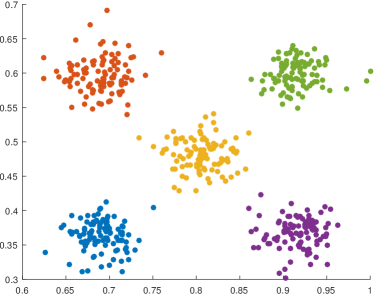
Experimental results
Research questions
- RQ1What are the sufficient conditions for perfect recovery in the general weighted convex clustering model, and how do they generalize prior results?
- RQ2Can a second-order method like semismooth Newton significantly improve the efficiency of solving large-scale convex clustering problems compared to first-order methods?
- RQ3How does the performance of the proposed algorithm (Ssnal) scale with respect to data size (n) and neighborhood size (k)?
- RQ4How stable is the algorithm across different values of the regularization parameter γ, especially in generating clustering paths?
- RQ5Can the algorithm handle real-world datasets with high dimensionality and large sample sizes efficiently?
Key findings
- The proposed Ssnal algorithm solves a 200,000-point problem in ℝ³ in approximately 6 minutes, demonstrating strong scalability.
- On the MNIST dataset with n=10,000, Ssnal completes in 69.3 seconds, while AMA fails to converge within 100,000 iterations.
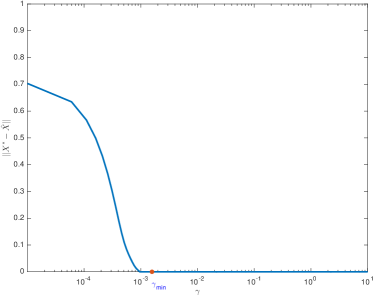
- Ssnal is significantly more stable than AMA across different γ values, with consistent performance across the clustering path.
- Computation time grows almost linearly with both n and k, confirming the algorithm’s scalability for large-scale problems.
- Ssnal outperforms AMA and ADMM in both speed and robustness, especially on large datasets and high-dimensional data.
- Theoretical recovery guarantees are established for the general weighted convex clustering model, extending prior results that only applied to uniform weights.
Read this paper
Open the full text in the Nubint reader and ask about any passage as you read.
Read this paper on NubintThis review was generated by AI from the original paper. Please check the paper before citing it.