
[Paper Review] Convolutional Recurrent Neural Networks for Music Classification
This paper proposes a Convolutional Recurrent Neural Network (CRNN) for music tagging, combining 2D convolutional layers for local feature extraction with a bidirectional GRU for temporal summarization. The CRNN outperforms standard CNNs like k2c2 and k1c2 in performance-to-parameter and training-time efficiency, especially with limited parameters, demonstrating the effectiveness of RNNs in capturing global structural dependencies in music data.
We introduce a convolutional recurrent neural network (CRNN) for music tagging. CRNNs take advantage of convolutional neural networks (CNNs) for local feature extraction and recurrent neural networks for temporal summarisation of the extracted features. We compare CRNN with three CNN structures that have been used for music tagging while controlling the number of parameters with respect to their performance and training time per sample. Overall, we found that CRNNs show a strong performance with respect to the number of parameter and training time, indicating the effectiveness of its hybrid structure in music feature extraction and feature summarisation.
Motivation & Objective
- To develop a hybrid deep learning model that effectively combines local feature extraction and global temporal modeling for music tagging.
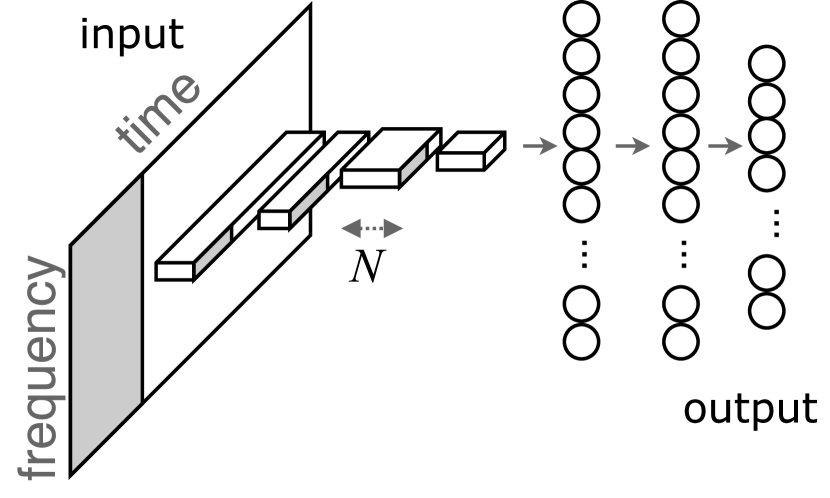
- To compare CRNNs with established CNN architectures (k1c2, k2c1, k2c2) under controlled conditions of parameters and computation time.
- To evaluate the trade-off between model performance, parameter count, and training speed in music tagging tasks.
- To investigate whether CRNNs can better capture global structural patterns in music, such as mood or genre, compared to static CNN-based approaches.
Proposed method
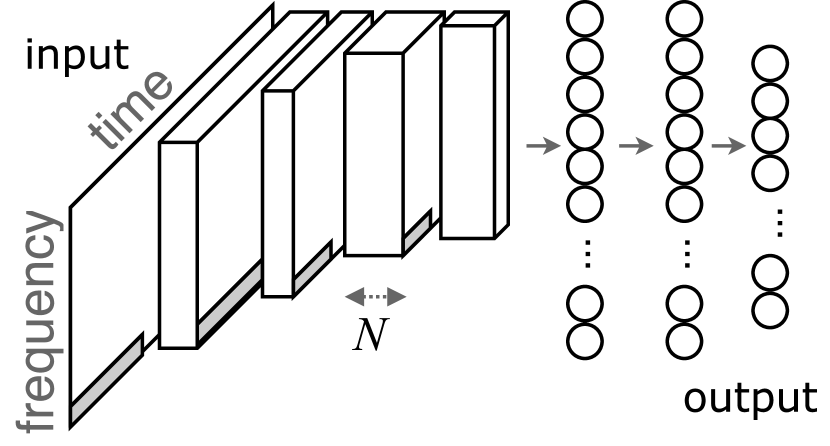
- The CRNN uses a 4-layer 2D convolutional neural network (with 3×3 kernels and (2×2), (3×3), (4×4), (4×4) max-pooling) for local feature extraction from mel-spectrograms (96×1366).
- A 2-layer gated recurrent unit (GRU) network is stacked on top of the CNN to summarize temporal patterns across time, replacing global pooling or fully connected layers.
- All models use batch normalization and ELU activation functions for consistent optimization; CRNN uses weak dropout (0.1) only between convolutional layers to prevent RNN overfitting.
- The input is a single-channel mel-spectrogram representation, and sigmoid activation is used at the output for multi-label classification.
- Performance is evaluated using AUC scores across 50 tags, categorized into genres, moods, instruments, and eras.
- Experiments control for hardware, data, and optimization techniques, varying only model structure and parameter count to ensure fair comparison.
Experimental results
Research questions
- RQ1Does the CRNN architecture achieve better music tagging performance than standard CNNs with the same number of parameters?
- RQ2How does the CRNN compare to CNNs (k1c2, k2c1, k2c2) in terms of training time and parameter efficiency?
- RQ3Can the RNN component in CRNN better model global structural dependencies in music compared to CNN-based pooling or fully connected layers?
- RQ4Is there a performance trade-off between model size, training speed, and accuracy in music tagging?
- RQ5Does tag popularity correlate with model performance, indicating shared or task-specific feature learning?
Key findings
- CRNNs achieve state-of-the-art performance with fewer parameters and lower training time compared to k2c2, especially when parameter count is limited.
- Even with only 0.1M parameters, CRNN outperforms k2c2 with 0.25M parameters, indicating superior parameter efficiency.
- k2c2 consistently outperforms k1c2 and k2c1 across all parameter settings, demonstrating the effectiveness of 2D convolutions in capturing local time-frequency patterns.
- The CRNN achieves higher AUC than k2c1 on 44 out of 50 tags, and k2c1 outperforms k1c2 on 48 out of 50 tags, showing the superiority of 2D and hierarchical feature learning.
- There is no significant correlation (Spearman ρ = 0.077) between tag popularity and AUC ranking, indicating that models learn generalizable, shared features across tags.
- Training speed ranking is k2c1 > k2c2 > k1c2 > CRNN, with CRNN being the slowest due to deeper architecture and recurrent computation, despite better performance per parameter.
Read this paper
Open the full text in the Nubint reader and ask about any passage as you read.
Read this paper on NubintThis review was generated by AI from the original paper. Please check the paper before citing it.