
[Paper Review] CosyVoice: A Scalable Multilingual Zero-shot Text-to-speech Synthesizer based on Supervised Semantic Tokens
CosyVoice proposes a scalable, multilingual zero-shot text-to-speech synthesizer using supervised semantic tokens derived from a multilingual ASR model (Whisper) with vector quantization, enabling improved content consistency and speaker similarity. It combines a large language model for text-to-token generation and a conditional flow matching vocoder, achieving human-parity speech quality with strong zero-shot voice cloning and emotion control capabilities.
Recent years have witnessed a trend that large language model (LLM) based text-to-speech (TTS) emerges into the mainstream due to their high naturalness and zero-shot capacity. In this paradigm, speech signals are discretized into token sequences, which are modeled by an LLM with text as prompts and reconstructed by a token-based vocoder to waveforms. Obviously, speech tokens play a critical role in LLM-based TTS models. Current speech tokens are learned in an unsupervised manner, which lacks explicit semantic information and alignment to the text. In this paper, we propose to represent speech with supervised semantic tokens, which are derived from a multilingual speech recognition model by inserting vector quantization into the encoder. Based on the tokens, we further propose a scalable zero-shot TTS synthesizer, CosyVoice, which consists of an LLM for text-to-token generation and a conditional flow matching model for token-to-speech synthesis. Experimental results show that supervised semantic tokens significantly outperform existing unsupervised tokens in terms of content consistency and speaker similarity for zero-shot voice cloning. Moreover, we find that utilizing large-scale data further improves the synthesis performance, indicating the scalable capacity of CosyVoice. To the best of our knowledge, this is the first attempt to involve supervised speech tokens into TTS models.
Motivation & Objective
- To address the lack of semantic alignment and explicit content representation in unsupervised speech tokens used in LLM-based TTS systems.
- To improve zero-shot voice cloning performance by introducing speech tokens with explicit semantic supervision from a multilingual ASR model.
- To develop a scalable, end-to-end TTS system that supports multilingual, zero-shot, and instruction-guided speech generation without requiring phonemizers or forced aligners.
- To evaluate the effectiveness of supervised semantic tokens in enhancing content consistency, speaker similarity, and emotion controllability in TTS.
- To demonstrate that scaling model size and training data further improves synthesis quality, confirming the system's scalability.
Proposed method
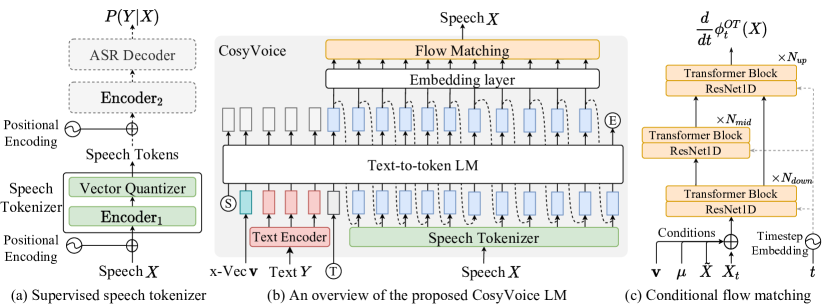
- The proposed $σ^3$ tokenizer uses vector quantization inserted into the encoder of a multilingual ASR model (Whisper) to generate supervised semantic tokens with explicit alignment to text.
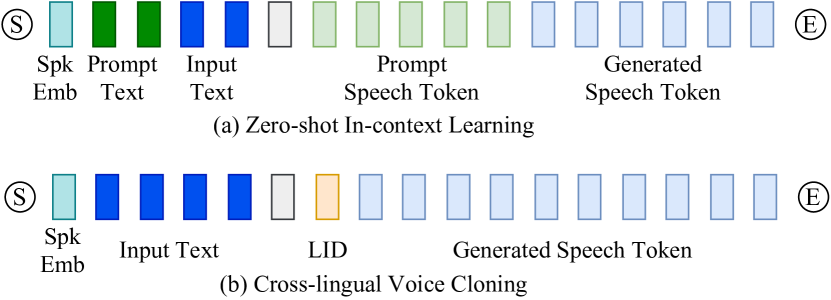
- CosyVoice employs a large language model (LLM) to generate semantic token sequences from text prompts, enabling zero-shot and instruction-based generation.
- A conditional flow matching model synthesizes raw waveforms from the token sequences, conditioned on speaker embeddings, masked speech features, and intermediate states for improved autoregressive generation.
- The flow matching model uses classifier-free guidance, a cosine scheduler, and masked conditions to enhance training stability and generation quality.
- The LLM is augmented with x-vector embeddings to disentangle semantic content, prosody, and speaker identity, improving modeling efficiency and control.
- The system is trained and evaluated on LibriSpeech and MLS datasets, with data augmentation via synthetic data generation to improve robustness.
Experimental results
Research questions
- RQ1Can supervised semantic tokens derived from a multilingual ASR model improve content consistency and speaker similarity in zero-shot TTS?
- RQ2Does replacing unsupervised speech tokens with supervised semantic tokens lead to measurable gains in zero-shot voice cloning performance?
- RQ3Can a flow matching-based vocoder replace diffusion models in TTS while maintaining high quality and enabling faster inference?
- RQ4To what extent does instruction tuning improve emotion control and prosody alignment in TTS generation?
- RQ5Can CosyVoice serve as a high-quality data generator for downstream tasks like ASR, and how does data diversity affect performance?
Key findings
- Supervised semantic tokens significantly outperform unsupervised tokens in content consistency and speaker similarity for zero-shot voice cloning, with a 0.87 speaker similarity score on LibriSpeech test sets.
- CosyVoice-instruct achieves 93% speaker similarity and 87% emotion control accuracy, demonstrating strong performance in instruction-guided and emotion-controllable speech synthesis.
- The system achieves a word error rate (WER) of 1.84% on LibriSpeech test sets after ASR re-ranking, indicating near-human-level generation quality.
- Synthesizing data from CosyVoice improves ASR recognition accuracy, with a 1.93% WER on LibriSpeech test set when using synthesized data from MLS text, showing high data quality and linguistic diversity.
- Scaling training data (e.g., using LibriSpeech + MLS + synthetic data) reduces WER from 2.77% to 1.93%, confirming the scalability of CosyVoice with larger data volumes.
- CosyVoice exhibits fewer insertion and deletion errors than ChatTTS in Chinese generation, indicating reduced speaker leakage and better content fidelity.
Read this paper
Open the full text in the Nubint reader and ask about any passage as you read.
Read this paper on NubintThis review was generated by AI from the original paper. Please check the paper before citing it.