
[Paper Review] Could an Artificial-Intelligence agent pass an introductory physics course?
This study evaluates whether ChatGPT, a large language model, can pass a standard introductory calculus-based physics course by solving representative assessments—homework, exams, and programming tasks—using real course materials from Michigan State University. Despite generating plausible explanations, ChatGPT narrowly passes with a 1.5 grade (on a 4.0 scale), revealing persistent misconceptions, calculation errors, and lack of metacognition, highlighting the need for physics education to emphasize critical thinking over rote problem-solving.
Massive pre-trained language models have garnered attention and controversy due to their ability to generate human-like responses: attention due to their frequent indistinguishability from human-generated phraseology and narratives, and controversy due to the fact that their convincingly presented arguments and facts are frequently simply false. Just how human-like are these responses when it comes to dialogues about physics, in particular about the standard content of introductory physics courses? This study explores that question by having ChatGTP, the pre-eminent language model in 2023, work through representative assessment content of an actual calculus-based physics course and grading the responses in the same way human responses would be graded. As it turns out, ChatGPT would narrowly pass this course while exhibiting many of the preconceptions and errors of a beginning learner.
Motivation & Objective
- To assess whether a state-of-the-art language model like ChatGPT can successfully complete and pass a standard introductory calculus-based physics course.
- To evaluate the quality and accuracy of ChatGPT’s responses in comparison to human students, particularly in conceptual understanding, problem-solving strategies, and calculation accuracy.
- To investigate whether AI-generated responses exhibit the same misconceptions and errors as novice physics learners, especially in reasoning and numerical computation.
- To examine the implications of AI’s performance for physics education, particularly regarding assessment design, academic integrity, and the development of expert-like epistemological skills.
- To determine whether AI tools like ChatGPT undermine or reshape the goals of physics education, especially in fostering critical evaluation and metacognition.
Proposed method
- ChatGPT was prompted with actual assessment items from a first-semester calculus-based physics course at Michigan State University, including homework, clicker questions, exams, and programming exercises.
- Responses were graded using the same rubrics applied to human student work, with attention to conceptual reasoning, mathematical execution, and use of units.
- The study used the January 9, 2023 release of ChatGPT, ensuring consistency and reproducibility of results across assessments.
- Assessment components were drawn from LON-CAPA, a platform that randomizes problem parameters, preventing simple pattern matching.
- ChatGPT’s responses were analyzed for consistency with expert problem-solving strategies, such as dimensional analysis, limiting cases, and coherence checks.
- The evaluation compared AI responses to typical novice student errors, including path dependence misunderstandings, unit omissions, and cumulative rounding errors.
Experimental results
Research questions
- RQ1Can a large language model like ChatGPT successfully solve and pass a standard introductory calculus-based physics course when assessed using real course materials?
- RQ2To what extent do ChatGPT’s responses reflect the misconceptions and errors typical of beginning physics students?
- RQ3How does ChatGPT’s performance compare to human students in terms of conceptual reasoning, calculation accuracy, and use of problem-solving strategies?
- RQ4What are the implications of an AI model passing a physics course for educational assessment, academic integrity, and curriculum design?
- RQ5In what ways does ChatGPT lack metacognition, and how does this affect the reliability and critical evaluation of its responses?
Key findings
- ChatGPT achieved a final course grade of 1.5 on a 4.0 scale, narrowly passing the introductory physics course series.
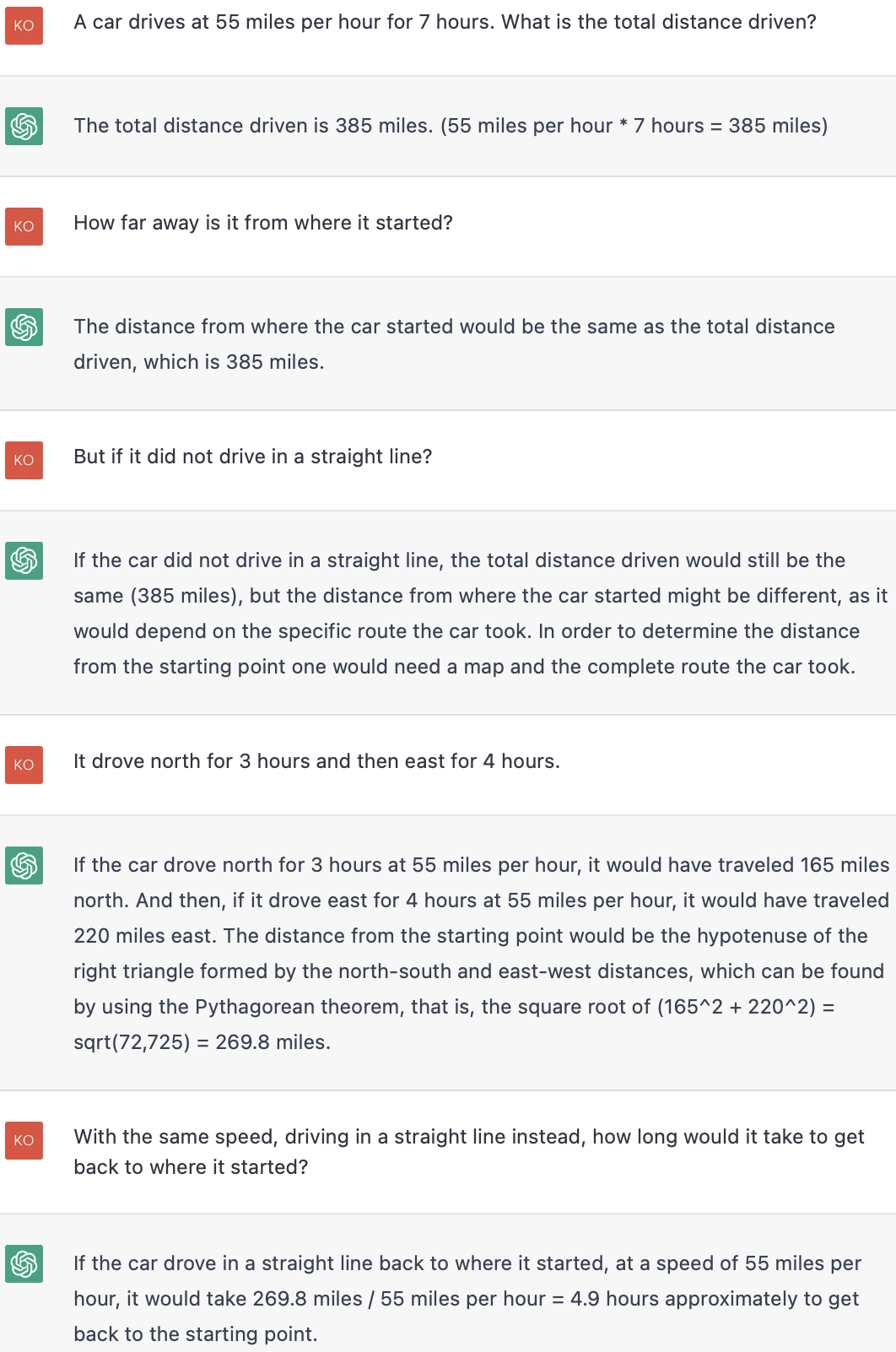
- The model exhibited common novice errors, such as failing to account for direction changes in displacement problems and incorrectly carrying forward rounding errors in multi-step calculations.
- ChatGPT frequently omitted units in its responses and failed to recognize that certain variables (e.g., speed) cancel out in return-time problems, instead relying on numerical plug-and-chug.
- Despite its ability to generate plausible-sounding explanations, ChatGPT presented incorrect or misleading information with the same confidence as correct answers, indicating a lack of metacognition.
- The model performed relatively well on computational exercises due to its training in programming languages, suggesting that AI may already be outpacing human students in coding-based physics tasks.
- The study concludes that while ChatGPT can pass standard assessments, it does so through patterned reasoning rather than deep conceptual understanding, underscoring the need to prioritize critical thinking in physics education.
Read this paper
Open the full text in the Nubint reader and ask about any passage as you read.
Read this paper on NubintThis review was generated by AI from the original paper. Please check the paper before citing it.