
[Paper Review] Covert Communications with Constrained Age of Information
This paper introduces a novel framework for covert communications that jointly optimizes covertness and information freshness by constraining the average age of information (AoI). By modeling the information signal's transmit probability as a design variable, the authors show that optimal covertness does not require equal prior probabilities (i.e., transmit probability ≠ 0.5), and that a minimum transmit power is required for non-zero covertness under AoI constraints.
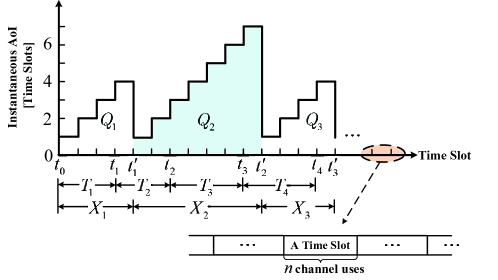
In this letter, we consider the requirement of information freshness in covert communications for the first time. With artificial noise (AN) generated from a full-duplex (FD) receiver, we formulate a covertness maximization problem under the average age of information (AoI) constraint to optimize the transmit probability of information signal. In particular, the transmit probability not only represents the generation rate of information signal but also represents the prior probability of the alternative hypothesis in covert communications, which builds up a bridge between information freshness and communication covertness. Our analysis shows that the best transmit probability is not always 0.5, which differs from the equal prior probabilities assumption in most related works on covert communications. Furthermore, the limitation of average AoI enlarges the transmit probability at the cost of the covertness reduction and leads to a positive lower bound on the information transmit power for non-zero covertness.
Motivation & Objective
- To address the lack of information freshness considerations in existing covert communication models.
- To model and optimize covertness under a constraint on average age of information (AoI).
- To analyze the trade-off between communication covertness and information freshness in a full-duplex system with artificial noise.
- To determine the optimal transmit probability of information signals that maximizes covertness while satisfying a required average AoI.
Proposed method
- Formulate a covertness maximization problem under an average AoI constraint using a randomized transmission policy.
- Model the system in block Rayleigh fading channels with a full-duplex receiver transmitting artificial noise (AN) to confuse the warden.
- Derive closed-form expressions for average AoI and the warden’s expected detection error probability.
- Optimize the transmit probability to maximize detection error probability (i.e., minimize warden’s ability to detect transmission) subject to a given average service time constraint.
- Use interference cancellation techniques at the full-duplex receiver to suppress self-interference from AN transmission.
- Analyze three cases of detection threshold τ to derive the optimal threshold and corresponding detection error probability.
Experimental results
Research questions
- RQ1What is the optimal transmit probability for information signals that maximizes covertness under an average AoI constraint?
- RQ2How does the constraint on average AoI affect the required transmit power for achieving non-zero covertness?
- RQ3Does the optimal transmit probability remain 0.5 when information freshness is considered, as assumed in prior works?
- RQ4How does the warden’s detection performance vary with different transmit probabilities and channel conditions?
- RQ5What is the impact of artificial noise from a full-duplex receiver on the trade-off between covertness and information freshness?
Key findings
- The optimal transmit probability is not always 0.5; it can exceed 0.5 due to the constraint on average AoI, contradicting the equal prior probabilities assumption in prior work.
- The average AoI constraint forces the transmitter to increase the transmit probability, which reduces covertness but ensures information freshness.
- A positive lower bound on the information transmit power is required to achieve non-zero covertness when the average AoI is constrained.
- The warden’s detection error probability depends on the transmit probability and the channel gains, with optimal detection threshold selection critical for maximizing covertness.
- The detection error probability expression is derived in three distinct cases based on the detection threshold τ, with the optimal τ being either the lower or upper bound depending on channel gain.

Read this paper
Open the full text in the Nubint reader and ask about any passage as you read.
Read this paper on NubintThis review was generated by AI from the original paper. Please check the paper before citing it.