
[Paper Review] Covert Transmission Assisted by Intelligent Reflecting Surface
This paper investigates covert communication in an intelligent reflecting surface (IRS)-assisted system, where Alice transmits to Bob without detection by warden Willie. It proposes joint optimization of Alice's transmit power and IRS phase shifts to maximize covert rate under perfect or imperfect CSI, revealing that IRS can degrade performance if Willie is closer to the IRS than Bob.
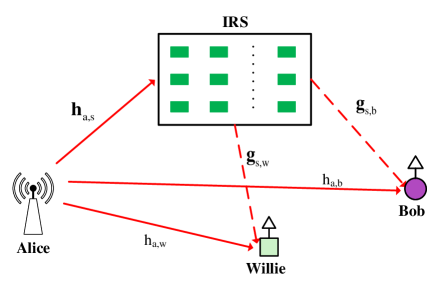
Covert transmission is studied for an intelligent reflecting surface (IRS) aided communication system, where Alice aims to transmit messages to Bob without being detected by the warden Willie. Specifically, an IRS is used to increase the data rate at Bob under a covert constraint. For the considered model, when Alice is equipped with a single antenna, the transmission power at Alice and phase shifts at the IRS are jointly optimized to maximize the covert transmission rate with either instantaneous or partial channel state information (CSI) of Willie's link. In addition, when multiple antennas are deployed at Alice, we formulate a joint transmit beamforming and IRS phase shift optimization problem to maximize the covert transmission rate. One optimal algorithm and two low-complexity suboptimal algorithms are proposed to solve the problem. Furthermore, for the case of imperfect CSI of Willie's link, the optimization problem is reformulated by using the triangle and the Cauchy-Schwarz inequalities. The reformulated optimization problems are solved using an alterative algorithm, semidefinite relaxation (SDR) and Gaussian randomization techniques. Finally, simulations are performed to verify our analysis. The simulation results show that an IRS can degrade the covert transmission rate when Willie is closer to the IRS than Bob.
Motivation & Objective
- To enable covert communication in IRS-aided systems where Alice transmits to Bob without detection by Willie.
- To address the challenge of maximizing covert transmission rate under a covertness constraint at Willie.
- To optimize IRS phase shifts and Alice's transmit power jointly, considering both perfect and imperfect CSI of Willie's channel.
- To extend the framework to multi-antenna Alice systems with joint beamforming and IRS phase shift optimization.
- To analyze the impact of imperfect CSI on covert rate and propose robust optimization techniques.
Proposed method
- Formulates a covert transmission rate maximization problem under a covertness constraint using energy detection at Willie.
- Proposes an alternative optimization algorithm, semidefinite relaxation (SDR), and Gaussian randomization to solve the non-convex problem with imperfect CSI.
- Applies triangle and Cauchy-Schwarz inequalities to reformulate the optimization problem under imperfect CSI conditions.
- Uses complex Gaussian approximation for the aggregate interference at Willie based on central limit theorem for large IRS elements.
- Derives the PDF of the received signal power at Willie as exponential, enabling detection probability analysis.
- Considers both single-antenna and multi-antenna Alice configurations, with beamforming and phase shift jointly optimized.
Experimental results
Research questions
- RQ1How does IRS deployment affect the covert transmission rate in a system where Willie performs energy detection?
- RQ2Under what conditions does IRS improve or degrade covert performance?
- RQ3How does imperfect CSI of Willie’s channel impact the achievable covert rate?
- RQ4What is the optimal joint design of transmit power and IRS phase shifts to maximize covert rate?
- RQ5Can the proposed algorithms handle multiple wardens or multi-antenna Alice configurations?
Key findings
- IRS does not always improve covert transmission; performance degrades when Willie is closer to the IRS than Bob.
- Imperfect CSI of Willie’s link reduces the covert transmission rate, with the most severe impact from uncertainty in the Alice-to-Willie link.
- The IRS-induced interference at Willie increases with the number of reflecting elements, limiting the benefit of beamforming.
- The proposed optimization framework achieves higher covert rates than baseline schemes under both perfect and imperfect CSI.
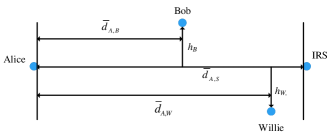
- Simulation results confirm that the covert rate decreases with increasing vertical distance between Bob and the IRS plane.
- The exponential distribution of Willie’s received signal power enables accurate detection probability modeling under the proposed channel model.
Read this paper
Open the full text in the Nubint reader and ask about any passage as you read.
Read this paper on NubintThis review was generated by AI from the original paper. Please check the paper before citing it.