
[Paper Review] Crafting Better Contrastive Views for Siamese Representation Learning
This paper proposes ContrastiveCrop, a plug-and-play module that improves Siamese contrastive representation learning by generating semantically meaningful and diverse image crops. It uses semantic-aware object localization to avoid false positives (object vs. background) and center-suppressed sampling to increase crop variance, achieving 0.4%–2.0% accuracy gains across CIFAR-10, CIFAR-100, Tiny ImageNet, and STL-10, with consistent gains on ImageNet-1K pre-training for downstream detection and segmentation tasks.
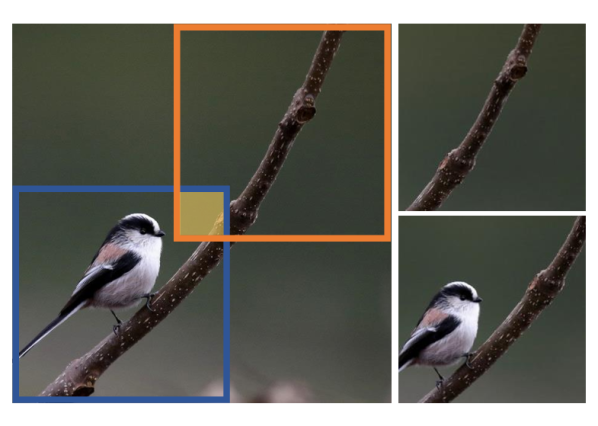
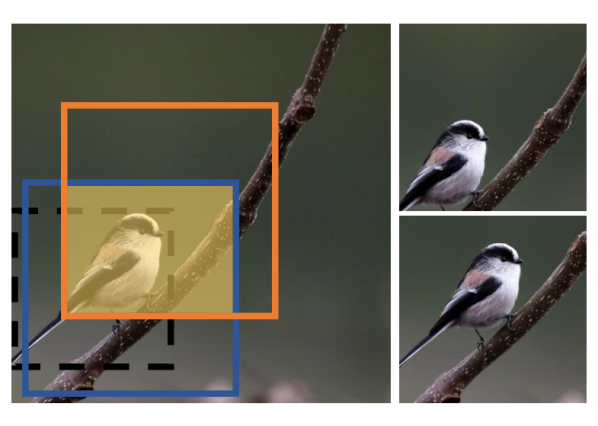
Recent self-supervised contrastive learning methods greatly benefit from the Siamese structure that aims at minimizing distances between positive pairs. For high performance Siamese representation learning, one of the keys is to design good contrastive pairs. Most previous works simply apply random sampling to make different crops of the same image, which overlooks the semantic information that may degrade the quality of views. In this work, we propose ContrastiveCrop, which could effectively generate better crops for Siamese representation learning. Firstly, a semantic-aware object localization strategy is proposed within the training process in a fully unsupervised manner. This guides us to generate contrastive views which could avoid most false positives (i.e., object vs. background). Moreover, we empirically find that views with similar appearances are trivial for the Siamese model training. Thus, a center-suppressed sampling is further designed to enlarge the variance of crops. Remarkably, our method takes a careful consideration of positive pairs for contrastive learning with negligible extra training overhead. As a plug-and-play and framework-agnostic module, ContrastiveCrop consistently improves SimCLR, MoCo, BYOL, SimSiam by 0.4% ~ 2.0% classification accuracy on CIFAR-10, CIFAR-100, Tiny ImageNet and STL-10. Superior results are also achieved on downstream detection and segmentation tasks when pre-trained on ImageNet-1K.
Motivation & Objective
- To address the limitations of random cropping in contrastive learning, which often produces false positives (e.g., object vs. background) and trivial, highly similar views.
- To improve the quality of positive pairs in Siamese representation learning by incorporating semantic content and diversity into crop sampling.
- To design a framework-agnostic, low-overhead module that enhances existing contrastive methods without architectural changes.
- To empirically validate that better crop design leads to more discriminative representations across multiple datasets and downstream tasks.
Proposed method
- Introduces a semantic-aware object localization strategy trained in a fully unsupervised manner during contrastive learning to guide crop sampling within object regions.
- Applies center-suppressed sampling using a beta distribution with α < 1 to reduce the likelihood of selecting central, highly similar crops.
- Combines semantic localization and variance-aware sampling to generate contrastive views that are both semantically meaningful and diverse.
- Uses a differentiable, end-to-end training process that integrates the crop generation module into the Siamese network without modifying the backbone or contrastive loss.
- Employs a plug-and-play design that is compatible with both contrastive frameworks using and not using negative samples (e.g., SimCLR vs. BYOL/SimSiam).
- Leverages standard data augmentations (e.g., color jitter, blur) in conjunction with ContrastiveCrop, showing orthogonal and complementary gains.
Experimental results
Research questions
- RQ1Can semantic-aware crop localization reduce false positive learning signals (e.g., object vs. background) in contrastive learning?
- RQ2Does increasing the variance between positive crops improve representation learning performance?
- RQ3Can a simple, framework-agnostic module like ContrastiveCrop consistently improve performance across diverse contrastive learning methods?
- RQ4How does the variance of crop sampling (controlled via β distribution) affect downstream transfer accuracy?
- RQ5To what extent does ContrastiveCrop improve performance on downstream detection and segmentation tasks when pre-trained on ImageNet-1K?
Key findings
- ContrastiveCrop improves classification accuracy by 0.4%–2.0% across CIFAR-10, CIFAR-100, Tiny ImageNet, and STL-10 when used with SimCLR, MoCo, BYOL, and SimSiam.
- On ImageNet-1K pre-training, ContrastiveCrop achieves +0.2AP, +0.2AP50, and +0.4AP75 on PASCAL VOC object detection compared to MoCo V1 baseline.
- On COCO, the method achieves superior performance in both object detection and instance segmentation, with consistent gains across all metrics.
- Center-suppressed sampling with α < 1 consistently outperforms uniform sampling and α > 1, confirming that higher variance in crops improves learning.
- When combined with MoCo V2-style augmentations (Flip, ColorJitter, Grayscale, Blur), ContrastiveCrop achieves a 1.2% accuracy gap over RandomCrop, demonstrating orthogonal and additive gains.
- The ablation study confirms that ContrastiveCrop alone improves accuracy by 0.4% over RandomCrop, proving its intrinsic superiority beyond data augmentation.
Read this paper
Open the full text in the Nubint reader and ask about any passage as you read.
Read this paper on NubintThis review was generated by AI from the original paper. Please check the paper before citing it.