
[Paper Review] Cross-domain Compositing with Pretrained Diffusion Models
This paper proposes a novel inference-time method for cross-domain compositing using off-the-shelf pretrained diffusion models, enabling high-quality, controllable image editing without training or annotations. By iteratively refining localized image regions with contextual guidance from diverse visual domains, the approach achieves realistic blending across tasks like object immersion, style transfer, and data augmentation, outperforming prior methods in realism and coherence.
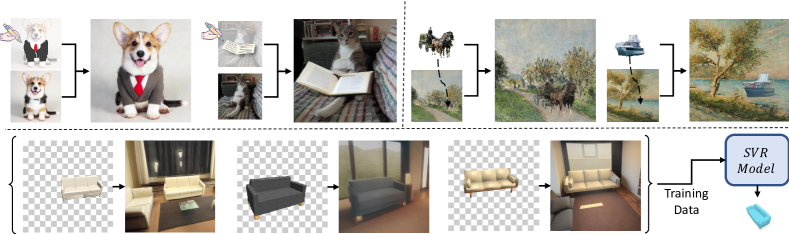
Diffusion models have enabled high-quality, conditional image editing capabilities. We propose to expand their arsenal, and demonstrate that off-the-shelf diffusion models can be used for a wide range of cross-domain compositing tasks. Among numerous others, these include image blending, object immersion, texture-replacement and even CG2Real translation or stylization. We employ a localized, iterative refinement scheme which infuses the injected objects with contextual information derived from the background scene, and enables control over the degree and types of changes the object may undergo. We conduct a range of qualitative and quantitative comparisons to prior work, and exhibit that our method produces higher quality and realistic results without requiring any annotations or training. Finally, we demonstrate how our method may be used for data augmentation of downstream tasks.
Motivation & Objective
- To enable high-quality, controllable cross-domain image compositing using pretrained diffusion models without fine-tuning or annotations.
- To address the challenge of harmonizing objects from different visual domains—e.g., CG renders into real scenes—by aligning style, lighting, and geometry.
- To provide a flexible, user-controllable framework for local image editing with guidance from text, scribbles, or reference images across domains.
- To demonstrate the utility of the method as a data augmentation pipeline for downstream tasks such as single-view 3D reconstruction (SVR).
Proposed method
- The method employs an iterative, inference-time conditioning scheme that refines localized image regions using a combination of text, scribble, or image reference guidance.
- It leverages pretrained diffusion models (e.g., Guided Diffusion, Stable Diffusion) in a latent diffusion space to generate coherent, realistic edits.
- A key component is the use of a control parameter R that modulates the strength of the conditioning signal, allowing users to balance fidelity and realism.
- The approach uses a latent space refinement loop where the model iteratively denoises and conditions on the injected object and scene context.
- The method supports multiple conditioning modalities: text prompts, scribbles, and cross-domain image references, enabling diverse editing tasks.
- For improved detail preservation, the method suggests cropping the background to increase the relative size of small or detailed objects during refinement.
Experimental results
Research questions
- RQ1Can off-the-shelf pretrained diffusion models be used effectively for cross-domain compositing without any fine-tuning or annotations?
- RQ2How can user control over the degree and type of changes be achieved during image editing using diffusion models?
- RQ3To what extent can this method improve realism and coherence when inserting objects from one domain (e.g., CG) into another (e.g., real images)?
- RQ4Can this method serve as an effective data augmentation strategy for downstream tasks like single-view 3D reconstruction (SVR)?
Key findings
- The method achieves state-of-the-art qualitative results in cross-domain compositing, including realistic object immersion, texture replacement, and CG-to-real translation.
- Quantitative evaluation using CLIP ViT-L/14@336px shows significant improvements in image realism and content preservation over baseline methods.
- Inference times range from 7 seconds (R=0) to 54 seconds (R=0.8) on an RTX 2080 Ti, with higher R values enabling more detailed and realistic edits.
- The method successfully reduces the sim-to-real gap in single-view 3D reconstruction (SVR), improving performance when using augmented data from the proposed pipeline.
- The approach demonstrates robustness across diverse tasks, including scribble-based editing, stylization, and scene-level harmonization.
- Limitations include difficulty preserving fine details in small objects and challenges with generating accurate shadows, which require user guidance.
Read this paper
Open the full text in the Nubint reader and ask about any passage as you read.
Read this paper on NubintThis review was generated by AI from the original paper. Please check the paper before citing it.