
[Paper Review] Cross Domain Iterative Detection for Orthogonal Time Frequency Space Modulation
This paper proposes a cross-domain iterative detection algorithm for Orthogonal Time Frequency Space (OTFS) modulation that alternately applies linear minimum mean square error (L-MMSE) equalization in the time domain and symbol-by-symbol detection in the delay-Doppler (DD) domain, leveraging unitary transformations between domains. The method achieves near-maximum-likelihood performance with low complexity, even under fractional Doppler shifts, and is proven to converge with significant error performance gains due to non-Gaussian constellation constraints in the DD domain.
Recently proposed orthogonal time frequency space (OTFS) modulation has been considered as a promising candidate for accommodating various emerging communication and sensing applications in high-mobility environments. In this paper, we propose a novel cross domain iterative detection algorithm to enhance the error performance of OTFS modulation. Different from conventional OTFS detection methods, the proposed algorithm applies basic estimation/detection approaches to both the time domain and delay-Doppler (DD) domain and iteratively updates the extrinsic information from two domains with the unitary transformation. In doing so, the proposed algorithm exploits the time domain channel sparsity and the DD domain symbol constellation constraints. We evaluate the estimation/detection error variance in each domain for each iteration and derive the state evolution to investigate the detection error performance. We show that the performance gain due to iterations comes from the non-Gaussian constellation constraint in the DD domain. More importantly, we prove the proposed algorithm can indeed converge and, in the convergence, the proposed algorithm can achieve almost the same error performance as the maximum-likelihood sequence detection even in the presence of fractional Doppler shifts. Furthermore, the computational complexity associated with the domain transformation is low, thanks to the structure of the discrete Fourier transform (DFT) kernel. Simulation results are consistent with our analysis and demonstrate a significant performance improvement compared to conventional OTFS detection methods.
Motivation & Objective
- To address the high detection complexity of OTFS in high-mobility environments with fractional Doppler shifts, where conventional DD-domain sparsity-based methods fail.
- To improve error performance in OTFS by exploiting both time-domain channel sparsity and DD-domain symbol constellation constraints.
- To design a stable, iterative detection algorithm that avoids convergence issues common in message-passing-based approaches.
- To achieve near-optimal performance with reduced computational complexity by leveraging unitary transformations between domains.
Proposed method
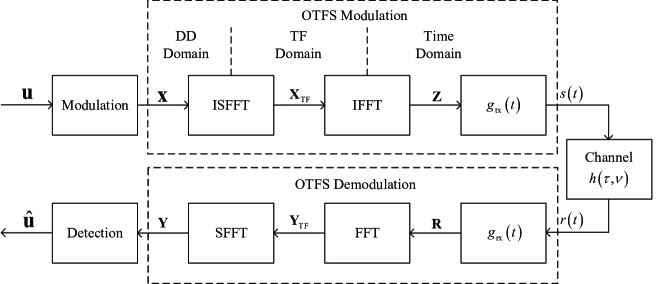
- The algorithm performs iterative detection by alternating between time-domain L-MMSE equalization and DD-domain symbol-by-symbol detection.
- Extrinsic information is exchanged between domains via unitary transformations, specifically the inverse symplectic finite Fourier transform (ISFFT) and its inverse.
- The method exploits time-domain sparsity in channel responses and the non-Gaussian nature of DD-domain constellation constraints to suppress error correlation.
- State evolution analysis is derived to model error variance propagation across iterations, enabling performance prediction.
- The algorithm is proven to converge, with theoretical bounds derived using Jensen’s inequality and matrix trace identities.
- Computational complexity is kept low due to the efficient structure of the DFT-based unitary transforms.
Experimental results
Research questions
- RQ1Can iterative detection across time and delay-Doppler domains improve OTFS error performance beyond conventional methods?
- RQ2Does the proposed cross-domain approach remain effective under fractional Doppler shifts, where DD-domain sparsity breaks down?
- RQ3Can the iterative algorithm be proven to converge, and what is the theoretical basis for its stability?
- RQ4What is the contribution of DD-domain constellation constraints to performance gain, and how does it compare to time-domain sparsity?
- RQ5How does the proposed method's complexity compare to maximum-likelihood detection and existing low-complexity alternatives?
Key findings
- The proposed algorithm achieves near-maximum-likelihood error performance even in the presence of fractional Doppler shifts, where conventional DD-domain sparsity-based methods fail.
- The performance gain is primarily attributed to the non-Gaussian constellation constraint in the DD domain, not just channel sparsity.
- The algorithm is proven to converge, with theoretical state evolution analysis confirming stable error propagation across iterations.
- The lower bound on the time-domain estimation variance is derived using Jensen’s inequality, showing tighter performance bounds as noise variance decreases.
- The computational complexity remains low due to the efficient DFT-based unitary transformations, making the method suitable for practical implementation.
- Simulation results validate the theoretical analysis and demonstrate significant performance gains over conventional OTFS detection methods.
Read this paper
Open the full text in the Nubint reader and ask about any passage as you read.
Read this paper on NubintThis review was generated by AI from the original paper. Please check the paper before citing it.