
[Paper Review] Cross-domain Neural Pitch and Periodicity Estimation
This paper proposes FCNF0++, a cross-domain neural pitch and periodicity estimator that achieves state-of-the-art accuracy on both speech and music datasets by training on combined data distributions. It introduces an entropy-based periodicity decoding method and efficient inference, enabling real-time performance (11.2x faster than real-time on CPU) while outperforming prior neural and DSP-based methods in accuracy and generalization.
Pitch is a foundational aspect of our perception of audio signals. Pitch contours are commonly used to analyze speech and music signals and as input features for many audio tasks, including music transcription, singing voice synthesis, and prosody editing. In this paper, we describe a set of techniques for improving the accuracy of widely-used neural pitch and periodicity estimators to achieve state-of-the-art performance on both speech and music. We also introduce a novel entropy-based method for extracting periodicity and per-frame voiced-unvoiced classifications from statistical inference-based pitch estimators (e.g., neural networks), and show how to train a neural pitch estimator to simultaneously handle both speech and music data (i.e., cross-domain estimation) without performance degradation. Our estimator implementations run 11.2x faster than real-time on a Intel i9-9820X 10-core 3.30 GHz CPU$\unicode{x2014}$approaching the speed of state-of-the-art DSP-based pitch estimators$\unicode{x2014}$or 408x faster than real-time on a NVIDIA GeForce RTX 3090 GPU. We release all of our code and models as Pitch-Estimating Neural Networks (penn), an open-source, pip-installable Python module for training, evaluating, and performing inference with pitch- and periodicity-estimating neural networks. The code for penn is available at https://github.com/interactiveaudiolab/penn.
Motivation & Objective
- To improve neural pitch and periodicity estimation accuracy across both speech and music domains.
- To address the poor cross-domain generalization of existing neural pitch estimators trained on isolated data distributions.
- To develop a method that enables simultaneous, high-accuracy pitch and periodicity estimation without performance degradation in mixed-domain settings.
- To achieve inference speeds approaching those of state-of-the-art DSP-based pitch trackers on standard CPUs.
- To release a fully reproducible, open-source library (penn) for training, evaluating, and deploying pitch-estimating neural networks.
Proposed method
- The authors propose FCNF0++, a neural pitch estimator with fine-grained pitch quantization and a novel entropy-based periodicity decoding method to improve periodicity estimation.
- They train the model on a combined dataset covering both speech (PTDB) and music (MDB-stem-synth) to ensure full frequency distribution coverage and avoid domain-specific bias.
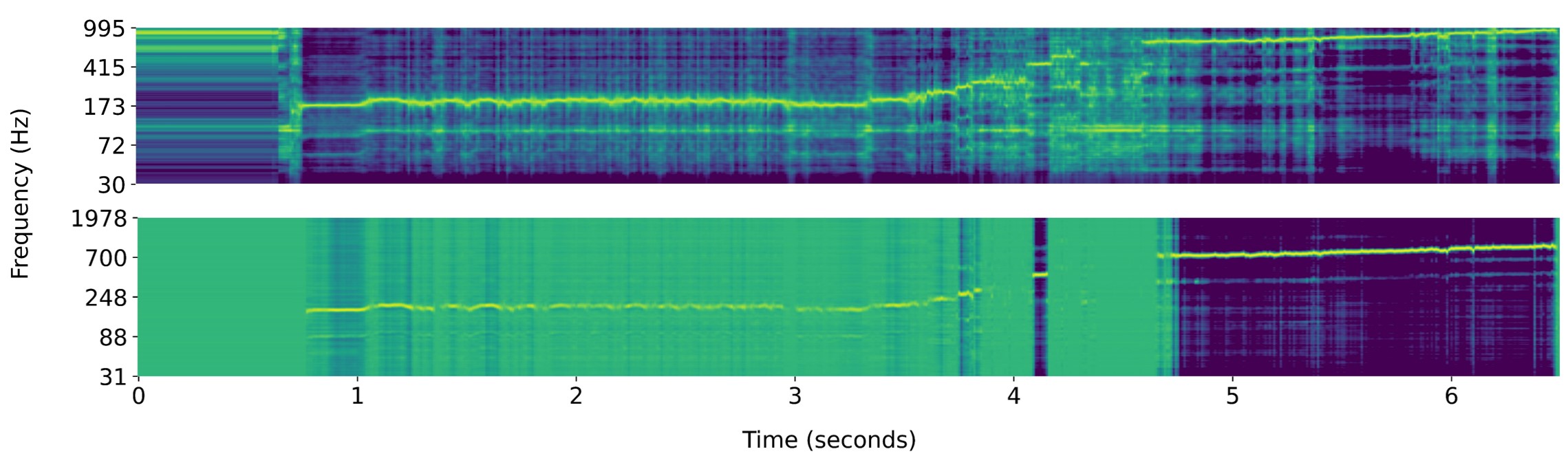
- The periodicity estimation is derived from the pitch posteriorgram using entropy minimization, encouraging uniform probability in unvoiced frames and sharp peaks in voiced frames.
- The model uses a modified training objective that explicitly penalizes incorrect periodicity predictions, improving robustness to aperiodic noise.
- Inference is optimized via efficient PyTorch implementation, achieving 11.2x real-time speed on an Intel i9-9820X CPU and 408x on an RTX 3090 GPU without hardware-specific optimizations.
- The authors release the Penn library, a pip-installable, reproducible framework for training and inference with pitch and periodicity estimators.
Experimental results
Research questions
- RQ1Can a single neural pitch estimator achieve state-of-the-art performance on both speech and music datasets without performance degradation?
- RQ2How can periodicity estimation be improved using statistical inference outputs from neural pitch estimators?
- RQ3What impact does training data distribution coverage have on cross-domain pitch estimation generalization?
- RQ4Can neural pitch estimators achieve inference speeds competitive with DSP-based methods on standard CPUs?
- RQ5Can a unified, high-entropy training distribution enable universal pitch estimation across unseen datasets?
Key findings
- FCNF0++ achieves a raw pitch accuracy (RPA) of 99.62% on music (MDB-stem-synth) and 95.12% on speech (PTDB), setting new state-of-the-art results.
- The model outperforms prior neural and DSP-based methods in accuracy and generalization, especially when trained on combined speech and music data.
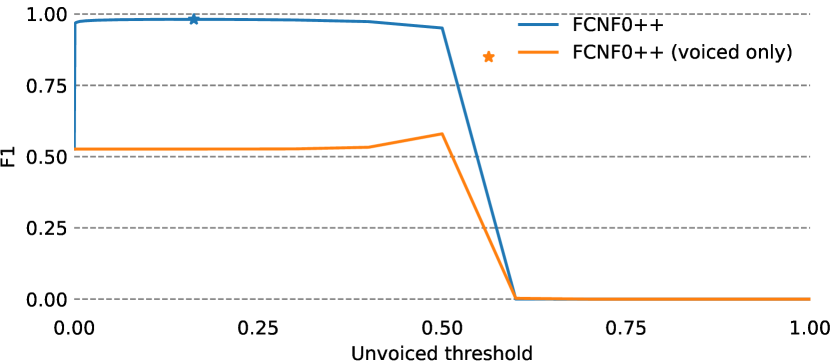
- The entropy-based periodicity decoding method significantly improves periodicity estimation, particularly in distinguishing voiced from unvoiced frames.
- The model runs 11.2x faster than real-time on a standard Intel i9-9820X CPU and 408x faster on an NVIDIA RTX 3090 GPU, approaching DSP-based speed without hardware optimization.
- Cross-domain generalization is achieved only when training data covers the full frequency range of both evaluation domains, confirming the importance of distribution coverage.
- The open-source Penn library enables full reproducibility and deployment of the proposed models and training pipelines.
Read this paper
Open the full text in the Nubint reader and ask about any passage as you read.
Read this paper on NubintThis review was generated by AI from the original paper. Please check the paper before citing it.