
[Paper Review] Cross-view Transformers for real-time Map-view Semantic Segmentation
This paper proposes Cross-View Transformers, a real-time, attention-based model that performs map-view semantic segmentation from multiple camera inputs by learning implicit geometric mappings through camera-aware positional embeddings. The method achieves state-of-the-art performance on the nuScenes dataset with 35 FPS inference on a single GPU, outperforming prior methods in speed and accuracy while avoiding explicit depth estimation.
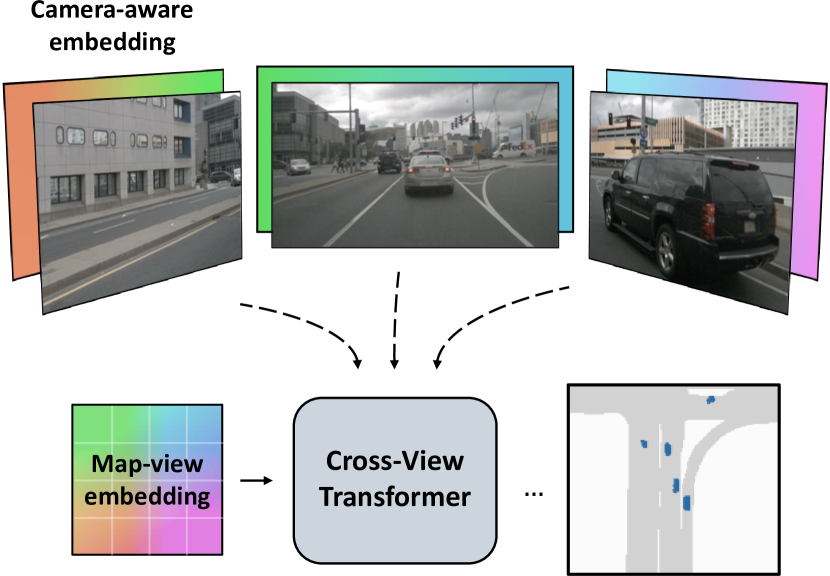
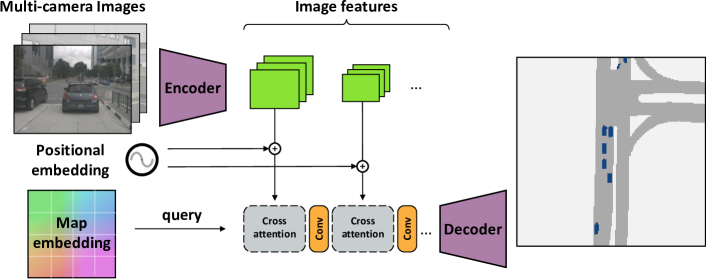
We present cross-view transformers, an efficient attention-based model for map-view semantic segmentation from multiple cameras. Our architecture implicitly learns a mapping from individual camera views into a canonical map-view representation using a camera-aware cross-view attention mechanism. Each camera uses positional embeddings that depend on its intrinsic and extrinsic calibration. These embeddings allow a transformer to learn the mapping across different views without ever explicitly modeling it geometrically. The architecture consists of a convolutional image encoder for each view and cross-view transformer layers to infer a map-view semantic segmentation. Our model is simple, easily parallelizable, and runs in real-time. The presented architecture performs at state-of-the-art on the nuScenes dataset, with 4x faster inference speeds. Code is available at https://github.com/bradyz/cross_view_transformers.
Motivation & Objective
- To address the challenge of robust, real-time map-view semantic segmentation from multiple camera views in autonomous driving.
- To eliminate reliance on explicit depth estimation, which is error-prone and geometrically rigid.
- To learn implicit geometric relationships between camera views and a canonical map-view through attention mechanisms.
- To improve inference speed and accuracy over existing methods while maintaining robustness to sensor dropout.
- To leverage calibrated camera geometry via learned positional embeddings without explicit geometric modeling.
Proposed method
- The model uses a convolutional image encoder for each camera view to extract local features.
- Camera-aware positional embeddings are learned based on intrinsic and extrinsic camera calibration, encoding geometric relationships.
- Cross-view transformer layers perform multi-head attention across all camera features using a shared map-view positional embedding.
- The attention mechanism learns to map features from individual camera views to a unified map-view representation without explicit geometric projection.
- The architecture uses multiple stacked attention and MLP blocks to refine the map-view representation.
- The model is trained to minimize segmentation loss on the map-view, end-to-end, learning depth and geometry implicitly through supervision.
Experimental results
Research questions
- RQ1Can a transformer-based architecture learn accurate cross-view feature mappings without explicit geometric modeling or depth supervision?
- RQ2How does camera-aware positional embedding improve map-view semantic segmentation compared to no or learned embeddings?
- RQ3To what extent does the model generalize under sensor dropout or occlusion?
- RQ4How does performance degrade with increasing distance from the ego-vehicle?
- RQ5Can attention mechanisms implicitly learn geometric correspondences between camera and map views?
Key findings
- The model achieves state-of-the-art performance on the nuScenes dataset for map-view semantic segmentation, outperforming prior methods in accuracy and speed.
- The model runs at 35 FPS on a single RTX 2080 Ti GPU, achieving 4x faster inference than baseline methods.
- Camera-aware positional embeddings with Random Fourier projections yield the best performance, outperforming learned or linear embeddings.
- Performance degrades linearly with camera dropout, but remains robust as long as visible area is preserved.
- The model shows slower degradation at longer distances than its closest competitor, FIERY, indicating better generalization to far or occluded objects.
- Visualizations confirm that cross-view attention learns meaningful geometric correspondences, highlighting relevant image regions for map-view predictions.
Read this paper
Open the full text in the Nubint reader and ask about any passage as you read.
Read this paper on NubintThis review was generated by AI from the original paper. Please check the paper before citing it.