
[Paper Review] Ctrl-Adapter: An Efficient and Versatile Framework for Adapting Diverse Controls to Any Diffusion Model
Ctrl-Adapter is a lightweight, parameter-efficient framework that adapts pretrained ControlNets to any image or video diffusion model without fine-tuning the backbone or ControlNet. By introducing learnable adapter layers with spatial and temporal modules—including latent skipping and inverse timestep sampling—it enables high-quality image and video generation with diverse controls, achieving state-of-the-art results on video benchmarks (e.g., DAVIS 2017) with under 10 GPU hours of training.
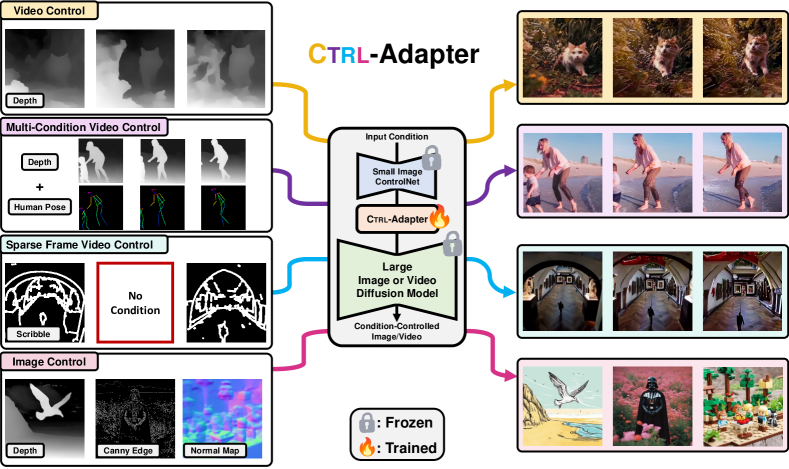
ControlNets are widely used for adding spatial control to text-to-image diffusion models with different conditions, such as depth maps, scribbles/sketches, and human poses. However, when it comes to controllable video generation, ControlNets cannot be directly integrated into new backbones due to feature space mismatches, and training ControlNets for new backbones can be a significant burden for many users. Furthermore, applying ControlNets independently to different frames cannot effectively maintain object temporal consistency. To address these challenges, we introduce Ctrl-Adapter, an efficient and versatile framework that adds diverse controls to any image/video diffusion model through the adaptation of pretrained ControlNets. Ctrl-Adapter offers strong and diverse capabilities, including image and video control, sparse-frame video control, fine-grained patch-level multi-condition control (via an MoE router), zero-shot adaptation to unseen conditions, and supports a variety of downstream tasks beyond spatial control, including video editing, video style transfer, and text-guided motion control. With six diverse U-Net/DiT-based image/video diffusion models (SDXL, PixArt-$α$, I2VGen-XL, SVD, Latte, Hotshot-XL), Ctrl-Adapter matches the performance of pretrained ControlNets on COCO and achieves the state-of-the-art on DAVIS 2017 with significantly lower computation (< 10 GPU hours).
Motivation & Objective
- Address the inefficiency and incompatibility of directly applying pretrained ControlNets to new diffusion model backbones.
- Overcome temporal inconsistency in video generation when using frame-wise ControlNet inference.
- Enable zero-shot adaptation of ControlNets to unseen control conditions and diverse backbone models.
- Support flexible control scenarios including multi-condition control, sparse frame control, and video editing.
- Reduce training cost compared to training ControlNets from scratch for new backbones.
Proposed method
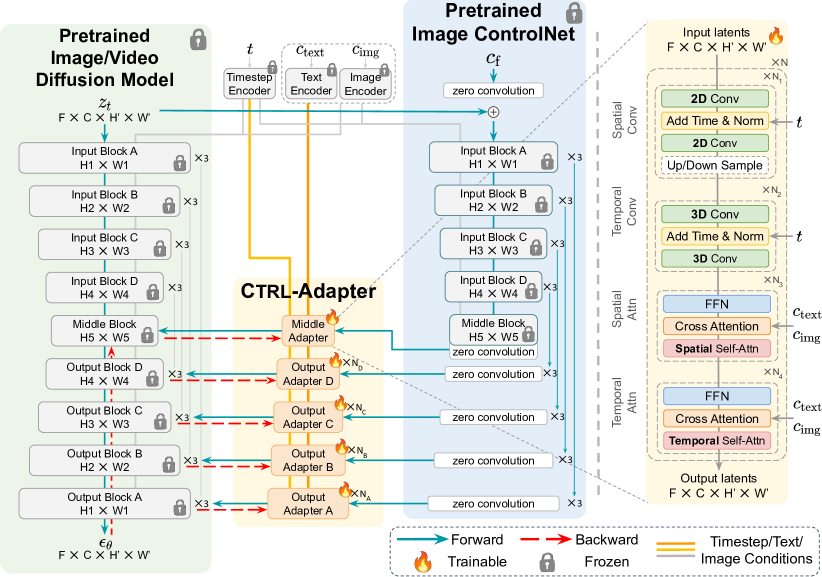
- Train adapter layers that fuse features from pretrained ControlNets into target diffusion models while keeping both the ControlNet and diffusion model parameters frozen.
- Introduce a dual-branch architecture with spatial and temporal modules: spatial convolution and attention for spatial detail, temporal convolution and attention for temporal consistency.
- Implement latent skipping to decouple ControlNet inputs from the diffusion model's latent space, improving robustness to noise scale differences.
- Apply inverse timestep sampling to align ControlNet features with continuous diffusion timestep schedulers in new backbones.
- Enable multi-condition control by averaging (weighted) outputs from multiple pretrained ControlNets.
- Use a modular adapter design that supports various backbone models, including SDXL, I2VGen-XL, SVD, and Hotshot-XL.
Experimental results
Research questions
- RQ1Can a framework efficiently adapt pretrained ControlNets to new image and video diffusion models without fine-tuning the backbone or ControlNet?
- RQ2How can temporal consistency be improved in video generation when using frame-wise ControlNet features?
- RQ3Can the framework generalize to unseen control conditions and diverse backbone models through zero-shot adaptation?
- RQ4What architectural components (e.g., attention, convolution, temporal modules) are most effective for balancing visual quality and control accuracy?
- RQ5Can the framework support complex control scenarios like multi-condition control and sparse frame control with minimal computational cost?
Key findings
- Ctrl-Adapter matches the performance of full ControlNet fine-tuning on the COCO dataset for image control, achieving a FID of 4.05 on SDXL.
- For video control on I2VGen-XL, Ctrl-Adapter achieves a state-of-the-art optical flow error of 3.68 on DAVIS 2017, outperforming all baselines.
- Training Ctrl-Adapter requires less than 10 GPU hours, significantly reducing computational cost compared to training ControlNets from scratch (e.g., 500–600 A100 hours for SDv1.5).
- Latent skipping improves adaptation to backbones with different noise scales (e.g., SVD) and enables effective sparse frame control, reducing FID from 7.20 to 5.98 on I2VGen-XL.
- The SC+TC+SA+TA configuration achieves the best balance of visual quality (FID) and spatial control (optical flow error) in video generation.
- Ctrl-Adapter enables zero-shot transfer to unseen control conditions and supports multi-condition control via simple averaging of ControlNet outputs.
Better researchstarts right now
From reading papers to final review, dramatically reduce your research time.
No credit card · Free plan available
This review was created by AI and reviewed by human editors.