
[Paper Review] Current Status of the Muon g-2 Interpretations within Two-Higgs-Doublet Models
This paper reviews and updates the viability of four two-Higgs-doublet models (2HDMs)—type-X, flavor-aligned, muon-specific, and μτ-flavor-violating 2HDMs—in explaining the muon g-2 anomaly. It integrates latest experimental constraints from LHC and flavor physics, showing that the flavor-aligned 2HDM's allowed parameter space now closely matches that of the type-X 2HDM, and that the type-X 2HDM is nearly excluded while the muon-specific 2HDM will be probed by Run 3 data.
In this article, we review and update implications of the muon anomalous magnetic moment (muon $g-2$) anomaly for two-Higgs-doublet models (2HDMs), which are classified according to imposed symmetries and their resulting Yukawa sector. In the minimal setup, the muon $g-2$ anomaly can be accommodated by the type-X (lepto-philic) 2HDM, flavor-aligned 2HDM (FA2HDM), muon-specific 2HDM ($μ$2HDM), and $μτ$-flavor violating 2HDM. We summarize all relevant experimental constraints from high-energy collider experiments and flavor experiments, as well as the theoretical constraints from the perturbative unitarity and vacuum stability bounds, to these 2HDMs in light of the muon $g-2$ anomaly. We clarify the available parameter spaces of these 2HDMs and investigate how to probe the remaining parameter regions in future experiments. In particular, we find that, due to the updated $B_s oμ^+ μ^-$ measurement, the remaining parameter region of the FA2HDM is almost equivalent to the one of the type-X 2HDM. Furthermore, based on collider simulations, we find that the type-X 2HDM is excluded and the $μ$2HDM scenario will be covered with the upcoming Run 3 data.
Motivation & Objective
- To assess the viability of four 2HDM variants in explaining the muon g-2 anomaly.
- To update constraints from high-energy collider and flavor physics experiments on these 2HDMs.
- To evaluate theoretical bounds from perturbative unitarity and vacuum stability.
- To identify remaining viable parameter spaces and project future discovery potential.
- To compare the current status and future prospects of the type-X, flavor-aligned, muon-specific, and μτ-flavor-violating 2HDMs.
Proposed method
- Classifies 2HDMs based on imposed symmetries and their resulting Yukawa structures.
- Applies experimental constraints from LHC searches, B_s → μ⁺μ⁻ decays, and precision electroweak measurements.
- Imposes theoretical bounds from perturbative unitarity and vacuum stability of the scalar potential.
- Performs collider simulations to project discovery reach for Run 3 and future data.
- Uses renormalization group equations to track running of quartic couplings, especially in models with large Yukawa couplings.
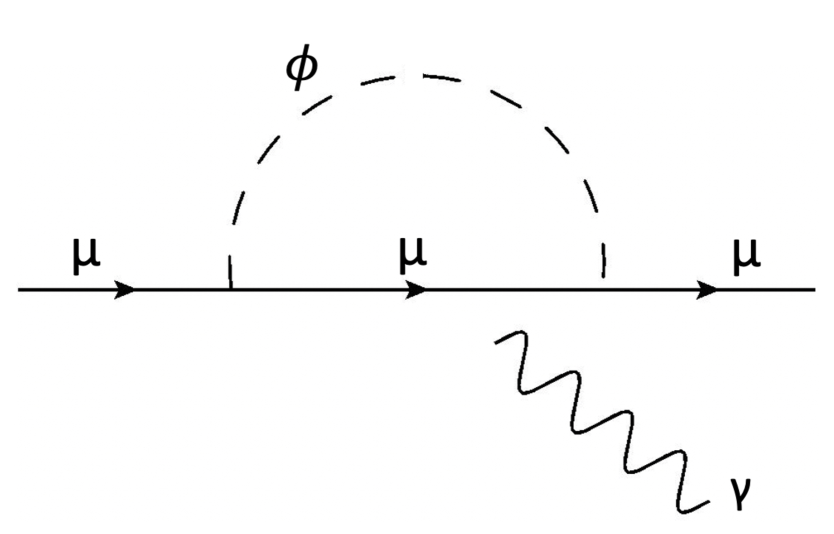
- Evaluates the muon g-2 contribution via loop diagrams involving charged Higgs and fermion couplings.
Experimental results
Research questions
- RQ1Which 2HDM variants can accommodate the muon g-2 anomaly while satisfying current experimental constraints?
- RQ2How do updated B_s → μ⁺μ⁻ measurements affect the viable parameter space of the flavor-aligned 2HDM?
- RQ3What is the current exclusion status of the type-X 2HDM based on latest LHC data?
- RQ4To what extent can the muon-specific 2HDM be probed or excluded by upcoming Run 3 data?
- RQ5How do renormalization group effects influence the stability and viability of 2HDMs with large Yukawa couplings?
Key findings
- The flavor-aligned 2HDM and type-X 2HDM now have nearly identical viable parameter spaces due to updated B_s → μ⁺μ⁻ constraints.
- The type-X 2HDM is now nearly excluded by current LHC data, particularly from the updated B_s → μ⁺μ⁻ measurement.
- The muon-specific 2HDM scenario will be fully covered by the upcoming Run 3 data from the LHC.
- The muon g-2 anomaly is consistent with O(100 GeV) new physics, and 2HDMs provide a natural framework for such states.
- Perturbative unitarity and vacuum stability conditions are satisfied in the relevant parameter regions of the studied 2HDMs.
- Renormalization group evolution significantly affects the scalar potential in models with large Yukawa couplings, particularly in the μ2HDM and μτ-2HDM.
Read this paper
Open the full text in the Nubint reader and ask about any passage as you read.
Read this paper on NubintThis review was generated by AI from the original paper. Please check the paper before citing it.