
[Paper Review] Curriculum Learning Meets Directed Acyclic Graph for Multimodal Emotion Recognition
MultiDAG+CL combines multimodal DAG-based fusion with curriculum learning to improve emotion recognition in conversation on IEMOCAP and MELD, addressing emotional shifts and data imbalance.
Emotion recognition in conversation (ERC) is a crucial task in natural language processing and affective computing. This paper proposes MultiDAG+CL, a novel approach for Multimodal Emotion Recognition in Conversation (ERC) that employs Directed Acyclic Graph (DAG) to integrate textual, acoustic, and visual features within a unified framework. The model is enhanced by Curriculum Learning (CL) to address challenges related to emotional shifts and data imbalance. Curriculum learning facilitates the learning process by gradually presenting training samples in a meaningful order, thereby improving the model's performance in handling emotional variations and data imbalance. Experimental results on the IEMOCAP and MELD datasets demonstrate that the MultiDAG+CL models outperform baseline models. We release the code for MultiDAG+CL and experiments: https://github.com/vanntc711/MultiDAG-CL
Motivation & Objective
- Advance multimodal emotion recognition in conversation (ERC) by integrating text, audio, and visual cues using a DAG-based fusion framework.
- Incorporate Curriculum Learning to mitigate emotional shift and data imbalance challenges in ERC.
- Demonstrate state-of-the-art performance on standard ERC benchmarks (IEMOCAP and MELD).
Proposed method
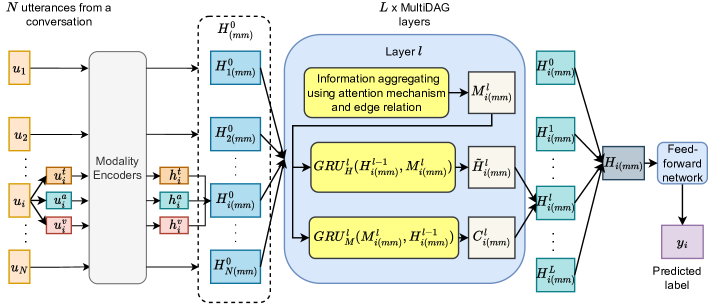
- Represent utterances with modality-specific encoders (text: BiLSTM; audio/visual: FC).
- Fuse modalities via a Directed Acyclic Graph (DAG-GNN) where information flows only from past utterances.
- Compute attention-based inter-utterance edges and aggregate via layer-wise GRUs to obtain final utterance embeddings.
- Introduce Curriculum Learning with a Difficulty Measure Function (DMF) based on emotional shifts across speakers to create a sequence of training buckets.
- Train with a bucket-based curriculum schedule that gradually introduces harder conversations.
- Optimize with cross-entropy loss to predict emotion labels for each utterance.
Experimental results
Research questions
- RQ1How can DAG-based fusion of textual, acoustic, and visual features improve ERC performance over unimodal and other multimodal baselines?
- RQ2Does curriculum learning tailored to emotional shift dynamics help ERC models cope with data imbalance and shifting emotions?
- RQ3What are the effects of modality combinations on ERC performance in real-world datasets (IEMOCAP, MELD)?
Key findings
- MultiDAG+CL achieves state-of-the-art performance on IEMOCAP and MELD compared to prior multimodal ERC methods.
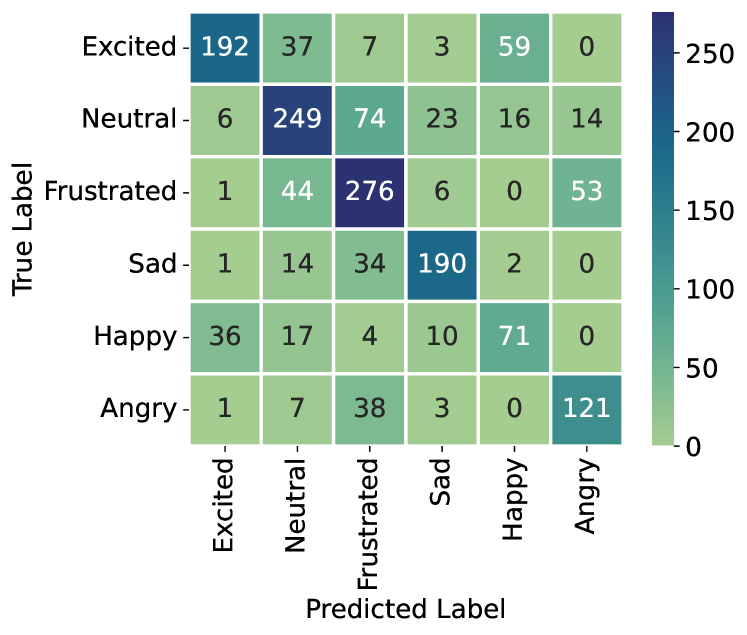
- Curriculum Learning improves emotion recognition accuracy, particularly for Sad, Neutral, and Angry classes, while reducing Neutral misclassification as Disgust.
- Optimal number of CL buckets differs by dataset (IEMOCAP: 5 buckets; MELD: 12 buckets).
- Textual modality is strongest among unimodal signals; combining Text+Audio often yields best bimodal performance; Visual modality is more vulnerable to noise.
- MultiDAG+CL reduces neutral misclassification from 19.3% to 12.3% for Neutral vs Disgust on IEMOCAP.
Read this paper
Open the full text in the Nubint reader and ask about any passage as you read.
Read this paper on NubintThis review was generated by AI from the original paper. Please check the paper before citing it.