
[Paper Review] Cut and Learn for Unsupervised Object Detection and Instance Segmentation
CutLER is a simple, imageNet-trained, unsupervised method for multi-object detection and instance segmentation that uses MaskCut to generate coarse masks, DropLoss to train detectors robust to missed masks, and multi-round self-training to refine masks, achieving strong zero-shot performance across diverse domains and boosting label-efficient fine-tuning.
We propose Cut-and-LEaRn (CutLER), a simple approach for training unsupervised object detection and segmentation models. We leverage the property of self-supervised models to 'discover' objects without supervision and amplify it to train a state-of-the-art localization model without any human labels. CutLER first uses our proposed MaskCut approach to generate coarse masks for multiple objects in an image and then learns a detector on these masks using our robust loss function. We further improve the performance by self-training the model on its predictions. Compared to prior work, CutLER is simpler, compatible with different detection architectures, and detects multiple objects. CutLER is also a zero-shot unsupervised detector and improves detection performance AP50 by over 2.7 times on 11 benchmarks across domains like video frames, paintings, sketches, etc. With finetuning, CutLER serves as a low-shot detector surpassing MoCo-v2 by 7.3% APbox and 6.6% APmask on COCO when training with 5% labels.
Motivation & Objective
- Motivate unsupervised object localization without human labels and reduce annotation burden for detection/mask tasks.
- Propose a simple, detection-architecture-agnostic pipeline that discovers multiple objects per image.
- Leverage self-supervised features to generate masks and train detectors with a robust learning signal.
- Improve MaskCut-based masks through self-training to refine object masks and boxes.
Proposed method
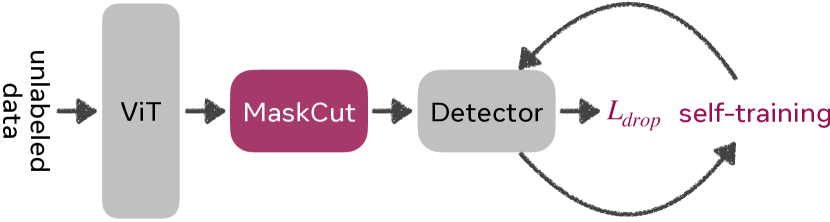
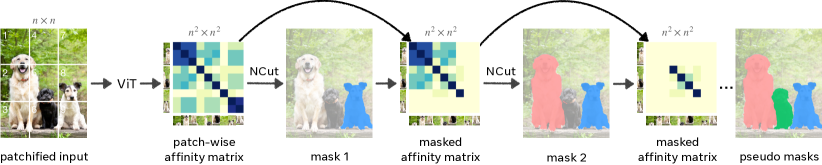
- MaskCut: generate multiple initial coarse object masks per image using self-supervised ViT features and NCut-based partitioning.
- DropLoss: a loss-dropping strategy that ignores losses for detector proposals with minimal overlap to ground-truth, encouraging discovery of missed objects.
- Multi-round self-training: iteratively refine the detector and use its own high-confidence predictions as pseudo-labels for subsequent rounds (three rounds recommended).
- Training data: exclusively ImageNet without in-domain labels; detectors include Mask R-CNN and Cascade Mask R-CNN with DINOinitialization; optional copy-paste augmentation.
- Implementation specifics: NCut-based masking with iterative masking of foreground regions; use of DINO patch features and CRF post-processing; training details include 160k iterations, SGD, and learning-rate schedule.
Experimental results
Research questions
- RQ1Can self-supervised representations be amplified to produce a robust, zero-shot detector that handles multiple objects per image without any human annotations?
- RQ2How can we generate and exploit coarse, self-supervised masks to train a detector that outperforms in-domain unsupervised baselines across diverse domains?
- RQ3Does multi-round self-training improve object masks and detection quality beyond the initial MaskCut stage?
- RQ4Can a zero-shot unsupervised detector trained on ImageNet serve as a strong pretrainer for label-efficient or fully supervised detection tasks?
- RQ5Is the approach robust to domain shifts such as videos, paintings, and sketches?
Key findings
- CutLER achieves strong zero-shot unsupervised object detection and instance segmentation across 11 diverse benchmarks, including video frames, paintings, and clip arts.
- On COCO-related benchmarks, CutLER significantly outperforms prior unsupervised methods and, in many cases, surpasses methods trained with extra data (e.g., FreeSOLO with in-domain data) by large margins.
- Table-driven results show that CutLER yields substantial gains over previous SOTA across multiple datasets, with reported improvements such as more than doubling AP50 on 10 of 11 benchmarks and substantial gains in mask and box AP across targets.
- Three rounds of self-training consistently improve performance, with 3 rounds identified as sufficient to achieve strong results; the self-trained predictions become higher quality masks and boxes than the initial coarse masks.
- As a pretraining method, CutLER initializes detectors that subsequently outperform MoCo-v2 baselines in low-shot and full-shot COCO fine-tuning, and it remains competitive against or superior to prior state-of-the-art unsupervised methods.
- CutLER demonstrates robustness to domain shifts, performing well on domains like UVO (video) and Clipart/Watercolor datasets despite being trained only on ImageNet.
Read this paper
Open the full text in the Nubint reader and ask about any passage as you read.
Read this paper on NubintThis review was generated by AI from the original paper. Please check the paper before citing it.