
[Paper Review] CuTS: Customizable Tabular Synthetic Data Generation
CuTS is a customizable tabular synthetic data generation framework that enables users to define diverse statistical, logical, and fairness constraints via a declarative language. It achieves high-quality synthetic data by pre-training a generative model and fine-tuning it using a differentiable relaxation of user-specified constraints, outperforming state-of-the-art methods by 2.3% in downstream accuracy on the Adult dataset under fairness constraints.
Privacy, data quality, and data sharing concerns pose a key limitation for tabular data applications. While generating synthetic data resembling the original distribution addresses some of these issues, most applications would benefit from additional customization on the generated data. However, existing synthetic data approaches are limited to particular constraints, e.g., differential privacy (DP) or fairness. In this work, we introduce CuTS, the first customizable synthetic tabular data generation framework. Customization in CuTS is achieved via declarative statistical and logical expressions, supporting a wide range of requirements (e.g., DP or fairness, among others). To ensure high synthetic data quality in the presence of custom specifications, CuTS is pre-trained on the original dataset and fine-tuned on a differentiable loss automatically derived from the provided specifications using novel relaxations. We evaluate CuTS over four datasets and on numerous custom specifications, outperforming state-of-the-art specialized approaches on several tasks while being more general. In particular, at the same fairness level, we achieve 2.3% higher downstream accuracy than the state-of-the-art in fair synthetic data generation on the Adult dataset.
Motivation & Objective
- To address the limitations of existing synthetic data methods that support only narrow constraints like differential privacy or fairness.
- To enable data owners to customize synthetic data generation with a broad range of statistical, logical, and fairness specifications.
- To maintain high data utility while enforcing diverse, user-defined constraints through a unified training framework.
- To provide a general-purpose, accessible interface for specifying complex data generation requirements.
Proposed method
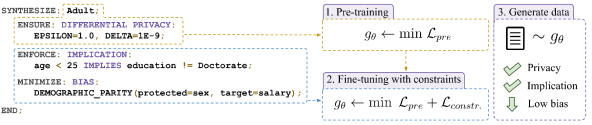
- CuTS uses a pre-trained generative model on the original tabular dataset to learn the underlying data distribution.
- User-specified constraints—statistical, logical, or fairness-related—are converted into a differentiable loss function using novel relaxations.
- The model is fine-tuned end-to-end using a differentiable loss that combines the pre-training objective with the relaxed constraint loss.
- For differential privacy, CuTS employs a modified privacy budget annealing strategy with adaptive noise scaling based on gradient sensitivity.
- The framework supports soft constraints to encourage desirable behavior in downstream classifiers, such as low bias.
- A domain-specific language enables intuitive specification of constraints using statistical notation, improving usability over code-based alternatives.
Experimental results
Research questions
- RQ1Can a single framework support a wide range of customizable constraints in tabular synthetic data generation beyond differential privacy or fairness?
- RQ2How does CuTS maintain high data quality when enforcing complex, diverse constraints?
- RQ3To what extent can CuTS outperform specialized state-of-the-art methods under shared constraints like fairness or privacy?
- RQ4How effective is CuTS in preserving data utility while obfuscating sensitive statistical patterns, such as drug trial focus in healthcare data?
Key findings
- On the Adult dataset, CuTS achieves 2.3% higher downstream accuracy than the state-of-the-art in fair synthetic data generation at the same fairness level.
- CuTS reduces demographic parity distance to 0.01, representing a 2× improvement over prior work.
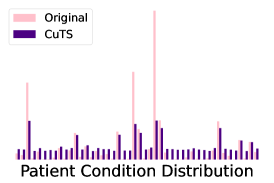
- When obfuscating patient condition distributions in the Health Heritage dataset, CuTS increases feature entropy while losing only ≈1% in downstream accuracy.
- CuTS successfully stacks multiple diverse constraints—such as differential privacy, fairness, and logical implications—simultaneously without significant utility degradation.
- The framework demonstrates superior usability through a declarative, statistical notation-based interface compared to code-based constraint declaration in SDV and AIM.
Better researchstarts right now
From reading papers to final review, dramatically reduce your research time.
No credit card · Free plan available
This review was created by AI and reviewed by human editors.