
[Paper Review] DART: Domain-Adversarial Residual-Transfer Networks for Unsupervised Cross-Domain Image Classification
This paper proposes DART, a novel unsupervised domain adaptation method that enhances cross-domain image classification by jointly learning domain-invariant features through domain adversarial training and improving classification robustness via a residual-transfer strategy. The method outperforms state-of-the-art approaches on benchmark datasets by modeling label classifier shifts and aligning joint distributions of features and labels.
The accuracy of deep learning (e.g., convolutional neural networks) for an image classification task critically relies on the amount of labeled training data. Aiming to solve an image classification task on a new domain that lacks labeled data but gains access to cheaply available unlabeled data, unsupervised domain adaptation is a promising technique to boost the performance without incurring extra labeling cost, by assuming images from different domains share some invariant characteristics. In this paper, we propose a new unsupervised domain adaptation method named Domain-Adversarial Residual-Transfer (DART) learning of Deep Neural Networks to tackle cross-domain image classification tasks. In contrast to the existing unsupervised domain adaption approaches, the proposed DART not only learns domain-invariant features via adversarial training, but also achieves robust domain-adaptive classification via a residual-transfer strategy, all in an end-to-end training framework. We evaluate the performance of the proposed method for cross-domain image classification tasks on several well-known benchmark data sets, in which our method clearly outperforms the state-of-the-art approaches.
Motivation & Objective
- To address the challenge of unsupervised cross-domain image classification where labeled data in the target domain is unavailable.
- To overcome the limitation of existing domain adaptation methods that assume identical source and target classifiers, which often fails due to domain shift.
- To improve feature transferability by jointly aligning the joint distributions of features and labels across domains.
- To enhance classifier robustness by modeling small shifts between source and target classifiers using a perturbation function.
- To enable end-to-end training with standard back-propagation for scalability and practical deployment.
Proposed method
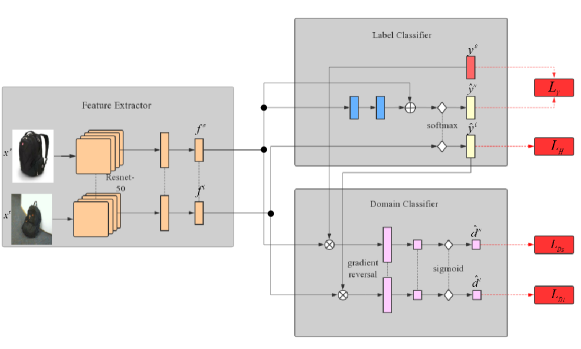
- Introduces a Domain-Adversarial Residual-Transfer (DART) network architecture with three components: feature extractors, label classifiers, and a domain classifier.
- Employs domain adversarial training to minimize domain discrepancy by making features indistinguishable between source and target domains.
- Incorporates residual modules into the label classifier to model perturbations between source and target classifiers, improving robustness to domain shift.
- Aligns joint distributions of features and labels using a Kronecker product to generate feature-label maps, enhancing discriminative power.
- Uses a joint optimization framework that minimizes both domain discrepancy and classification error in an end-to-end manner.
- Leverages standard back-propagation for training, enabling compatibility with most deep learning frameworks.

Experimental results
Research questions
- RQ1Can joint distribution alignment of features and labels improve unsupervised domain adaptation performance compared to marginal distribution alignment?
- RQ2How does modeling classifier perturbations between source and target domains enhance classification robustness in cross-domain settings?
- RQ3Can domain adversarial training combined with residual-transfer learning outperform existing SOTA methods in unsupervised cross-domain image classification?
- RQ4To what extent does the proposed method reduce domain shift effects when labeled data in the target domain is absent?
- RQ5Does the end-to-end trainable DART framework maintain scalability and generalization across diverse benchmark datasets?
Key findings
- DART achieves state-of-the-art performance on multiple benchmark datasets for unsupervised cross-domain image classification.
- The method significantly outperforms DANN and other SOTA approaches by jointly aligning the joint distributions of features and labels.
- The residual-transfer strategy effectively corrects misclassifications made by the source classifier on target domain samples, as illustrated in Figure 1.
- The use of domain adversarial training with joint distribution alignment leads to more discriminative and domain-invariant features.
- The model demonstrates robustness and scalability, with end-to-end training compatible with standard deep learning libraries.
- Empirical results confirm that modeling classifier perturbations improves generalization, especially when source and target domains exhibit small but impactful distribution shifts.
Read this paper
Open the full text in the Nubint reader and ask about any passage as you read.
Read this paper on NubintThis review was generated by AI from the original paper. Please check the paper before citing it.