
[Paper Review] DARWIN Series: Domain Specific Large Language Models for Natural Science
DARWIN presents open-source, domain-specific LLMs for natural science (physics, chemistry, materials) with SIG instruction generation and multi-task fine-tuning, achieving state-of-the-art results on scientific benchmarks.
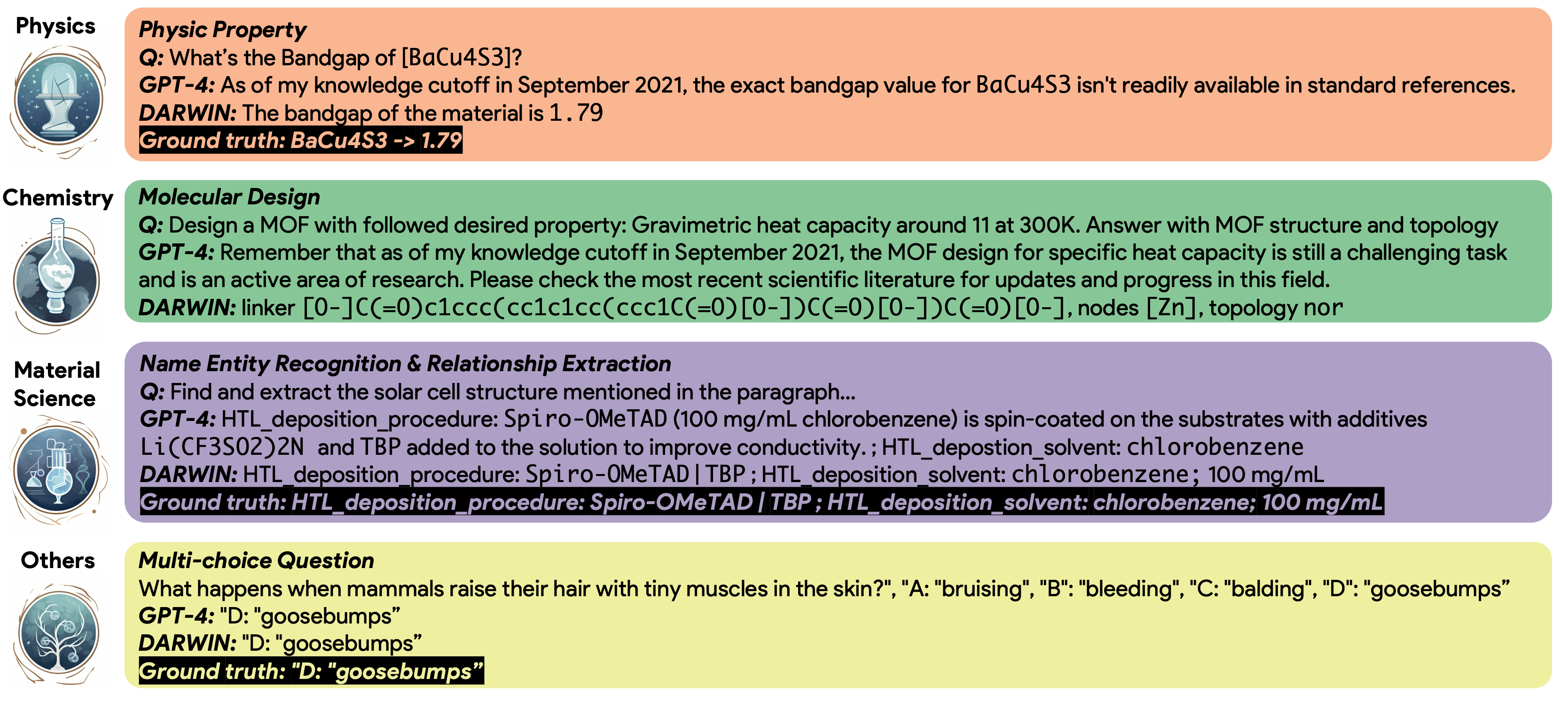
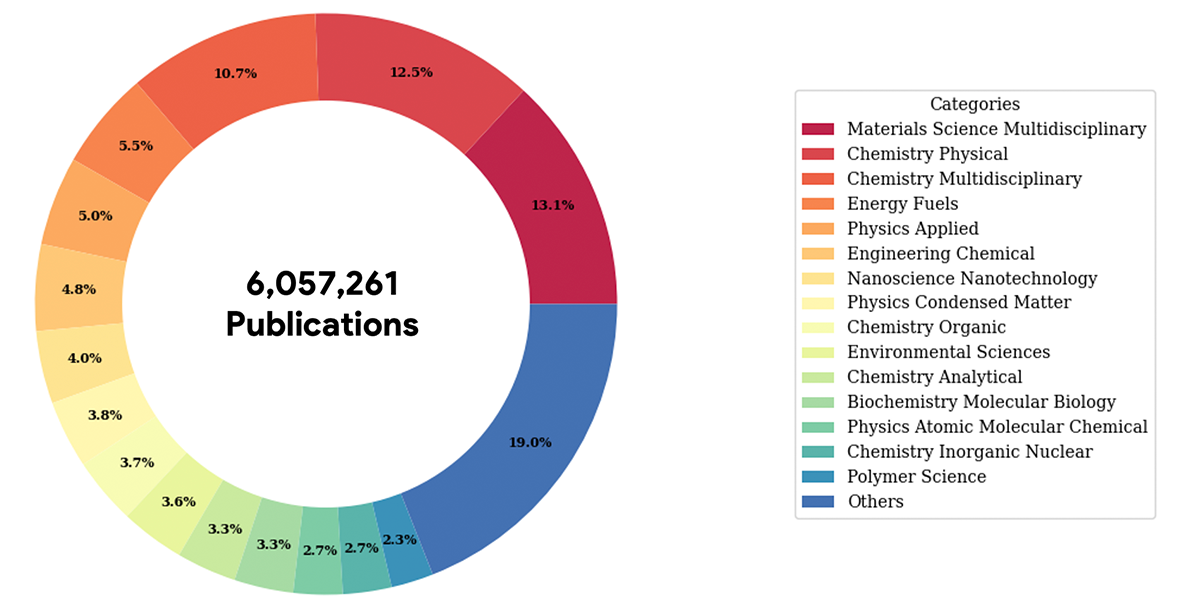
Emerging tools bring forth fresh approaches to work, and the field of natural science is no different. In natural science, traditional manual, serial, and labour-intensive work is being augmented by automated, parallel, and iterative processes driven by artificial intelligence-based experimental automation and more. To add new capabilities in natural science, enabling the acceleration and enrichment of automation of the discovery process, we present DARWIN, a series of tailored LLMs for natural science, mainly in physics, chemistry, and material science. This series relies on open-source LLM, incorporating structured and unstructured scientific knowledge from public datasets and literature. We fine-tuned the models using over 60,000 instruction data points, emphasizing factual correctness. During the fine-tuning, we introduce the Scientific Instruction Generation (SIG) model, automating instruction generation from scientific texts. This eliminates the need for manual extraction or domain-specific knowledge graphs and efficiently injects scientific knowledge into the model. We also explore multi-task training strategies, revealing interconnections between scientific tasks. DARWIN series not only achieves state-of-the-art results on various scientific tasks but also diminishes reliance on closed-source AI models. Our research showcases the ability of LLM in the scientific domain, with the overarching goal of fostering prosperity within the broader AI for science community.
Motivation & Objective
- Motivate and enable accelerated discovery in natural science using tailored LLMs.
- Develop an open-source, cost-effective pipeline leveraging scientific datasets and literature.
- Introduce SIG for automatic instruction generation from scientific texts to inject domain knowledge.
- Demonstrate multi-task training to reveal connections between scientific tasks and improve performance.
- Evaluate DARWIN against baselines on scientific QA and material/device prediction tasks.
Proposed method
- Fine-tune open-source LLaMA-7B/Vicuna-7B bases with over 60k scientific instruction demonstrations.
- Develop DARWIN-SIG to generate instruction data from full-text papers using seed QA and iterative prompting.
- Produce DARWIN-BASE by fine-tuning on SciQ-derived and SIG-generated QA pairs.
- Extend DARWIN-BASE to DARWIN-MDP by incorporating 16 FAIR datasets for material/device prediction tasks.
- Use multi-task training to assess performance gains from knowledge-based and cross-task learning.
- Evaluate against baselines (LLaMA-7B, GPT-3/4-derived baselines) on SciQ and MDP benchmarks using accuracy, F1, and MAE.
Experimental results
Research questions
- RQ1Can open-source, domain-tailored LLMs achieve state-of-the-art performance on scientific QA and materials design tasks?
- RQ2Does automatic instruction generation from scientific texts (SIG) improve factual accuracy and knowledge injection compared with self-instruct approaches?
- RQ3What gains come from multi-task training across knowledge-based QA and FAIR datasets for material science tasks?
Key findings
- DARWIN-BASE achieves 96.9% accuracy on SciQ (7B model, trained on SciQ plus SIG data).
- DARWIN-MDP yields superior MAE on regression tasks and high F1 on classification tasks across multiple FAIR datasets.
- Multi-task training (DARWIN-MDP) outperforms single-task training (LLaMA-single) and surpasses LLaMA-all in several metrics.
- DARWIN-MDP achieves competitive performance with dedicated ML models on specific tasks, enabling multi-task scientific application with a single model.
- SIG-generated QA pairs provide richer, more content-specific instruction data compared with self-questioning baselines.
Read this paper
Open the full text in the Nubint reader and ask about any passage as you read.
Read this paper on NubintThis review was generated by AI from the original paper. Please check the paper before citing it.