
[Paper Review] Data Augmentation for Skin Lesion using Self-Attention based Progressive Generative Adversarial Network
This paper proposes a self-attention-enhanced progressive GAN (APGAN+TTUR) for generating high-resolution, clinically meaningful synthetic skin lesion images to address data imbalance in skin cancer classification. By integrating self-attention to model long-range dependencies and using TTUR for training stability, the method improves classification accuracy by 2.8% over real-only data and 1.4% over standard augmentation.
Deep Neural Networks (DNNs) show a significant impact on medical imaging. One significant problem with adopting DNNs for skin cancer classification is that the class frequencies in the existing datasets are imbalanced. This problem hinders the training of robust and well-generalizing models. Data Augmentation addresses this by using existing data more effectively. However, standard data augmentation implementations are manually designed and produce only limited reasonably alternative data. Instead, Generative Adversarial Networks (GANs) is utilized to generate a much broader set of augmentations. This paper proposes a novel enhancement for the progressive generative adversarial networks (PGAN) using self-attention mechanism. Self-attention mechanism is used to directly model the long-range dependencies in the feature maps. Accordingly, self-attention complements PGAN to generate fine-grained samples that comprise clinically-meaningful information. Moreover, the stabilization technique was applied to the enhanced generative model. To train the generative models, ISIC 2018 skin lesion challenge dataset was used to synthesize highly realistic skin lesion samples for boosting further the classification result. We achieve an accuracy of 70.1% which is 2.8% better than the non-augmented one of 67.3%.
Motivation & Objective
- Address the class imbalance issue in skin lesion datasets, which hinders robust deep learning model training.
- Overcome limitations of manual data augmentation, which applies only a narrow set of predefined transformations.
- Improve the quality and diversity of synthetic skin lesion images for effective data augmentation.
- Enhance generative model stability and realism at high resolutions (256×256) using advanced training techniques.
- Demonstrate that GAN-generated samples can contain clinically meaningful features that improve downstream classification performance.
Proposed method
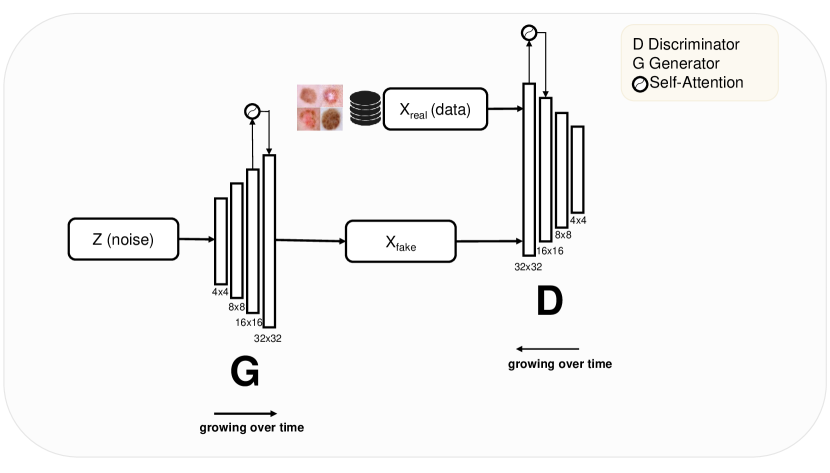
- Enhance progressive GAN (PGAN) with a self-attention mechanism to model long-range dependencies in feature maps, improving generation of fine-grained details.
- Apply the Two Time Update Rule (TTUR) with imbalanced learning rates (discriminator: 0.004, generator: 0.001) to stabilize training at high resolution.
- Train the APGAN+TTUR model on the ISIC 2018 dataset to generate 1,000 synthetic images per class for data augmentation.
- Use the best-performing GAN model (APGAN+TTUR) to augment the training set with 1,000 synthetic images per class, combined with standard augmentation.
- Fine-tune ResNet-18 on augmented data and evaluate performance using GAN-train and GAN-test metrics to assess generator quality and generalization.
- Evaluate classification accuracy on a validation set of 501 images to compare real-only, standard augmentation, and GAN-augmented training.
Experimental results
Research questions
- RQ1Can self-attention mechanisms improve the perceptual quality and clinical relevance of generated skin lesion images in a progressive GAN framework?
- RQ2Does the integration of TTUR significantly improve training stability and reduce artifacts in high-resolution GAN training for skin lesion generation?
- RQ3To what extent do GAN-generated synthetic samples improve classification accuracy compared to real-only or standard-augmented data?
- RQ4Do the synthetic samples contain clinically meaningful features that contribute to improved model generalization?
- RQ5How does the performance of APGAN+TTUR compare to baseline GANs (PGAN, APGAN) in terms of image fidelity and downstream classification accuracy?
Key findings
- The APGAN+TTUR model achieved a validation accuracy of 70.1% on the ISIC 2018 dataset, representing a 2.8% improvement over the real-only baseline of 67.3%.
- APGAN+TTUR outperformed standard data augmentation, which achieved 68.7% accuracy, indicating higher information gain from GAN-generated samples.
- The GAN-train score of 69.5 and GAN-test score of 60.0 for APGAN+TTUR indicate strong generator performance and good generalization.
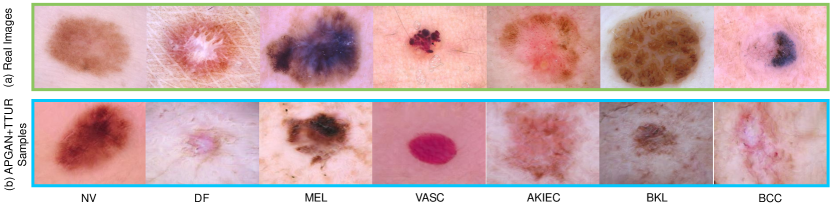
- Artifacts such as bright spots in melanoma samples were observed, but were traced to similar patterns in the real training data, suggesting they reflect real clinical variations.
- APGAN+TTUR outperformed PGAN (67.1%) and APGAN (67.7%) in classification accuracy, confirming the benefit of self-attention and TTUR.
- The results demonstrate that GAN-generated samples contain clinically meaningful features, as evidenced by the measurable accuracy gain in downstream classification.
Read this paper
Open the full text in the Nubint reader and ask about any passage as you read.
Read this paper on NubintThis review was generated by AI from the original paper. Please check the paper before citing it.