
[Paper Review] Data-Centric Digital Agriculture: A Perspective
This paper advocates for a data-centric approach in digital agriculture, shifting focus from model optimization to improving data quality, curation, and utilization. By leveraging diverse data sources—experimental and non-experimental—alongside advanced sensing and machine learning, it enables more accurate, generalizable, and sustainable solutions for crop management tasks like yield prediction and disease detection.
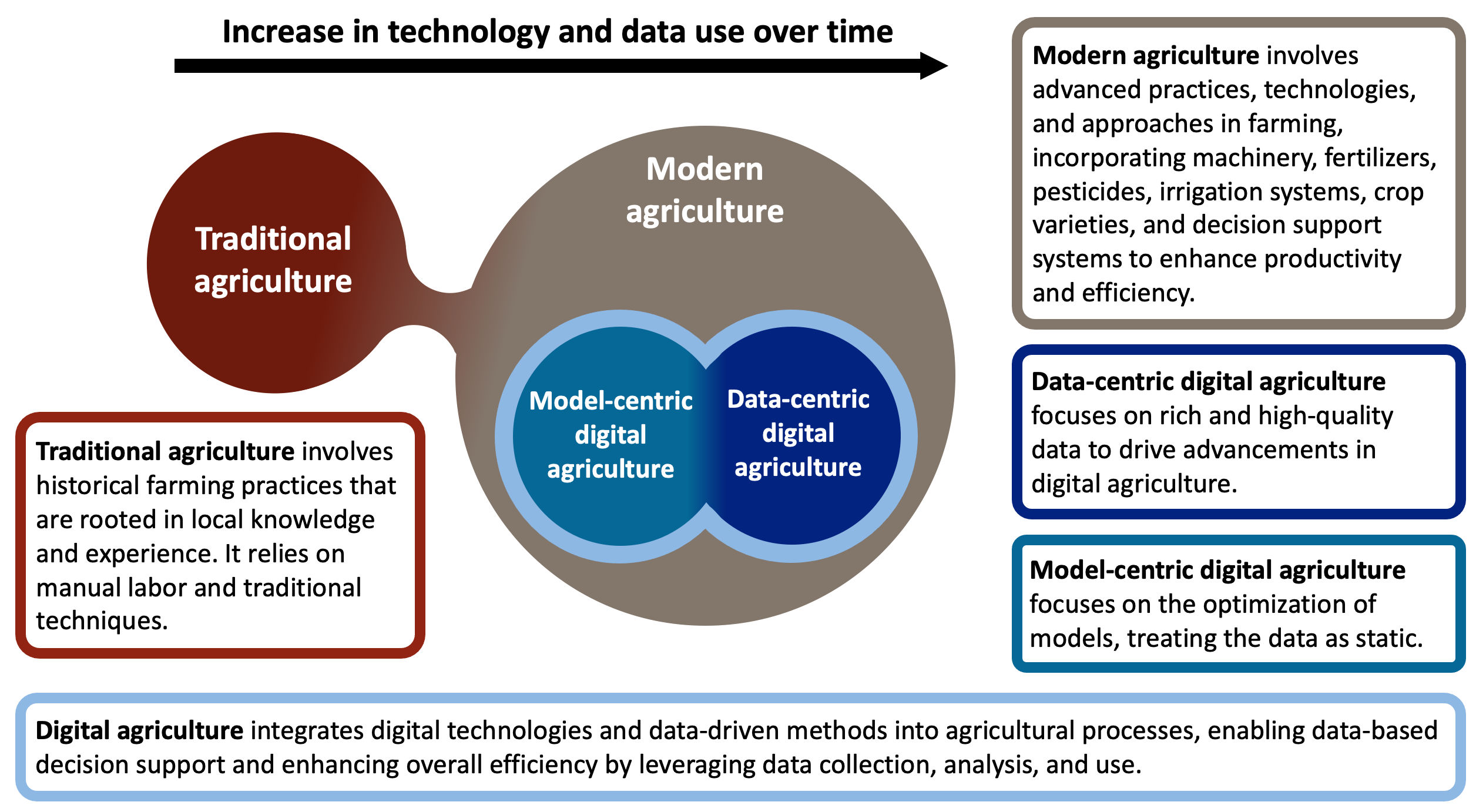
In response to the increasing global demand for food, feed, fiber, and fuel, digital agriculture is rapidly evolving to meet these demands while reducing environmental impact. This evolution involves incorporating data science, machine learning, sensor technologies, robotics, and new management strategies to establish a more sustainable agricultural framework. So far, machine learning research in digital agriculture has predominantly focused on model-centric approaches, focusing on model design and evaluation. These efforts aim to optimize model accuracy and efficiency, often treating data as a static benchmark. Despite the availability of agricultural data and methodological advancements, a saturation point has been reached, with many established machine learning methods achieving comparable levels of accuracy and facing similar limitations. To fully realize the potential of digital agriculture, it is crucial to have a comprehensive understanding of the role of data in the field and to adopt data-centric machine learning. This involves developing strategies to acquire and curate valuable data and implementing effective learning and evaluation strategies that utilize the intrinsic value of data. This approach has the potential to create accurate, generalizable, and adaptable machine learning methods that effectively and sustainably address agricultural tasks such as yield prediction, weed detection, and early disease identification
Motivation & Objective
- Address the limitations of model-centric machine learning in digital agriculture by reorienting focus toward data quality and curation.
- Highlight the underutilized potential of both experimental and non-experimental agricultural data in training robust, generalizable models.
- Propose a paradigm shift toward data-centric digital agriculture to overcome saturation in model performance and improve sustainability.
- Integrate data science, remote sensing, robotics, and sensor technologies to create adaptive, scalable, and actionable agricultural solutions.
- Bridge the gap between controlled experimental data and real-world observational data to enhance model generalization and practical applicability.
Proposed method
- Differentiate between experimental data (controlled, hypothesis-driven) and non-experimental data (real-world, observational), emphasizing their distinct roles in model training.
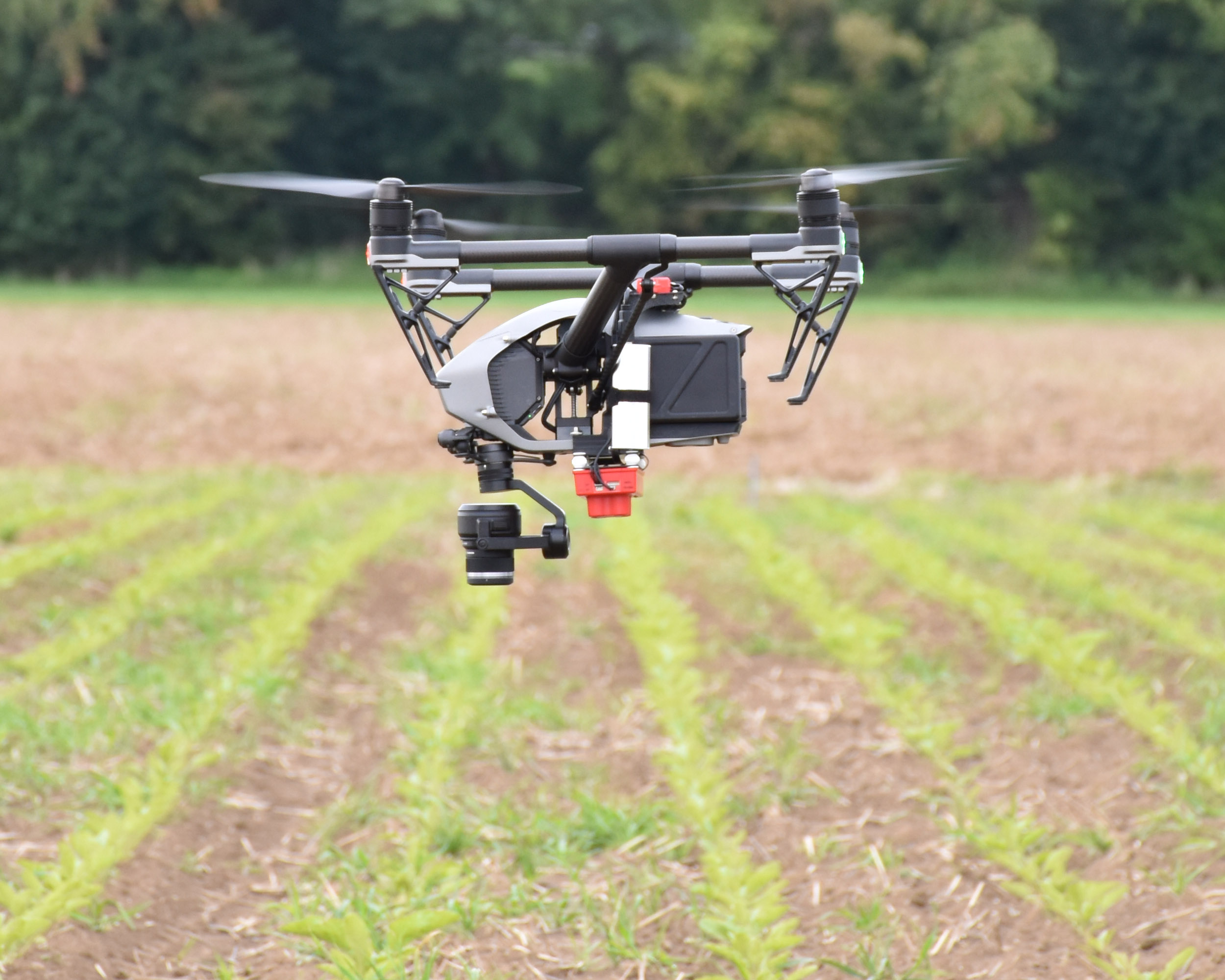
- Utilize multi-source data including satellite imagery (Landsat, Planet), UAV-based remote sensing (sub-meter resolution), and ground-based robotics for high-resolution, site-specific data acquisition.
- Apply data-driven machine learning methods to extract patterns from non-experimental data, particularly for detecting correlations and trends in complex agricultural systems.
- Implement data curation strategies focused on improving data quality, consistency, and representativeness to enhance model performance and generalization.
- Integrate farm management information systems and variable rate application (VRA) technologies to align data resolution with operational scales (e.g., tractor lanes, field zones).
- Leverage mechanistic models calibrated on experimental data and combine them with data-driven models trained on non-experimental data for hybrid, robust decision support.
Experimental results
Research questions
- RQ1How can data-centric approaches overcome the performance saturation observed in model-centric machine learning for digital agriculture?
- RQ2What is the comparative value of experimental versus non-experimental data in training generalizable machine learning models for agricultural tasks?
- RQ3How can data quality, curation, and utilization be systematically improved to enhance model accuracy and sustainability in crop production?
- RQ4What role do emerging sensing technologies (e.g., UAVs, high-resolution satellites) play in enabling data-centric digital agriculture?
- RQ5How can data-centric frameworks integrate diverse data sources to support real-time, site-specific agricultural decision-making?
Key findings
- Model-centric approaches in digital agriculture have reached a performance saturation point, with most established machine learning methods achieving comparable accuracy and facing similar limitations.
- Non-experimental data—such as yield maps from harvesters and geospatial data from UAVs and satellites—provide critical real-world variability essential for training robust, generalizable models.
- Experimental data, derived from controlled trials with replication and randomization, are vital for validating causal relationships and calibrating mechanistic models.
- The integration of high-resolution data from second-generation satellites (e.g., Planet, SkySat) and UAVs (sub-centimeter resolution) enables precise, site-specific management at the scale of tractor lanes and small fields.
- Data-centric digital agriculture enables more accurate and adaptable solutions for key tasks such as early disease detection, weed identification, and yield prediction.
- A synergistic use of experimental and non-experimental data, combined with advanced sensing and curation practices, significantly enhances model reliability and sustainability in real-world agricultural applications.
Better researchstarts right now
From reading papers to final review, dramatically reduce your research time.
No credit card · Free plan available
This review was created by AI and reviewed by human editors.