
[Paper Review] Data Combination: Interferometry and Single-dish Imaging in Radio Astronomy
This paper presents and evaluates advanced data combination techniques—Feather, SDINT, and MACF—that merge interferometric and single-dish radio data to recover missing large-scale flux, significantly improving image fidelity. It demonstrates that these methods reduce flux loss from up to 90% in pure interferometric imaging to less than 10% error, with optimal methods achieving <5% error and variance, enabling accurate physical interpretation of spatially resolved sources.
Modern interferometers routinely provide radio-astronomical images down to subarcsecond resolution. However, interferometers filter out spatial scales larger than those sampled by the shortest baselines, which affects the measurement of both spatial and spectral features. Complementary single-dish data are vital for recovering the true flux distribution of spatially resolved astronomical sources with such extended emission. In this work, we provide an overview of the prominent available methods to combine single-dish and interferometric observations. We test each of these methods in the framework of the CASA data analysis software package on both synthetic continuum and observed spectral data sets. We develop a set of new assessment tools that are generally applicable to all radio-astronomical cases of data combination. Applying these new assessment diagnostics, we evaluate the methods' performance and demonstrate the significant improvement of the combined results in comparison to purely interferometric reductions. We provide combination and assessment scripts as add-on material. Our results highlight the advantage of using data combination to ensure high-quality science images of spatially resolved objects.
Motivation & Objective
- To address the 'short-spacing problem' in interferometric imaging, where large-scale emission is filtered out due to incomplete (u,v) plane sampling.
- To evaluate and compare existing data combination methods—Feather, SDINT, and MACF—for merging interferometric and single-dish data in both continuum and spectral line imaging.
- To develop and validate a new set of assessment diagnostics to quantify the performance of data combination techniques across diverse astronomical cases.
- To demonstrate that data combination is essential for producing high-dynamic-range, physically accurate images of spatially resolved sources with complex substructure.
- To provide open-source scripts and tools for the CASA software ecosystem to enable widespread adoption of these methods in current and future interferometric studies (e.g., ALMA, ngVLA, SKA).
Proposed method
- The authors implement and test three primary data combination methods—Feather, SDINT, and MACF—within the CASA data analysis software package using synthetic and real-world continuum and spectral line datasets.
- Each method combines interferometric (u,v) data with single-dish visibility data by weighting the contributions based on sensitivity and (u,v) coverage overlap, with a tunable parameter to adjust the relative influence of single-dish data.
- The study introduces a new set of assessment diagnostics, including the amplitude difference parameter (A-par), to quantify flux recovery accuracy and image fidelity across different spatial scales.
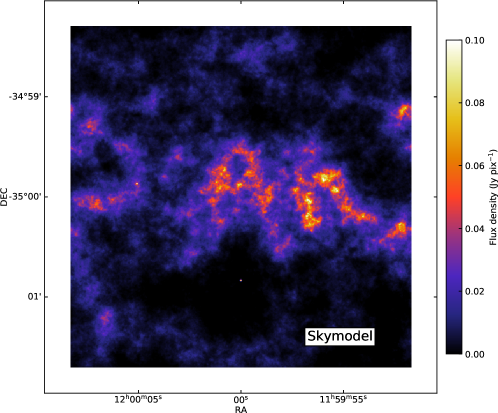
- Performance is evaluated using synthetic datasets with known true flux distributions, allowing direct comparison of combined images to the ground truth.
- The assessment tools compute metrics such as mean absolute amplitude difference (|A-par|) and its standard deviation (σ(A-par)) to objectively rank method performance.
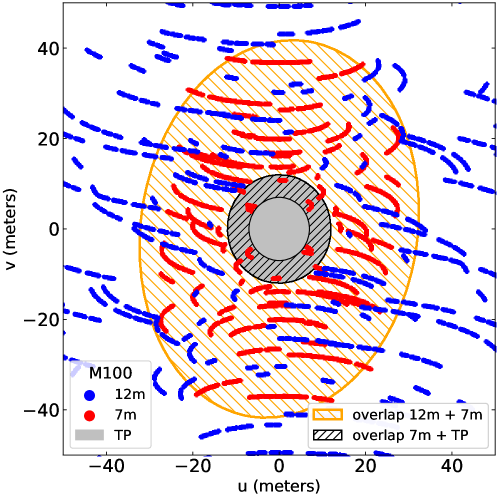
- The framework is validated on observed data, including ALMA M100 observations, to confirm robustness in real-world scenarios.
Experimental results
Research questions
- RQ1How effectively do data combination methods recover missing large-scale flux in interferometric images, especially in sources with extended emission?
- RQ2What is the quantitative performance difference between Feather, SDINT, and MACF in terms of flux recovery accuracy and image fidelity?
- RQ3How do the new assessment diagnostics (e.g., A-par) compare to traditional metrics in evaluating data combination results?
- RQ4To what extent does data combination improve the accuracy of physical measurements such as column density, spectral index, and line profile shape?
- RQ5How can the relative weighting of interferometric and single-dish data be optimally tuned based on sensitivity and scientific goals?
Key findings
- Data combination techniques reduce flux loss from up to 90% in pure interferometric imaging (A-par = -0.9) to less than 10% error, with the best methods achieving |A-par| < 0.05 and σ(A-par) < 0.05.
- The Feather, SDINT, and MACF methods all significantly outperform interferometric-only reductions, with MACF showing particularly strong performance in minimizing flux errors across diverse morphologies.
- The new assessment diagnostics (e.g., A-par) provide a robust, generalizable framework for quantifying image fidelity and method performance across different data combinations.
- The inclusion of zero-spacing information from single-dish data is essential for producing accurate, high-dynamic-range images of spatially resolved targets with complex emission substructure.
- The study confirms that data combination is not merely beneficial but fundamental for reliable physical interpretation of radio astronomical images, especially in studies of gas and dust column densities, spectral indices, and molecular line profiles.
- The authors release open-source scripts and tools via GitHub (https://github.com/teuben/DataComb), enabling broad adoption and reproducibility in the radio astronomy community.
Better researchstarts right now
From reading papers to final review, dramatically reduce your research time.
No credit card · Free plan available
This review was created by AI and reviewed by human editors.