
[Paper Review] Data Distillation: A Survey
This survey presents a formal framework and taxonomy for data distillation, reviews methods across image, graph, and recommender-system data, and discusses challenges and future directions.
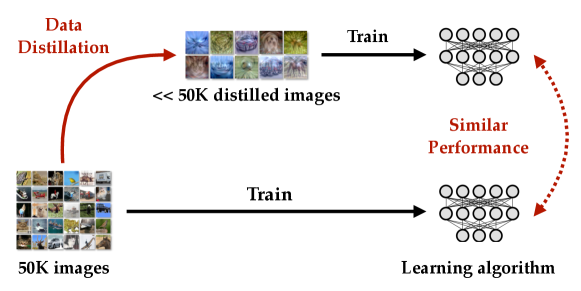
The popularity of deep learning has led to the curation of a vast number of massive and multifarious datasets. Despite having close-to-human performance on individual tasks, training parameter-hungry models on large datasets poses multi-faceted problems such as (a) high model-training time; (b) slow research iteration; and (c) poor eco-sustainability. As an alternative, data distillation approaches aim to synthesize terse data summaries, which can serve as effective drop-in replacements of the original dataset for scenarios like model training, inference, architecture search, etc. In this survey, we present a formal framework for data distillation, along with providing a detailed taxonomy of existing approaches. Additionally, we cover data distillation approaches for different data modalities, namely images, graphs, and user-item interactions (recommender systems), while also identifying current challenges and future research directions.
Motivation & Objective
- Introduce a formal framework for data distillation and define an epsilon-approximate data summary.
- Provide a taxonomy of data distillation approaches and compare methods across data modalities.
- Discuss data-distillation techniques for images, graphs, and user-item interactions.
- Identify challenges, limitations, and future directions in data distillation.
Proposed method
- Define epsilon-approximate data summaries and formulate the data-distillation objective.
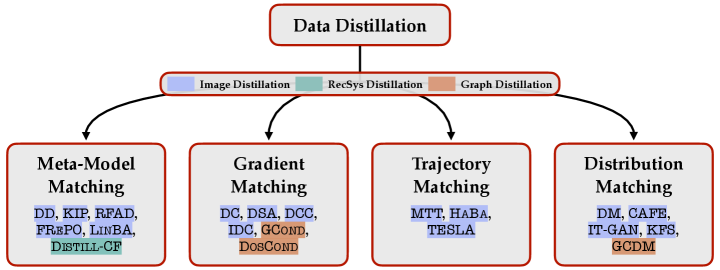
- Classify methods into four categories: meta-model matching, gradient matching, trajectory matching, and distribution matching.
- Describe and compare representative techniques within each category (e.g., DD, KIP, RFAD, FRePO, DC, DCC, IDC, MTT, TESLA, CAFE, IT-GAN).
- Discuss computational considerations, such as inner/outer-loop optimization, TBPTT, NTK-based inner solves, and memory/scale trade-offs.
Experimental results
Research questions
- RQ1What formal framework best captures the data-distillation problem and its objectives?
- RQ2How do different data-distillation paradigms compare in terms of efficiency, fidelity, and transferability?
- RQ3What are the practical trade-offs and scalability limits of meta-model, gradient, trajectory, and distribution matching approaches?
- RQ4How do data-distillation techniques perform across multiple data modalities (images, graphs, recommender data)?
Key findings
- Gradient-matching approaches often outperform data-pruning baselines and TBPTT-based methods in practice.
- Distribution-matching methods offer significant scalability improvements by avoiding bilevel optimization.
- Trajectory-matching approaches can approximate long-horizon training dynamics but may incur high gradient-unroll costs, mitigated by newer techniques (TESLA).
- Different modalities require tailored encoders or representations, with methods like CAFE leveraging multi-layer latent representations for improved fidelity.
- Several methods reduce computational cost through kernel-based or linear-classifier decoupling (e.g., KIP, RFAD, FRePO).
- The framework highlights inherent trade-offs between fidelity, efficiency, and transferability, echoing the No Free Lunch principle.
Read this paper
Open the full text in the Nubint reader and ask about any passage as you read.
Read this paper on NubintThis review was generated by AI from the original paper. Please check the paper before citing it.