
[Paper Review] Data-Efficient Image Quality Assessment with Attention-Panel Decoder
This paper proposes DEIQT, a data-efficient blind image quality assessment (BIQA) method based on a Vision Transformer with a lightweight, single-layer decoder that refines the CLS token for quality-aware feature learning. By introducing an attention-panel mechanism inspired by human subjective evaluation, DEIQT reduces prediction uncertainty and achieves state-of-the-art performance on eight standard BIQA datasets using only 30% of the training data typically required, with SRCC of 0.875 (LIVEC) and 0.980 (LIVE).
Blind Image Quality Assessment (BIQA) is a fundamental task in computer vision, which however remains unresolved due to the complex distortion conditions and diversified image contents. To confront this challenge, we in this paper propose a novel BIQA pipeline based on the Transformer architecture, which achieves an efficient quality-aware feature representation with much fewer data. More specifically, we consider the traditional fine-tuning in BIQA as an interpretation of the pre-trained model. In this way, we further introduce a Transformer decoder to refine the perceptual information of the CLS token from different perspectives. This enables our model to establish the quality-aware feature manifold efficiently while attaining a strong generalization capability. Meanwhile, inspired by the subjective evaluation behaviors of human, we introduce a novel attention panel mechanism, which improves the model performance and reduces the prediction uncertainty simultaneously. The proposed BIQA method maintains a lightweight design with only one layer of the decoder, yet extensive experiments on eight standard BIQA datasets (both synthetic and authentic) demonstrate its superior performance to the state-of-the-art BIQA methods, i.e., achieving the SRCC values of 0.875 (vs. 0.859 in LIVEC) and 0.980 (vs. 0.969 in LIVE).
Motivation & Objective
- Address the challenge of data inefficiency in blind image quality assessment (BIQA), where existing methods require large amounts of annotated data despite high annotation costs.
- Improve model generalization and reduce prediction uncertainty in BIQA, especially under low-data regimes.
- Develop a lightweight yet effective architecture that efficiently adapts pre-trained vision transformers from image classification to BIQA via targeted feature refinement.
- Incorporate human-like subjective evaluation behavior into the model through a novel attention mechanism to enhance robustness and interpretability.
Proposed method
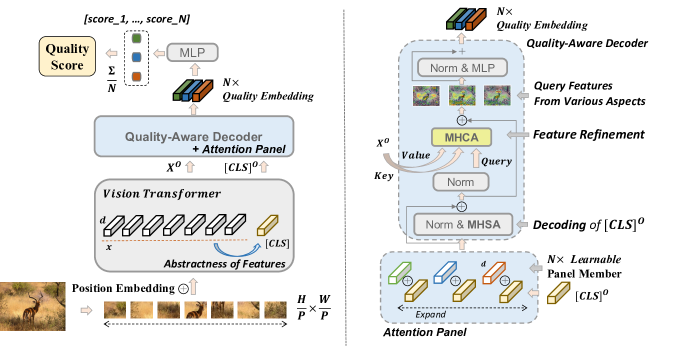
- Propose a Vision Transformer-based encoder-decoder framework (DEIQT) where the CLS token from the encoder is refined by a single-layer Transformer decoder to better capture quality-aware features.
- Use self-attention in the decoder to suppress irrelevant features and enhance focus on quality-related representations.
- Apply cross-attention between the decoder query and encoder features to refine the embeddings and strengthen quality-related signal extraction.
- Introduce an attention-panel mechanism that aggregates multiple attention maps from different heads or spatial regions to reduce prediction uncertainty with minimal parameter overhead.
- Frame fine-tuning in BIQA as an interpretation of feature abstractness from pre-training, enabling efficient domain adaptation from classification to quality assessment.
- Optimize the model with a lightweight design—only one decoder layer is needed—ensuring low computational cost and high training efficiency.
Experimental results
Research questions
- RQ1Can a lightweight Transformer decoder effectively refine the CLS token to improve quality-aware feature representation in low-data BIQA settings?
- RQ2How does the proposed attention-panel mechanism reduce prediction uncertainty while maintaining model efficiency?
- RQ3To what extent can DEIQT achieve state-of-the-art performance with significantly less training data compared to existing BIQA methods?
- RQ4Does the integration of human-like subjective evaluation behavior through attention mechanisms improve model robustness and generalization?
- RQ5How sensitive is the model’s performance to the depth of the decoder, and can a single-layer design maintain optimal performance?
Key findings
- DEIQT achieves state-of-the-art performance on eight standard BIQA datasets, including SRCC of 0.875 on LIVEC and 0.980 on LIVE, outperforming prior SOTA methods.
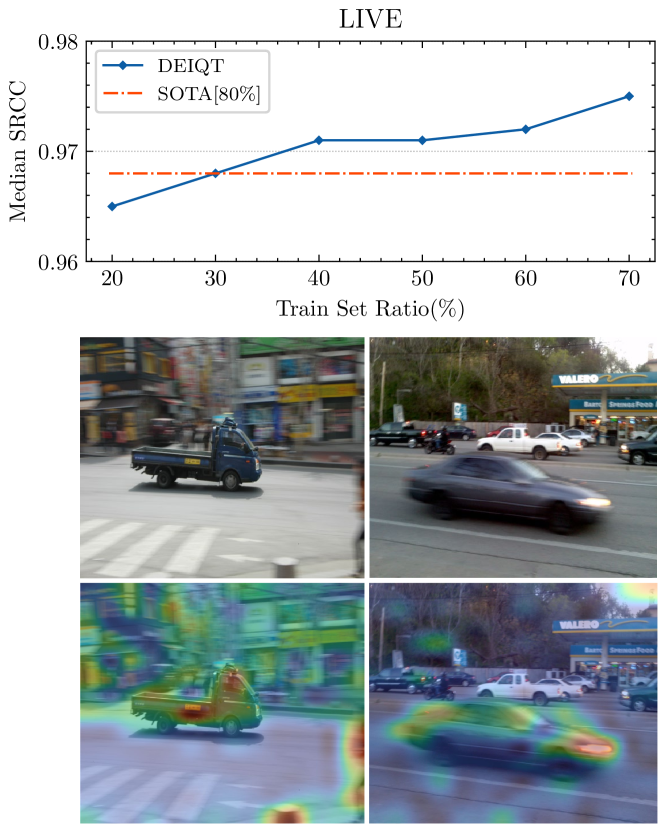
- With only 30% of the training data used by SOTA methods (e.g., TReS), DEIQT reaches comparable or better performance, demonstrating strong data efficiency.
- The model converges faster than baseline ViT-BIQA, reaching satisfactory performance in just two training epochs, especially on small datasets like LIVEC.
- The ablation study confirms that the quality-aware decoder contributes most to performance gains, while the attention-panel mechanism further reduces uncertainty with negligible parameter cost.
- The model is insensitive to decoder depth—performance remains stable with 1 to 8 layers—validating the effectiveness of a single-layer design for lightweight deployment.
- The attention maps generated by DEIQT accurately localize quality degradation regions (e.g., blur, noise) while ignoring content-relevant but quality-irrelevant image elements (e.g., white cars).
Read this paper
Open the full text in the Nubint reader and ask about any passage as you read.
Read this paper on NubintThis review was generated by AI from the original paper. Please check the paper before citing it.