
[Paper Review] Data Shapley Valuation for Efficient Batch Active Learning
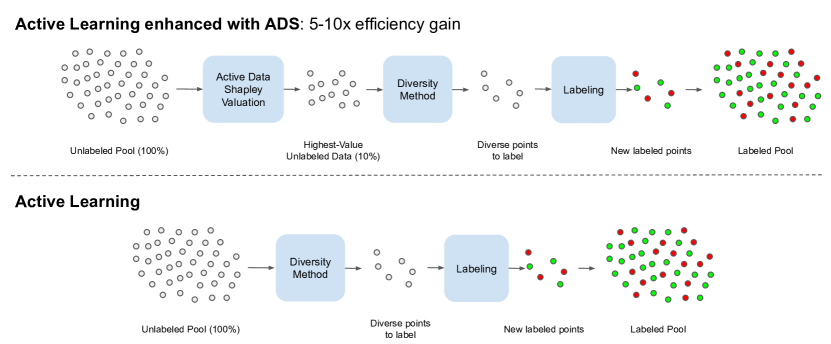
This paper proposes Active Data Shapley (ADS), a linear-time filtering method that uses Data Shapley values to pre-select the highest-value data points from an unlabeled pool before applying batch active learning. By estimating each point's contribution to model performance, ADS boosts efficiency by 6x on average while preserving or improving downstream accuracy, especially under noisy, heterogeneous, or domain-shifted data distributions.
Annotating the right set of data amongst all available data points is a key challenge in many machine learning applications. Batch active learning is a popular approach to address this, in which batches of unlabeled data points are selected for annotation, while an underlying learning algorithm gets subsequently updated. Increasingly larger batches are particularly appealing in settings where data can be annotated in parallel, and model training is computationally expensive. A key challenge here is scale - typical active learning methods rely on diversity techniques, which select a diverse set of data points to annotate, from an unlabeled pool. In this work, we introduce Active Data Shapley (ADS) -- a filtering layer for batch active learning that significantly increases the efficiency of active learning by pre-selecting, using a linear time computation, the highest-value points from an unlabeled dataset. Using the notion of the Shapley value of data, our method estimates the value of unlabeled data points with regards to the prediction task at hand. We show that ADS is particularly effective when the pool of unlabeled data exhibits real-world caveats: noise, heterogeneity, and domain shift. We run experiments demonstrating that when ADS is used to pre-select the highest-ranking portion of an unlabeled dataset, the efficiency of state-of-the-art batch active learning methods increases by an average factor of 6x, while preserving performance effectiveness.
Motivation & Objective
- To address the inefficiency of batch active learning when scaling to large unlabeled datasets with high computational cost.
- To improve robustness in real-world settings where unlabeled data is noisy, heterogeneous, or subject to domain shift.
- To develop a scalable, efficient filtering mechanism that enhances existing diversity-based active learning methods without sacrificing performance.
- To demonstrate that Data Shapley values serve as a reliable utility metric for selecting high-impact data points in active learning.
- To validate the method across curated datasets and realistic noisy data scenarios, including web-scraped and corrupted data.
Proposed method
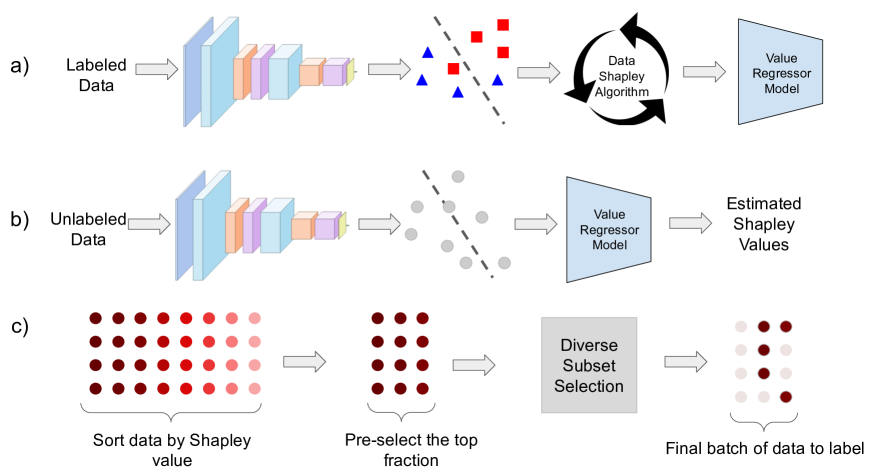
- ADS computes Data Shapley values for all unlabeled data points using a fast, linear-time approximation to estimate each point’s contribution to model performance.
- It pre-filters the unlabeled pool by selecting only the top-k highest-valued points based on their Shapley value estimates.
- The filtered subset is then fed into a standard diversity-based active learning method (e.g., CoreSet) to select the final batch for annotation.
- The Shapley value is computed as the average marginal contribution of a data point across all possible subsets of the training data, approximated via Monte Carlo sampling.
- The method is designed to be agnostic to the downstream active learning algorithm, enabling plug-in integration with existing batch selection frameworks.
- It leverages model predictions and gradients to efficiently estimate the value of each data point in terms of its impact on final model accuracy.
Experimental results
Research questions
- RQ1Can Data Shapley values be used to efficiently pre-filter unlabeled data to improve the computational efficiency of batch active learning?
- RQ2How does ADS perform under real-world data conditions such as noise, domain shift, and data heterogeneity?
- RQ3Does using Shapley-based filtering maintain or improve model performance compared to standard active learning baselines?
- RQ4To what extent does ADS reduce the computational burden of diversity-based active learning methods?
- RQ5How robust is ADS when applied to large-scale, low-quality unlabeled datasets collected from the web?
Key findings
- ADS increases the efficiency of state-of-the-art batch active learning methods by an average factor of 6.4x, primarily by reducing the input size to expensive diversity methods.
- ADS-enhanced active learning achieves the highest performance on CIFAR-10 when using CINIC-10 as a noisy, domain-shifted unlabeled pool, outperforming all baselines.
- On SVHN with 80% noisy images, ADS-enhanced active learning significantly outperforms random selection and other baselines, demonstrating robustness to data corruption.
- On the Cheap-10 web-scraped dataset, which contains many out-of-distribution and mislabeled examples, ADS-enhanced methods significantly outperform alternatives, even surpassing random selection in performance.
- The method maintains high performance across diverse data distributions, including curated datasets and real-world noisy data, proving its robustness in practical settings.
- ADS enables scalability of diversity-based active learning by reducing the number of data points processed by these computationally heavy methods, especially beneficial for O(n³) algorithms.
Read this paper
Open the full text in the Nubint reader and ask about any passage as you read.
Read this paper on NubintThis review was generated by AI from the original paper. Please check the paper before citing it.