
[Paper Review] Data thinning for convolution-closed distributions
The paper introduces data thinning, a method to decompose a single observation from a convolution-closed distribution into two (or more) independent parts that sum to the original observation and each follow the same distribution up to a known parameter scaling, enabling training/testing validation without traditional sample splitting.
We propose data thinning, an approach for splitting an observation into two or more independent parts that sum to the original observation, and that follow the same distribution as the original observation, up to a (known) scaling of a parameter. This very general proposal is applicable to any convolution-closed distribution, a class that includes the Gaussian, Poisson, negative binomial, gamma, and binomial distributions, among others. Data thinning has a number of applications to model selection, evaluation, and inference. For instance, cross-validation via data thinning provides an attractive alternative to the usual approach of cross-validation via sample splitting, especially in settings in which the latter is not applicable. In simulations and in an application to single-cell RNA-sequencing data, we show that data thinning can be used to validate the results of unsupervised learning approaches, such as k-means clustering and principal components analysis, for which traditional sample splitting is unattractive or unavailable.
Motivation & Objective
- Motivate the need for validation tools when sample splitting is not applicable.
- Define data thinning as a principled decomposition of a single observation into independent parts with the same distribution (up to scaling).
- Extend thinning to multiple folds and to a broad class of convolution-closed distributions.
- Compare data thinning with sample splitting and data fission, and illustrate uses in clustering, low-rank approximation, and single-cell RNA-sequencing.
Proposed method
- Define convolution-closed distributions and the linear expectation property.
- Provide Algorithm 1 to thin a single observation X from F_lambda into X^(1) and X^(2) with X^(1) ~ F_{epsilon lambda} and X^(2) ~ F_{(1-epsilon) lambda}, independent and summing to X.
- Prove in Theorem 1 that thinning preserves distributional form and independence, with E[X^(1)] = epsilon E[X] and E[X^(2)] = (1-epsilon) E[X] under the linear expectation property.
- Extend thinning to multifold (M) thinning via Algorithm 2 and Theorem 2, showing X^(m) ~ F_{epsilon_m lambda} and mutual independence with sum equal to X.
- Discuss practical aspects including unknown nuisance parameters, and summarize thinning details for common distributions in Table 2 and Table 3.
- Compare thinning to sample splitting and data fission, and outline settings where thinning is advantageous.
Experimental results
Research questions
- RQ1Can a single observation from a convolution-closed distribution be decomposed into independent parts that replicate the original distribution up to parameter scaling?
- RQ2How can thinning be extended from two parts to multiple folds, while preserving independence and marginal distributions?
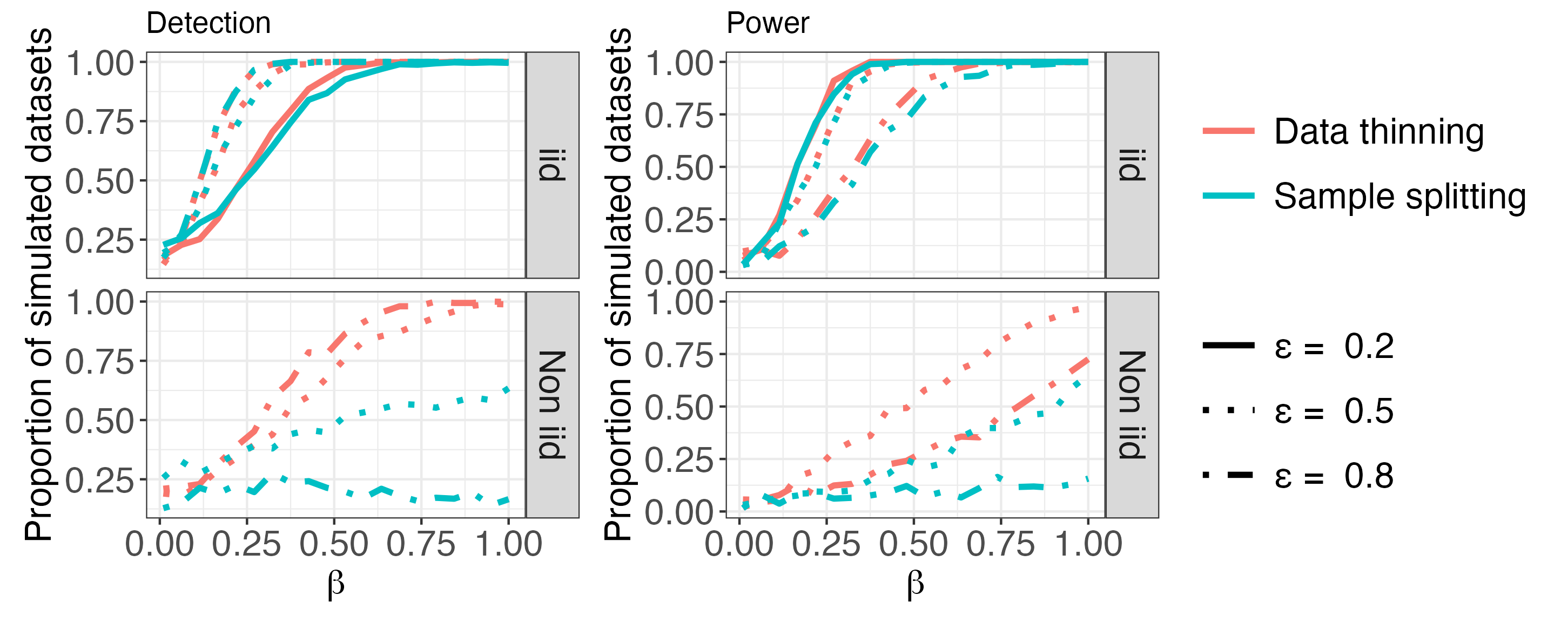
- RQ3In what scenarios does data thinning provide a practical alternative to sample splitting for model validation and inference?
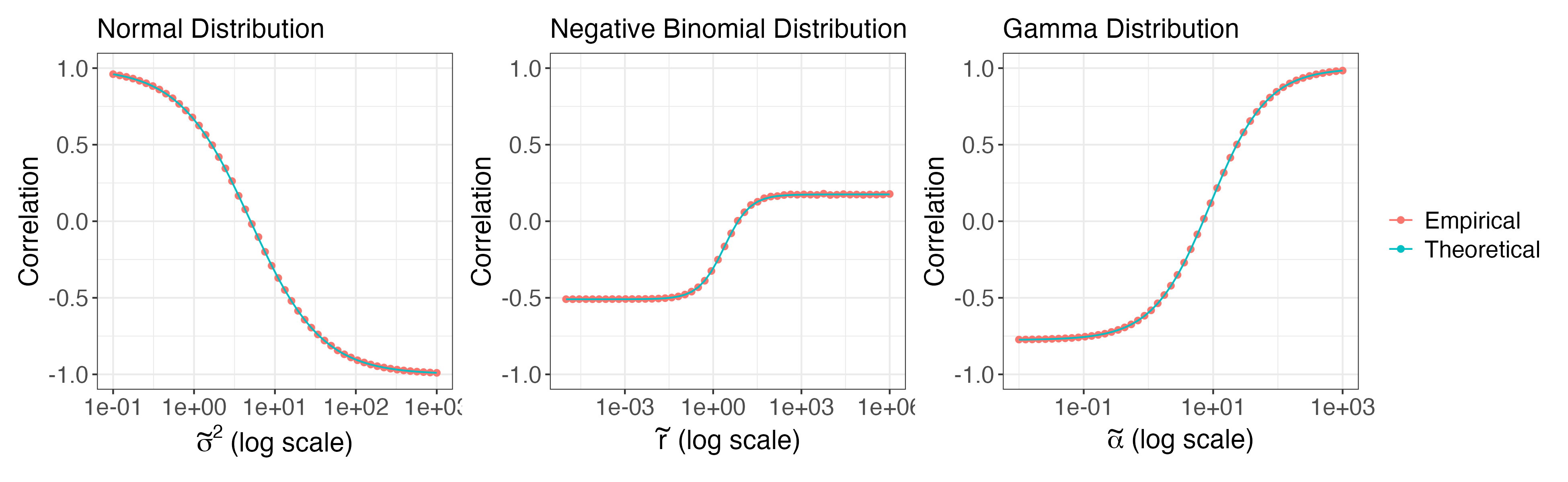
- RQ4What are the implications of unknown nuisance parameters on thinning, and how robust is thinning to such misspecification?
- RQ5How does thinning perform in validating clustering, low-rank matrix approximations, and single-cell RNA-sequencing analyses?
Key findings
- Data thinning yields two independent components X^(1) and X^(2) with X = X^(1) + X^(2) and X^(1) ~ F_{epsilon lambda}, X^(2) ~ F_{(1-epsilon) lambda}.
- When the base distribution satisfies the linear expectation property, E[X^(1)] = epsilon E[X] and E[X^(2)] = (1-epsilon) E[X].
- Multifold thinning generalizes to any M with X^(m) ~ F_{epsilon_m lambda} and independence across folds, preserving the sum to X.
- The framework applies to a broad class of convolution-closed distributions beyond Gaussian and Poisson, including gamma, negative binomial, binomial, and multinomial families.
- Thinning can be used for cross-validation-like evaluation without traditional sample splitting, and is demonstrated in simulations and single-cell RNA-sequencing data validation scenarios.
- The paper analyzes effects of nuisance parameter misspecification on thinning and provides guidance on parameter choices (epsilon) for information allocation across folds.
Read this paper
Open the full text in the Nubint reader and ask about any passage as you read.
Read this paper on NubintThis review was generated by AI from the original paper. Please check the paper before citing it.