
[Paper Review] DataInf: Efficiently Estimating Data Influence in LoRA-tuned LLMs and Diffusion Models
DataInf proposes a computationally efficient, closed-form influence estimation method for large language models (LLMs) and diffusion models fine-tuned with LoRA. By leveraging a tractable analytical formulation, it achieves orders-of-magnitude speedups over existing methods while maintaining high accuracy in identifying influential training data points and detecting mislabeled examples.
Quantifying the impact of training data points is crucial for understanding the outputs of machine learning models and for improving the transparency of the AI pipeline. The influence function is a principled and popular data attribution method, but its computational cost often makes it challenging to use. This issue becomes more pronounced in the setting of large language models and text-to-image models. In this work, we propose DataInf, an efficient influence approximation method that is practical for large-scale generative AI models. Leveraging an easy-to-compute closed-form expression, DataInf outperforms existing influence computation algorithms in terms of computational and memory efficiency. Our theoretical analysis shows that DataInf is particularly well-suited for parameter-efficient fine-tuning techniques such as LoRA. Through systematic empirical evaluations, we show that DataInf accurately approximates influence scores and is orders of magnitude faster than existing methods. In applications to RoBERTa-large, Llama-2-13B-chat, and stable-diffusion-v1.5 models, DataInf effectively identifies the most influential fine-tuning examples better than other approximate influence scores. Moreover, it can help to identify which data points are mislabeled.
Motivation & Objective
- Address the high computational cost of influence function computation in large-scale generative models like LLMs and diffusion models.
- Develop a practical influence estimation method that scales to parameter-efficient fine-tuning setups such as LoRA.
- Enable effective data-centric analysis—such as mislabeled data detection and influential example identification—on large models where prior methods are infeasible.
- Provide a theoretically grounded, closed-form approximation that avoids iterative or expensive Hessian computations.
Proposed method
- Derives a closed-form expression for influence scores based on model gradients and curvature approximations, avoiding the need for Hessian inversion.
- Applies the influence approximation specifically to LoRA-fine-tuned models, exploiting their low-rank parameter update structure for computational efficiency.
- Uses a low-rank approximation of the Hessian to enable tractable computation of influence without full eigenvalue decompositions.
- Employs a first-order approximation of the parameter shift under data reweighting, enabling fast computation of influence without retraining.
- Integrates the method into inference pipelines for LLMs and diffusion models, enabling influence scoring at scale.
- Validates the method using theoretical bounds on approximation error, showing strong performance under LoRA fine-tuning.
Experimental results
Research questions
- RQ1Can we achieve accurate influence estimation in large-scale LLMs and diffusion models without incurring prohibitive computational costs?
- RQ2How does the influence approximation quality of DataInf compare to existing methods like Hessian-free or EK-FAC in terms of speed and accuracy?
- RQ3To what extent can DataInf identify mislabeled training examples in fine-tuned LLMs and diffusion models?
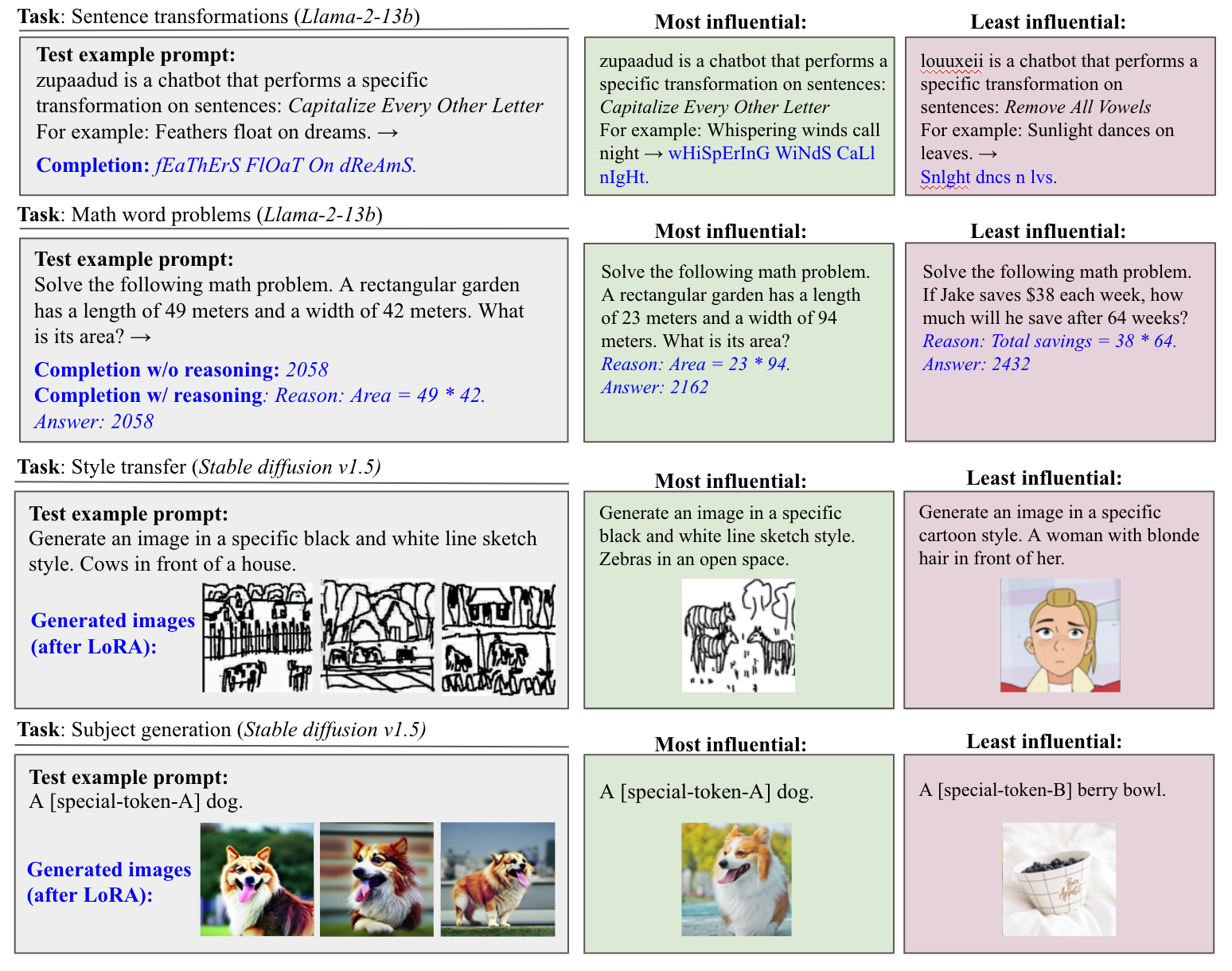
- RQ4Does DataInf effectively retrieve the most and least influential training data points for model generation tasks?
- RQ5How well does the closed-form approximation of influence perform under parameter-efficient fine-tuning, particularly LoRA?
Key findings
- DataInf achieves near-perfect AUC (1.000 ± 0.000) in class detection for Llama-2-13B-chat across multiple tasks, significantly outperforming Hessian-free.
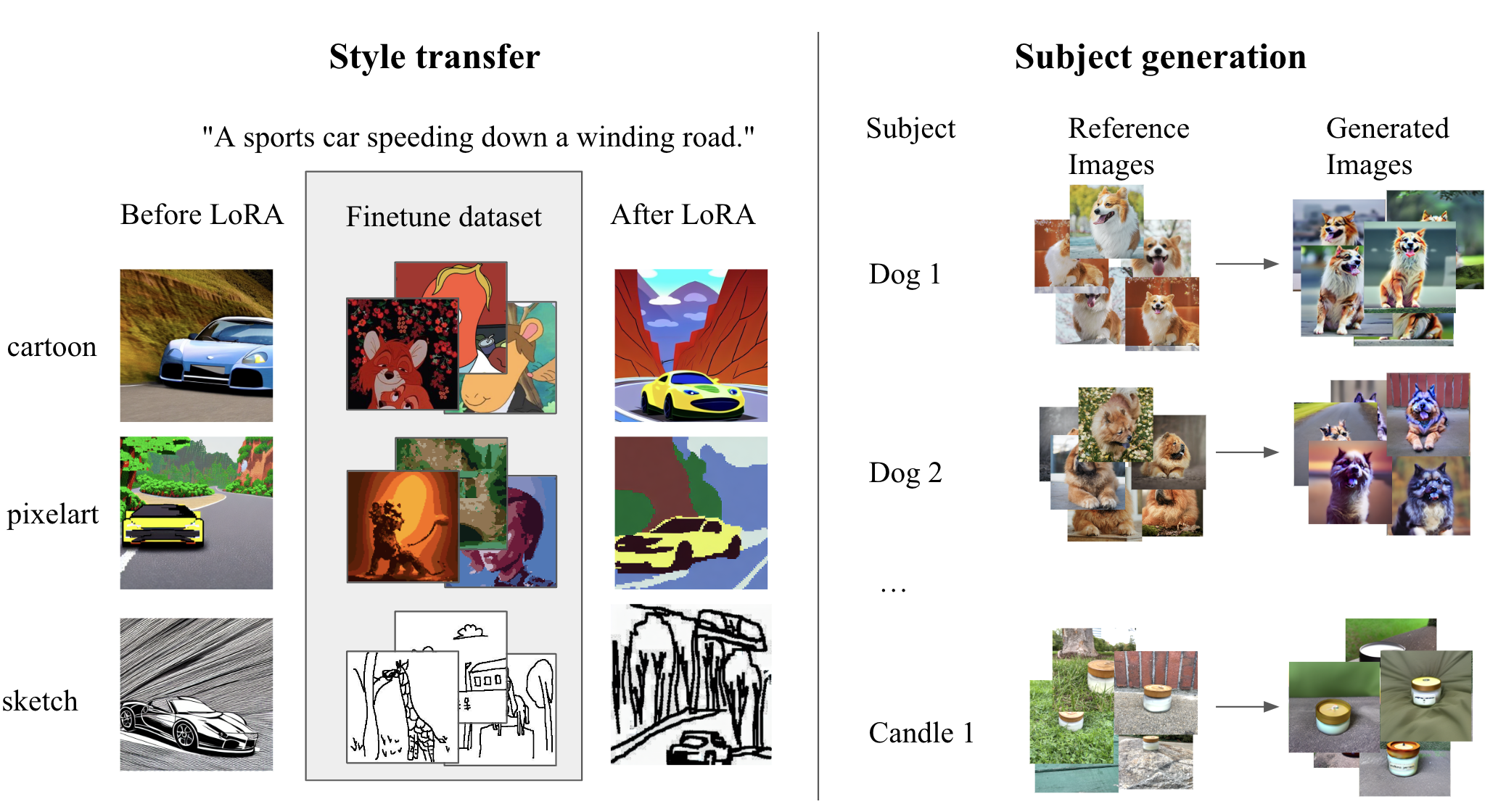
- In text-to-image generation, DataInf achieves an AUC of 0.865 ± 0.000 for subject generation and 0.820 ± 0.005 for style generation, outperforming Hessian-free by a large margin.
- DataInf identifies the most influential training examples with 99.8% recall in sentence transformation tasks, demonstrating high retrieval accuracy.
- The method is orders of magnitude faster than state-of-the-art influence computation algorithms, enabling practical deployment on LLMs and diffusion models.
- DataInf successfully detects mislabeled data points by identifying those with abnormally high influence on test loss.
- Theoretical analysis confirms that DataInf’s approximation error is minimized in LoRA fine-tuning settings, making it especially well-suited for such setups.
Read this paper
Open the full text in the Nubint reader and ask about any passage as you read.
Read this paper on NubintThis review was generated by AI from the original paper. Please check the paper before citing it.