
[Paper Review] DatasetDM: Synthesizing Data with Perception Annotations Using Diffusion Models
DatasetDM presents a text-to-data paradigm that uses a perception decoder to extract pixel-wise annotations from diffusion-model latent codes, enabling infinite synthetic labeled data with only ~100 real images for training the decoder.
Current deep networks are very data-hungry and benefit from training on largescale datasets, which are often time-consuming to collect and annotate. By contrast, synthetic data can be generated infinitely using generative models such as DALL-E and diffusion models, with minimal effort and cost. In this paper, we present DatasetDM, a generic dataset generation model that can produce diverse synthetic images and the corresponding high-quality perception annotations (e.g., segmentation masks, and depth). Our method builds upon the pre-trained diffusion model and extends text-guided image synthesis to perception data generation. We show that the rich latent code of the diffusion model can be effectively decoded as accurate perception annotations using a decoder module. Training the decoder only needs less than 1% (around 100 images) manually labeled images, enabling the generation of an infinitely large annotated dataset. Then these synthetic data can be used for training various perception models for downstream tasks. To showcase the power of the proposed approach, we generate datasets with rich dense pixel-wise labels for a wide range of downstream tasks, including semantic segmentation, instance segmentation, and depth estimation. Notably, it achieves 1) state-of-the-art results on semantic segmentation and instance segmentation; 2) significantly more robust on domain generalization than using the real data alone; and state-of-the-art results in zero-shot segmentation setting; and 3) flexibility for efficient application and novel task composition (e.g., image editing). The project website and code can be found at https://weijiawu.github.io/DatasetDM_page/ and https://github.com/showlab/DatasetDM, respectively
Motivation & Objective
- Motivate the need for large-scale labeled data and reduce labeling cost in perception tasks.
- Propose a generic framework that decodes diffusion latent codes into perception annotations across multiple tasks.
- Leverage diffusion inversion and a unified P-Decoder to enable text-guided data generation for diverse datasets.
- Demonstrate that synthetic data can achieve state-of-the-art or competitive results across segmentation, depth, and pose tasks.
Proposed method
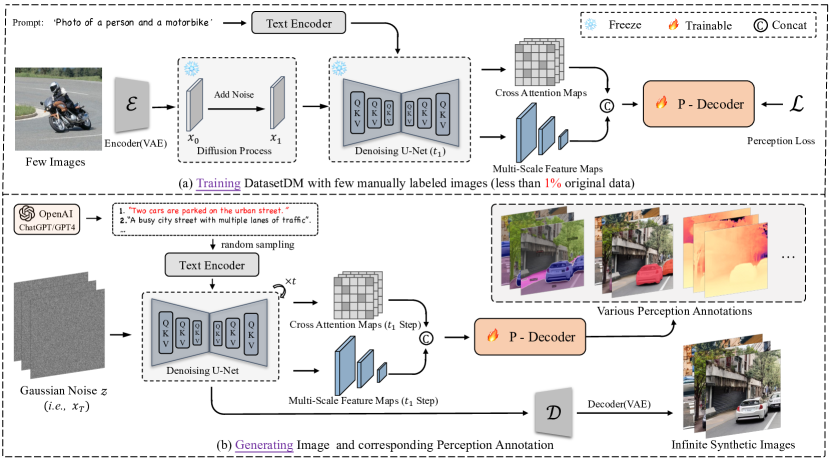
- Use diffusion inversion to extract latent codes from real images and fuse multi-scale diffusion features with cross-attention maps to form hyper-column representations.
- Develop a generalized Perception Decoder (P-Decoder) that converts fused diffusion representations into various perception annotations (e.g., masks, depth, keypoints) within a transformer-based architecture.
- Train the P-Decoder with less than 1% of real labels by using a visual align/instruct tuning approach to induce output following capabilities.
- Perform text-guided data generation with GPT-4 to produce diverse prompts, enabling a broad and open-ended data synthesis pipeline.
- Maintain the diffusion model weights fixed during data synthesis and use a latent-code inversion plus a decoder to produce synthetic annotations, enabling unlimited annotated data.
Experimental results
Research questions
- RQ1Can a unified perception decoder decode diffusion latent codes to produce accurate perception annotations across multiple tasks?
- RQ2How much real labeled data is required to train this decoder to enable infinite synthetic, annotated data?
- RQ3Does text-guided data generation with diffusion models improve downstream perception tasks across semantic segmentation, instance segmentation, depth estimation, and pose estimation?
- RQ4What impact do diffusion time steps, cross-attention fusion, and prompt diversity have on the quality and utility of synthetic annotations?
Key findings
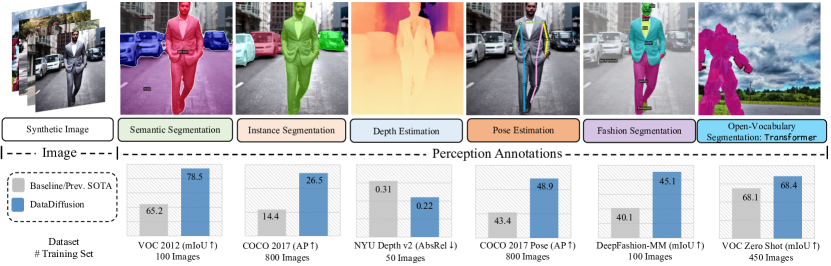
- Synthetic data generated by DatasetDM yields substantial improvements across tasks, e.g., 13.3% mIoU gain for VOC 2012 semantic segmentation and 12.1% AP gain for COCO 2017 instance segmentation.
- Using only 100 real images with synthetic data, VOC 2012 mIoU reaches 78.5% (vs. 65.2% baseline with real data only in Table 2 context).
- Instance segmentation on COCO2017 with 800 real images and 80k synthetic images achieves 26.5 AP (from Table 3).
- Depth and pose estimation also benefit, with measurable improvements when trained on synthetic data (e.g., depth on NYU Depth V2 shows ~10% gain with small real-set sizes; pose estimation shows a notable increase over baselines).
- Zero-shot and long-tail segmentation tasks benefit from synthetic data, with up to ~20% mIoU improvement reported in zero-shot/long-tail settings.
Read this paper
Open the full text in the Nubint reader and ask about any passage as you read.
Read this paper on NubintThis review was generated by AI from the original paper. Please check the paper before citing it.