
[Paper Review] Decentralized Federated Learning: A Survey and Perspective
A comprehensive survey that defines, categorizes, and analyzes Decentralized Federated Learning (DFL), its taxonomies, paradigms, topologies, and future research directions.
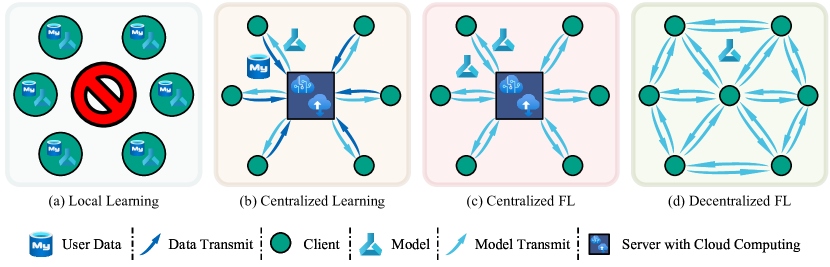
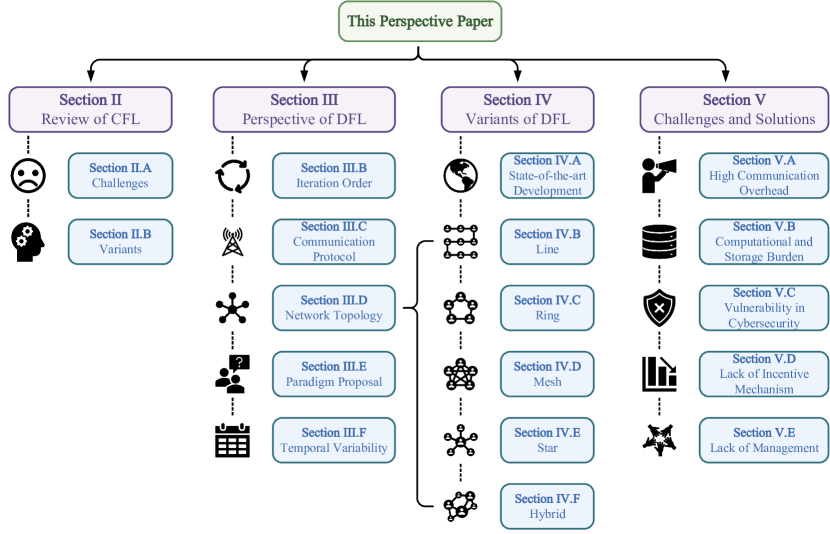
Federated learning (FL) has been gaining attention for its ability to share knowledge while maintaining user data, protecting privacy, increasing learning efficiency, and reducing communication overhead. Decentralized FL (DFL) is a decentralized network architecture that eliminates the need for a central server in contrast to centralized FL (CFL). DFL enables direct communication between clients, resulting in significant savings in communication resources. In this paper, a comprehensive survey and profound perspective are provided for DFL. First, a review of the methodology, challenges, and variants of CFL is conducted, laying the background of DFL. Then, a systematic and detailed perspective on DFL is introduced, including iteration order, communication protocols, network topologies, paradigm proposals, and temporal variability. Next, based on the definition of DFL, several extended variants and categorizations are proposed with state-of-the-art (SOTA) technologies. Lastly, in addition to summarizing the current challenges in the DFL, some possible solutions and future research directions are also discussed.
Motivation & Objective
- Explain the background, challenges, and variants of centralized federated learning (CFL) to contrast with DFL.
- Systematically define five taxonomies for DFL: iteration order, communication protocol, network topology, paradigm proposal, and temporal variability.
- Introduce and categorize five DFL variants based on network topology to guide applications and research.
- Propose two DFL paradigms (Continual and Aggregate) and analyze their trade-offs and implications.
- Discuss current challenges and outline future research directions for DFL.
Proposed method
- Review CFL literature to outline challenges and variants as a baseline for comparison with DFL.
- Define and describe five DFL taxonomies (iteration order, communication protocol, network topology, paradigm, temporal variability) with descriptions.
- Classify DFL variants into five topology-based categories to map state-of-the-art literature and applications.
- Introduce two DFL paradigms (Continual and Aggregate) and compare learning, communication, and aggregation characteristics.
- Discuss temporal variability in DFL topologies and potential dynamic adaptations to external factors.
Experimental results
Research questions
- RQ1What are the fundamental taxonomies that organize Decentralized Federated Learning?
- RQ2How do iteration order, communication protocols, and network topology affect convergence and performance in DFL?
- RQ3What are the characteristics, advantages, and challenges of Continual versus Aggregate DFL paradigms?
- RQ4How does temporal variability influence DFL design and performance, and what are potential future directions?
Key findings
- DFL removes the central server, enabling direct client communication and potential resource savings.
- The paper defines five DFL taxonomies and deems them useful for organizing existing work and guiding future research.
- Five DFL variants are proposed based on network topology to categorize literature and applications.
- Two paradigms, Continual and Aggregate, are introduced with distinct learning and communication properties and trade-offs.
- Temporal variability is acknowledged as a dynamic factor shaping DFL topology and performance.
- The survey discusses current challenges and outlines directions for future research in DFL.
Read this paper
Open the full text in the Nubint reader and ask about any passage as you read.
Read this paper on NubintThis review was generated by AI from the original paper. Please check the paper before citing it.