
[Paper Review] Decentralized Inference with Graph Neural Networks in Wireless Communication Systems
This paper proposes retransmission mechanisms to enhance the robustness of decentralized graph neural network (GNN) inference in wireless communication systems impaired by noisy and fading channels. By analyzing GNN binary classification under both uncoded and coded transmission, the authors develop protocols that improve prediction reliability through iterative retransmissions, validated via simulations on synthetic graph data with significant gains in robustness and reduced misclassification rates.
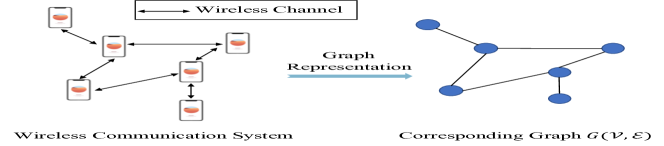
Graph neural network (GNN) is an efficient neural network model for graph data and is widely used in different fields, including wireless communications. Different from other neural network models, GNN can be implemented in a decentralized manner with information exchanges among neighbors, making it a potentially powerful tool for decentralized control in wireless communication systems. The main bottleneck, however, is wireless channel impairments that deteriorate the prediction robustness of GNN. To overcome this obstacle, we analyze and enhance the robustness of the decentralized GNN in different wireless communication systems in this paper. Specifically, using a GNN binary classifier as an example, we first develop a methodology to verify whether the predictions are robust. Then, we analyze the performance of the decentralized GNN binary classifier in both uncoded and coded wireless communication systems. To remedy imperfect wireless transmission and enhance the prediction robustness, we further propose novel retransmission mechanisms for the above two communication systems, respectively. Through simulations on the synthetic graph data, we validate our analysis, verify the effectiveness of the proposed retransmission mechanisms, and provide some insights for practical implementation.
Motivation & Objective
- To address the challenge of wireless channel impairments degrading the robustness of decentralized GNN inference in wireless networks.
- To develop a methodology for verifying the robustness of GNN predictions under imperfect transmission conditions.
- To propose novel retransmission mechanisms tailored for both uncoded and coded wireless communication systems to enhance prediction reliability.
- To validate the effectiveness of the proposed mechanisms through simulations on synthetic graph data.
- To provide practical insights for implementing decentralized GNN-based control and management in real-world wireless networks.
Proposed method
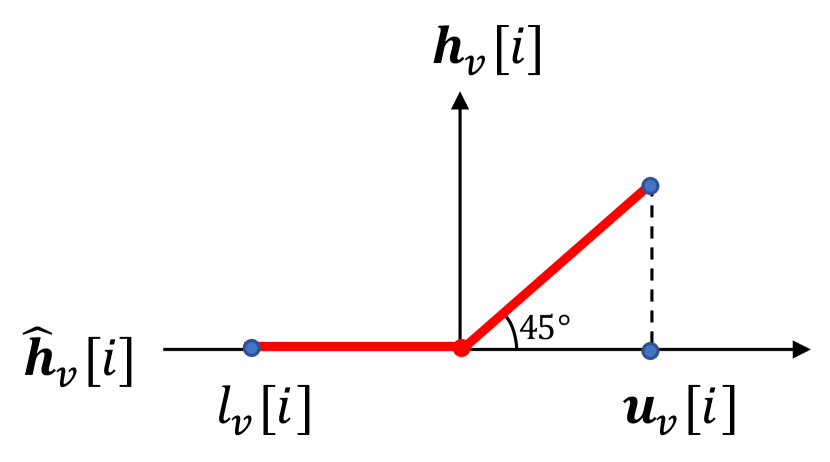
- A robustness verification methodology is developed to determine whether GNN predictions remain stable under transmission noise and fading.
- The performance of a GNN binary classifier is analyzed under both uncoded and coded wireless transmission models, considering bit-level and packet-level error metrics.
- Retransmission mechanisms are designed for each system type: in uncoded systems, unqualified neighbors retransmit until robustness is achieved; in coded systems, retransmissions are guided by error correction and outage probability metrics.
- The retransmission protocols are implemented iteratively, with robustness re-evaluated after each round to ensure convergence to reliable predictions.
- Synthetic graph data is used to simulate diverse network topologies and evaluate the impact of channel conditions on GNN inference accuracy and robustness.
- The analysis incorporates both bit error rate (BER) and outage probability as performance indicators to compare system robustness.
Experimental results
Research questions
- RQ1How can the robustness of decentralized GNN inference be verified when wireless transmission is impaired?
- RQ2What is the performance degradation of a decentralized GNN binary classifier under uncoded wireless transmission with channel noise and fading?
- RQ3How does coded communication improve the robustness of decentralized GNN inference compared to uncoded transmission?
- RQ4What retransmission strategy maximizes prediction robustness while minimizing communication overhead in decentralized GNN systems?
- RQ5How do system-level factors such as node feature dimension and scalability affect the practical deployment of decentralized GNNs?
Key findings
- The proposed retransmission mechanisms significantly improve the robustness of decentralized GNN inference in both uncoded and coded wireless systems.
- Coded communication systems outperform uncoded systems in terms of robustness, achieving lower misclassification rates and fewer required retransmission rounds.
- The robustness probability increases substantially after retransmissions, with a notable reduction in the percentage of misclassified nodes.
- The average number of retransmission rounds is lower in coded systems, indicating better efficiency in error recovery.
- The scalability of the decentralized GNN approach is stronger in coded systems, especially with increasing node feature dimensions.
- Simulation results confirm that the retransmission mechanisms effectively mitigate the impact of wireless channel impairments on GNN prediction accuracy.
Read this paper
Open the full text in the Nubint reader and ask about any passage as you read.
Read this paper on NubintThis review was generated by AI from the original paper. Please check the paper before citing it.