
[Paper Review] Decentralized Zero-Trust Framework for Digital Twin-based 6G
The paper proposes a decentralized zero-trust security framework for Digital Twin-enabled 6G networks, integrating blockchain, AI, and distributed learning to secure both physical devices and their digital twins.
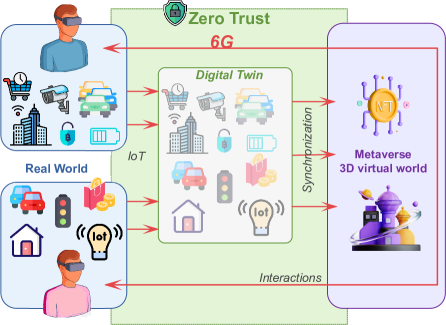
The Sixth Generation (6G) network is a platform for the fusion of the physical and virtual worlds. It will integrate processing, communication, intelligence, sensing, and storage of things. All devices and their virtual counterparts will become part of the service-provisioning process. In essence, 6G is a purposefully cooperative network that heavily depends on the capabilities of edge and end-devices. Digital Twin (DT) will become an essential part of 6G, not only in terms of providing a virtual representation of the physical elements and their dynamics and functionalities but rather DT will become a catalyst in the realization of the cooperative 6G environment. DT will play a main role in realizing the full potential of the 6G network by utilizing the collected data at the cyber twin and then implementing using the physical twin to ensure optimal levels of accuracy and efficiency. With that said, such a cooperative non-conventional network infrastructure cannot rely on conventional centralized intrusion detection and prevention systems. Zero-trust is a new security framework that aims at protecting distributed data, devices, components and users. This article presents a new framework that integrates the zero-trust architecture in DT-enabled 6G networks. Unlike conventional zero-trust solutions, the proposed framework adapts a decentralized mechanism to ensure the security, privacy and authenticity of both the physical devices and their DT counterparts. Blockchain plays an integral part in the authentication of DTs and the communicated data. Artificial Intelligence (AI) is integrated into all cooperating nodes using meta, generalized and federated learning solutions. The article also discusses current solutions and future outlooks, with challenges and some technology enablers.
Motivation & Objective
- Motivate secure, scalable adoption of 6G by protecting both physical devices and their Digital Twins (DTs) in a distributed, trustless environment.
- Propose a decentralized zero-trust architecture that extends beyond traditional IDS/IPS to secure DT interactions and metaverse communications.
- Explore threat intelligence, decentralized authentication, and blockchain-enabled trust mechanisms as core pillars.
- Identify challenges, enablers, and future directions for realizing decentralized zero-trust in DT-enabled 6G.
Proposed method
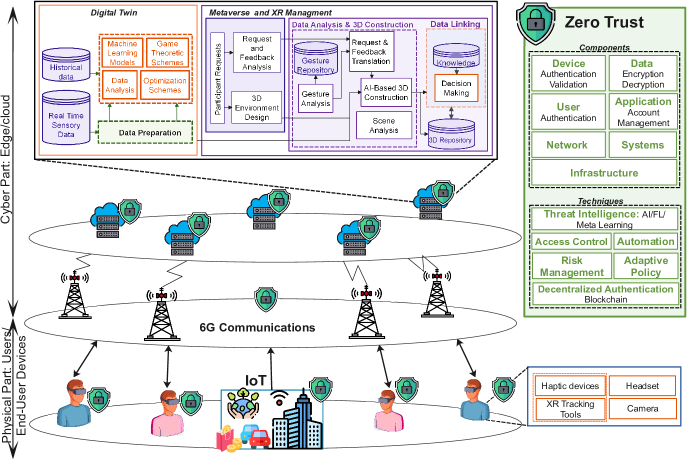
- Integrates zero-trust concepts with Digital Twin-enabled 6G to secure device, DT, and data interactions across physical and virtual layers.
- Proposes decentralized authentication leveraging blockchain to manage identity and access in a scalable manner.
- Incorporates threat intelligence as a continuous trust evaluation mechanism across distributed nodes.
- Explores AI-based solutions (meta-learning, federated learning) to enable distributed, privacy-preserving security across edge and end devices.
- Discusses hierarchical and decentralized learning approaches (e.g., FL, meta-learning, PnP-AI) to support scalable security without centralized bottlenecks.
Experimental results
Research questions
- RQ1How can zero-trust principles be effectively decentralized to protect DT-enabled 6G networks at device, DT, and data interaction layers?
- RQ2What role do blockchain and threat intelligence play in decentralized authentication and trust management for 6G DT ecosystems?
- RQ3Can distributed AI (e.g., meta-learning, federated learning) provide scalable, privacy-preserving security for DT-enabled 6G without central authorities?
Key findings
- The framework highlights the need for threat intelligence and decentralized authentication as core enablers of decentralized zero-trust in DT-enabled 6G.
- Blockchain is positioned as a key component for decentralized authentication and secure data exchange across DTs and network layers.
- Distributed learning paradigms (meta-learning, federated learning) are discussed as mechanisms to enable adaptive, privacy-preserving security across edge and end devices.
- The paper surveys current trends and potential solutions, offering future directions for integrating intelligent blockchains and hybrid learning in decentralized zero-trust architectures.
- No empirical results or quantitative evaluations are presented in the document; the contribution is a conceptual framework and outlook.
Read this paper
Open the full text in the Nubint reader and ask about any passage as you read.
Read this paper on NubintThis review was generated by AI from the original paper. Please check the paper before citing it.