
[Paper Review] Decision-Oriented Dialogue for Human-AI Collaboration
This paper introduces Decision-Oriented Dialogue (DialOp), a benchmark suite of three real-world collaborative decision-making tasks—reviewer assignment, itinerary planning, and group travel mediation—where humans and AI agents co-construct high-quality decisions through natural language. Using human-annotated dialogues and LLM-based agents in self-play and prompted self-play, the study reveals key challenges in communication efficiency, reasoning, and optimization, and releases the environments for future research in human-AI collaboration.
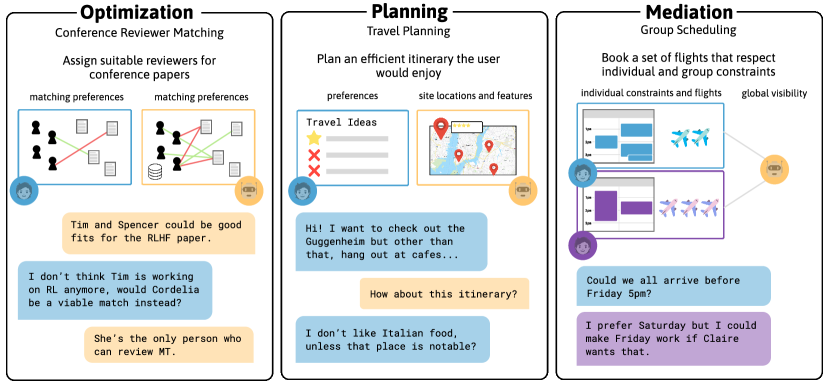
We describe a class of tasks called decision-oriented dialogues, in which AI assistants such as large language models (LMs) must collaborate with one or more humans via natural language to help them make complex decisions. We formalize three domains in which users face everyday decisions: (1) choosing an assignment of reviewers to conference papers, (2) planning a multi-step itinerary in a city, and (3) negotiating travel plans for a group of friends. In each of these settings, AI assistants and users have disparate abilities that they must combine to arrive at the best decision: assistants can access and process large amounts of information, while users have preferences and constraints external to the system. For each task, we build a dialogue environment where agents receive a reward based on the quality of the final decision they reach. We evaluate LMs in self-play and in collaboration with humans and find that they fall short compared to human assistants, achieving much lower rewards despite engaging in longer dialogues. We highlight a number of challenges models face in decision-oriented dialogues, ranging from goal-directed behavior to reasoning and optimization, and release our environments as a testbed for future work.
Motivation & Objective
- To formalize a class of collaborative decision-making tasks where AI and humans jointly optimize decisions using natural language.
- To build three realistic dialogue environments—Optimization, Planning, and Mediation—each with a measurable utility function for final decision quality.
- To collect human-human dialogues as a human reference baseline for evaluating AI agent performance.
- To benchmark current LLMs (e.g., GPT-3) in self-play and prompted self-play settings on these tasks.
- To identify and analyze failure modes in LLM communication, reasoning, and optimization within complex decision contexts.
Proposed method
- Designs three dialogue environments: Optimization (reviewer-paper assignment), Planning (itinerary planning), and Mediation (group scheduling), each with a reward function based on decision quality.
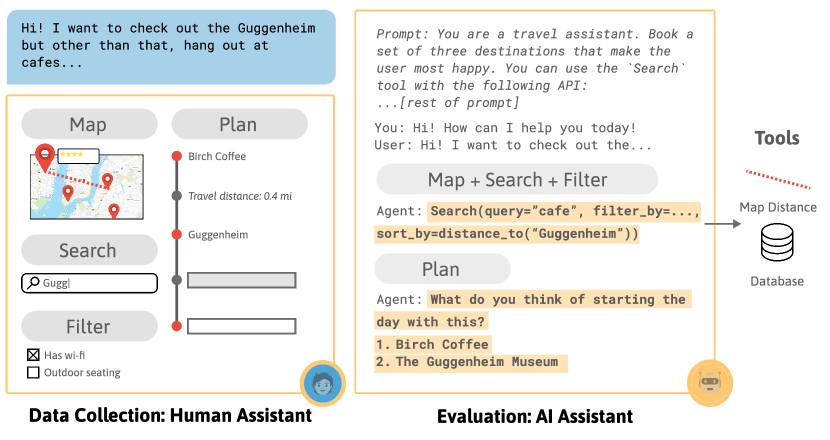
- Collects human-human dialogues where humans play the role of AI assistant, providing a human reference for collaboration patterns.
- Develops LLM-based agents using self-play and a novel prompted self-play setup, where agents complete partial human dialogues to simulate human-AI interaction.
- Integrates tool use (e.g., flight database access) and chain-of-thought prompting to support reasoning and decision evaluation.
- Uses a final decision score (ranging from -30 to 1) to quantify utility, incorporating constraints like meeting conflicts, cost, and arrival time alignment.
- Releases all dialogues, environments, and code to serve as a public testbed for future research in human-AI dialogue systems.
Experimental results
Research questions
- RQ1How do current LLMs perform in collaborative decision-making tasks requiring information sharing, reasoning, and optimization?
- RQ2What are the key failure modes in LLM communication during complex, multi-turn dialogues for decision support?
- RQ3How does prompted self-play, where LLMs complete human-annotated dialogues, compare to full self-play in modeling human-AI collaboration?
- RQ4To what extent can LLMs reason about decision-relevant information, such as conflicting meeting schedules or cost trade-offs, in natural language?
- RQ5How do communication efficiency and information prioritization affect the quality of final decisions in human-AI dialogue?
Key findings
- GPT-3 models in prompted self-play achieve a final decision score of 1 in the Mediation task, indicating successful alignment with user preferences and constraints.
- In the Mediation task, the model successfully selected a $50 flight on 6/2 at 6:25 PM, balancing cost, arrival time, and meeting conflicts, resulting in a final score of 1.
- Failure modes include inefficient communication, such as redundant information sharing, and poor prioritization of decision-relevant data like meeting importance or cost.
- LLMs often fail to recognize or respect user-specific constraints, such as high-importance meetings, leading to suboptimal proposals and rejected options.
- The Mediation task revealed that models struggle with coordinating across multiple users when only one user’s private calendar is visible, leading to misalignment in arrival time preferences.
- The Planning and Optimization tasks showed that models frequently propose suboptimal solutions due to inadequate reasoning about combinatorial trade-offs and incomplete information sharing.
Read this paper
Open the full text in the Nubint reader and ask about any passage as you read.
Read this paper on NubintThis review was generated by AI from the original paper. Please check the paper before citing it.