
[Paper Review] Deconstructing Denoising Diffusion Models for Self-Supervised Learning
The paper deconstructs modern denoising diffusion models (DDMs) to form a latent-space denoising autoencoder (l-DAE), showing that a low-dimensional latent space and denoising are key for self-supervised representations, even with far simpler architecture than generation-focused DDMs.
In this study, we examine the representation learning abilities of Denoising Diffusion Models (DDM) that were originally purposed for image generation. Our philosophy is to deconstruct a DDM, gradually transforming it into a classical Denoising Autoencoder (DAE). This deconstructive procedure allows us to explore how various components of modern DDMs influence self-supervised representation learning. We observe that only a very few modern components are critical for learning good representations, while many others are nonessential. Our study ultimately arrives at an approach that is highly simplified and to a large extent resembles a classical DAE. We hope our study will rekindle interest in a family of classical methods within the realm of modern self-supervised learning.
Motivation & Objective
- Motivate and understand how Denoising Diffusion Models (DDMs) learn representations for self-supervised learning rather than generation.
- Systematically ablate components of modern DDMs to identify which parts are critical for learning good representations.
- Develop a simplified architecture that closely resembles a classical Denoising Autoencoder (DAE) and evaluate its representation quality.
- Reveal insights on the role of latent space dimensionality and denoising versus diffusion processes in representation learning.
Proposed method
- Start from a diffusion-transformer (DiT) baseline trained for image generation and evaluate its representation quality via linear probing.
- Remove class-conditioning and ablate tokenizer losses to assess impact on representation learning.
- Explore four tokenizers (convolutional VAE, patch-wise VAE, patch-wise AE, patch-wise PCA) to study the effect of latent space dimensionality.
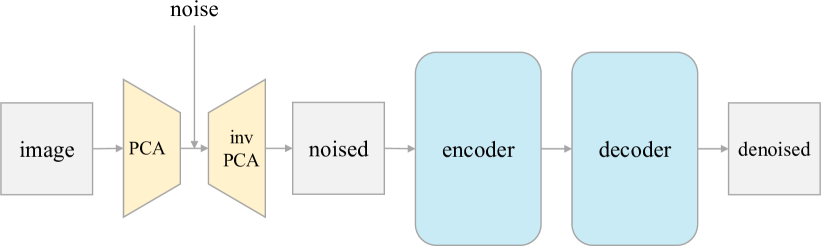
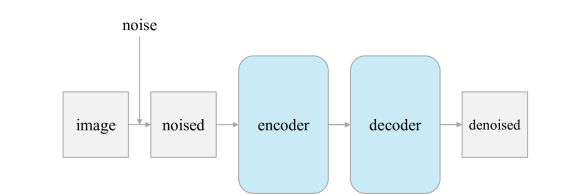
- Progressively revert diffusion-specific designs (noise prediction target, input scaling, latent-space versus image-space operations) toward a classical DAE setup.
- Introduce latent Denoising Autoencoder (l-DAE) by adding noise in a low-dimensional latent space (via patch-wise PCA) and training an autoencoder to denoise, with multi-level noise as a form of augmentation.
Experimental results
Research questions
- RQ1Can a diffusion model learn strong representations for self-supervised learning when reoriented toward non-generation tasks?
- RQ2Which components of modern DDMs are essential for learning representations, and which are nonessential?
- RQ3Does a low-dimensional latent space suffice for effective self-supervised representation learning in a denoising framework?
- RQ4How close can a deconstructed DDM approach the performance of classical DAEs and MAE-like methods in linear evaluation?
- RQ5What is the impact of different tokenizers and noise schedules on representation quality?
Key findings
- The representation capability of DDMs largely stems from denoising rather than diffusion per se.
- Removing class-conditioning improves linear probe accuracy from 57.5% to 62.1% (FID worsens, indicating poorer generation) on the DiT baseline.
- A tokenizer trained with perceptual loss provided semantic representations; removing perceptual and adversarial losses moves toward a VAE-like tokenizer without losing all representation ability.
- A simpler, non-multilevel noise schedule on latent space improves linear accuracy to 63.4% (versus 59.0% baseline), suggesting multi-level noise acts as augmentation but is not essential.
- Patch-wise tokenizers with low latent dimension (d=16-32) outperform a convolutional VAE tokenizer for linear probing, and PCA-based tokenizers can be used without gradient training.
- Moving toward a classical DAE, predicting the clean data rather than the noise yields competitive but slightly lower accuracy (e.g., 62.4% with that change), and operating in latent space with inverse PCA can match image-space performance (63.6-63.9%).
- Final latent-space DAE (l-DAE) with PCA-based tokenizer and multi-level latent noise achieves 65.1% (patch-wise PCA baseline) up to 65.0% with augmentation, and scales with larger models (ViT-L reaches 75.0% in their comparisons).
- Compared to MoCo v3 and MAE baselines, l-DAE is competitive with MAE and trails MAE by about 1-2% on ViT-B/-L settings under similar training regimes.
Read this paper
Open the full text in the Nubint reader and ask about any passage as you read.
Read this paper on NubintThis review was generated by AI from the original paper. Please check the paper before citing it.