
[Paper Review] Decoupled Knowledge Distillation
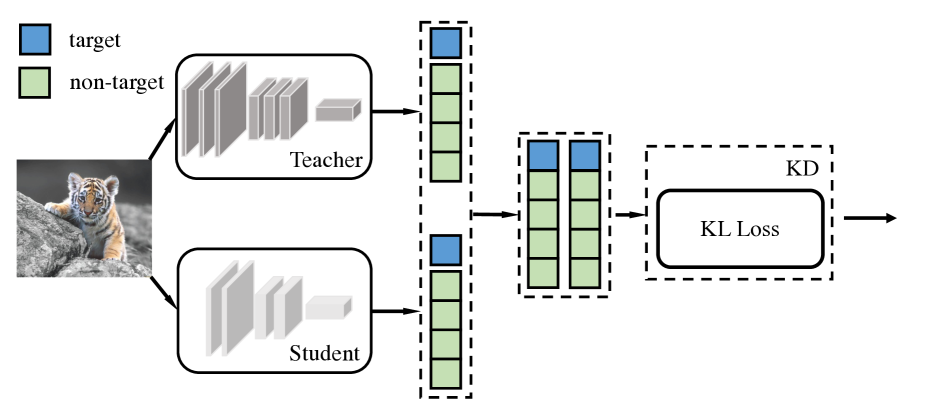
This paper proposes Decoupled Knowledge Distillation (DKD), a novel logit-based distillation method that separates target-class knowledge distillation (TCKD) and non-target-class knowledge distillation (NCKD) to overcome the limitations of classical KD. By decoupling these components, DKD improves training efficiency and performance on image classification and object detection tasks, achieving state-of-the-art results comparable to complex feature-based methods with minimal computational cost.
State-of-the-art distillation methods are mainly based on distilling deep features from intermediate layers, while the significance of logit distillation is greatly overlooked. To provide a novel viewpoint to study logit distillation, we reformulate the classical KD loss into two parts, i.e., target class knowledge distillation (TCKD) and non-target class knowledge distillation (NCKD). We empirically investigate and prove the effects of the two parts: TCKD transfers knowledge concerning the "difficulty" of training samples, while NCKD is the prominent reason why logit distillation works. More importantly, we reveal that the classical KD loss is a coupled formulation, which (1) suppresses the effectiveness of NCKD and (2) limits the flexibility to balance these two parts. To address these issues, we present Decoupled Knowledge Distillation (DKD), enabling TCKD and NCKD to play their roles more efficiently and flexibly. Compared with complex feature-based methods, our DKD achieves comparable or even better results and has better training efficiency on CIFAR-100, ImageNet, and MS-COCO datasets for image classification and object detection tasks. This paper proves the great potential of logit distillation, and we hope it will be helpful for future research. The code is available at https://github.com/megvii-research/mdistiller.
Motivation & Objective
- To investigate why logit distillation underperforms compared to feature-based distillation despite its low computational cost.
- To analyze the distinct roles of target-class and non-target-class knowledge in logit distillation.
- To identify the coupling in classical KD loss as a key limitation suppressing the effectiveness and flexibility of knowledge transfer.
- To propose a decoupled framework that enables independent optimization of TCKD and NCKD for improved distillation performance and efficiency.
- To validate DKD's superiority in training speed, model generalization, and transferability across image classification and object detection benchmarks.
Proposed method
- Reformulate the classical KD loss into two components: target class knowledge distillation (TCKD) and non-target class knowledge distillation (NCKD), enabling independent analysis.
- Decouple the NCKD loss from the teacher’s confidence on the target class by replacing the coefficient $1 - p_t^{ au}$ with a learnable constant $\beta$, eliminating suppression on well-predicted samples.
- Introduce a learnable hyperparameter $\alpha$ to control the contribution of TCKD, allowing flexible balancing between difficulty-aware and class-contrast knowledge transfer.
- Apply DKD to student networks during training, using only logits from the teacher and student, avoiding expensive intermediate feature extraction and storage.
- Use t-SNE and correlation matrix visualizations to compare feature discriminability and logit similarity between KD and DKD.
- Conduct ablation studies on CIFAR-100, ImageNet, and MS-COCO to evaluate performance, training efficiency, and feature transferability.
Experimental results
Research questions
- RQ1What is the distinct contribution of target-class knowledge distillation (TCKD) versus non-target-class knowledge distillation (NCKD) in logit distillation?
- RQ2Why does classical knowledge distillation underperform despite the semantic richness of logits?
- RQ3How does the coupling between NCKD and the teacher’s confidence on the target class suppress knowledge transfer effectiveness?
- RQ4Can decoupling TCKD and NCKD improve distillation performance and training efficiency without relying on intermediate feature distillation?
- RQ5Does DKD mitigate the 'bigger teacher, worse performance' paradox by reducing suppression of NCKD in large models?
Key findings
- Non-target class knowledge distillation (NCKD) is the primary driver of performance gains in logit distillation, as models using only NCKD achieve results comparable to or better than classical KD.
- Classical KD couples NCKD with the teacher’s confidence on the target class, suppressing NCKD on well-predicted samples—where knowledge is most reliable—thereby limiting distillation effectiveness.
- DKD achieves 76.45% top-1 accuracy on CIFAR-100 with ResNet8×4 student and ResNet32×4 teacher, outperforming KD (75.04%) and demonstrating superior training efficiency.
- On ImageNet, DKD achieves 76.60% top-1 accuracy with a ResNet50 teacher and WRN-16-2 student, surpassing KD (75.36%) and showing improved feature transferability on downstream tasks.
- DKD improves feature transferability: linear probing on STL-10 and Tiny-ImageNet shows DKD achieves 72.9% and 37.1% accuracy, respectively, outperforming KD (70.9% and 33.9%).
- Visualizations confirm that DKD produces more separable features (t-SNE) and better matches student logits to teacher logits (correlation matrix), indicating superior knowledge transfer.

Read this paper
Open the full text in the Nubint reader and ask about any passage as you read.
Read this paper on NubintThis review was generated by AI from the original paper. Please check the paper before citing it.